
Facility engineering / Simulation
Data Center Digital Twins: When Are They Worth It?
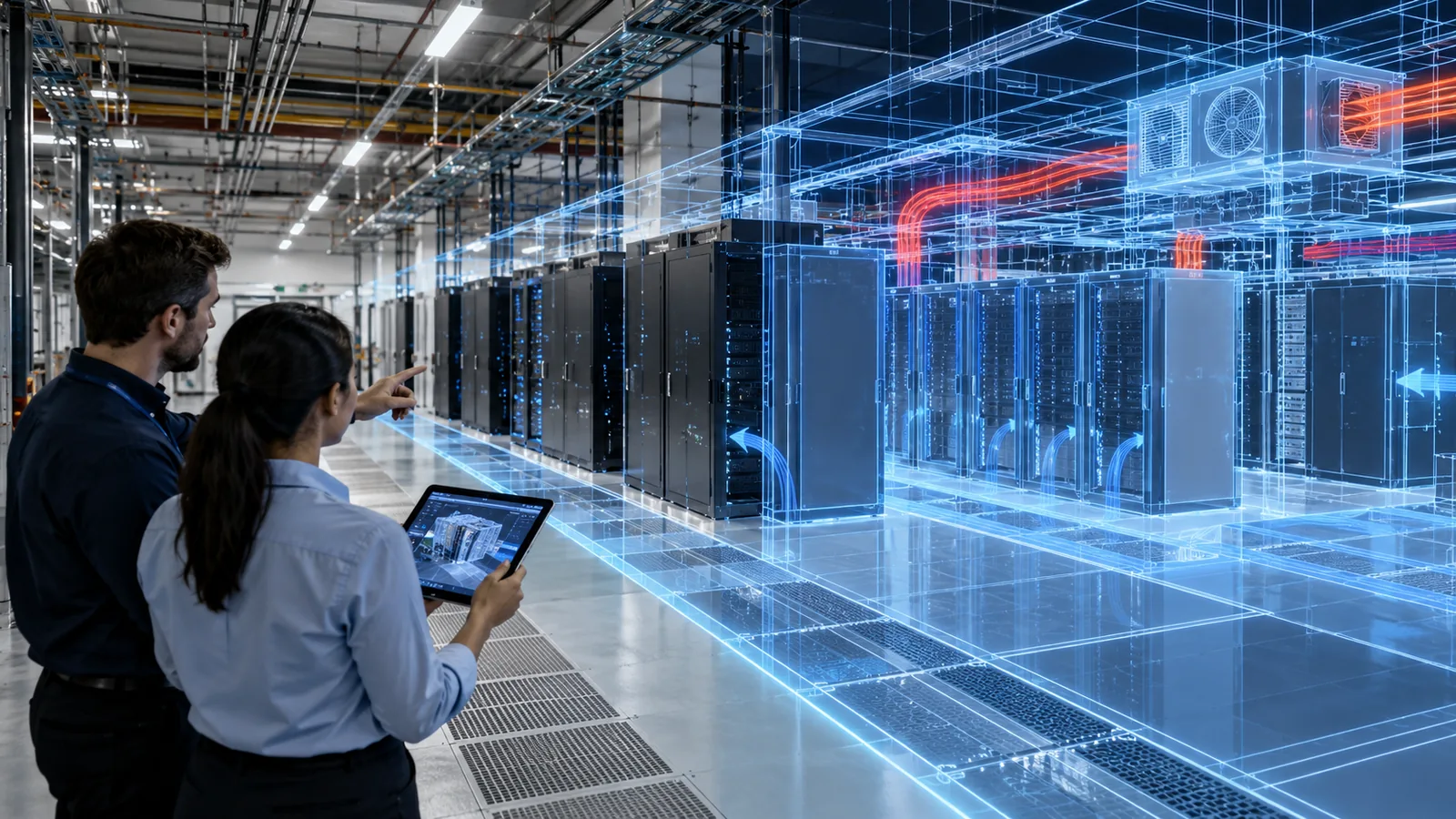
A virtual model can reveal a cooling bottleneck before equipment is installed. But not every facility needs a live, expensive digital twin.
Sections in this article
You are planning a 60 kW rack row. The drawings show enough floor area, yet the engineering team cannot agree whether the existing cooling plant can handle the concentrated heat. You could commission a computational fluid dynamics (CFD) study, construct a spreadsheet-based thermal model or deploy a live digital twin linked to building telemetry. Those are different tools at different costs, not three names for the same product.
A useful digital twin represents selected characteristics of a physical asset or process, is updated using relevant data and can support questions about current state or possible changes. It does not automatically need a photo-realistic 3D interface or an autonomous control system. NIST's work on definitions and verification highlights why assumptions, connections and intended purpose matter.
Choose the simplest model capable of answering the question
Engineering calculation
Thermal balance, pump curve, rack load spreadsheet or steady-state equipment model.
Useful for:Initial feasibility and rough sizing with known inputs.
Scenario simulation
CFD, hydraulic or electrical model calibrated at agreed operating points.
Useful for:Rack layout changes, cooling path analysis and commissioning questions.
Connected digital twin
Versioned model synchronized with selected live BMS, EPMS or IT telemetry.
Useful for:Recurring decisions where current state, drift and changing loads matter.
Start with the decision, not the technology brochure. A one-time containment layout assessment may justify a focused CFD model and a physical measurement campaign. A multi-site operator repeatedly adding liquid-cooled hardware may derive more value from a connected model—provided the inputs stay trustworthy and the team maintains it.
Four questions a twin can help answer
| Question | Model output | Physical evidence needed |
|---|---|---|
| Can another rack fit? | Predicted inlet temperatures, cooling flow, electrical allocation | Load measurements, coolant capacity and redundancy checks |
| What happens if a unit is offline? | Scenario temperature and flow response | Commissioning data; tested equipment availability |
| Will a layout change help? | Airflow distribution or pressure change | Spot measurements before and after the alteration |
| Should an AI controller be released? | Possible decisions under simulated faults | Shadow-mode and bounded real-world checks |
Be careful about scale. A room CFD model does not capture every network transient. An electrical protection study needs different physics and timing assumptions. One glossy 3D scene will not validate both. Read our AI cooling oversight guide for the operational boundary between predictions and real controllers.
Budget ownership, not just the license
Software is only part of the total cost. Ask who will build the initial asset model, collect and clean data, map sensors to equipment, validate predictions after room changes and train facility engineers. If the twin is used in important decisions, those tasks are ongoing—not optional extras.
Example only—not a market quote or benchmark.
- Initial modeling and commissioning
- $30,000
- Integration and sensor mapping
- $18,000
- Software and hosting, three years
- $30,000
- Annual model upkeep, three years
- $18,000
With this hypothetical budget, a simple business case asks whether the twin can reasonably avoid at least $96,000 of engineering work, rework, incident exposure or otherwise measurable cost over the same period. Do not promise a payback merely because the model reports an energy-optimization opportunity.
How to test whether its predictions are useful
Before relying on a virtual output, specify which predictions matter. An inlet-temperature estimate, a pressure drop and equipment availability should not share a generic “95% model accuracy” label. They have different measurement errors and practical consequences.
- Define the decision. Identify the equipment, operating envelope and predicted quantities needed.
- Reserve validation observations. Compare against field measurements not used merely to tune the model.
- Check several operating regimes. Use low and high IT load, relevant seasonal conditions and maintenance states when available.
- Record uncertainty. Report the error distribution, missing variables and the circumstances where forecasts become unreliable.
- Set recalibration triggers. Equipment replacement, major rack relocation or a containment change may invalidate earlier assumptions.
NIST emphasizes validation with quantified uncertainty. A universal “less than 3% error” rule cannot be borrowed across facility types, sensor positions or predicted variables.
Three things a digital twin cannot guarantee
Local interlocks, relays, equipment controllers and approved emergency procedures remain responsible for their designed safety functions.
Hidden leakage, a miswired sensor or a changed pump curve may make predictions look precise but be wrong.
Comparing a simulation only against data generated by the same model is not an independent check.
A purchase decision worth documenting
Ask vendors to demonstrate one actual facility question with your data and to specify who owns the model, exports and update process. Require an explanation of what happens when the telemetry link fails. If a focused engineering study resolves the problem at a fraction of the lifecycle cost, that is a legitimate decision—not a missed innovation opportunity.
Bottom line: buy a digital twin to support recurring, measurable engineering decisions. If it cannot show where evidence ends and assumptions begin, it is not yet ready to influence facility changes.
Sources and further reading
Primary frameworks and reference materials. Engineering decisions require site-specific validation; legal classifications require assessment of the actual use case.