
Incident management / Operational response
AI Incident Response in Data Centers: A Practical Runbook
When automation behaves unexpectedly, the first job is to protect the facility—not to debug the model. This runbook separates immediate safety actions from investigation and re-entry.
Sections in this article
Keep personnel safe and preserve cooling, power and redundancy. Use the site's engineered procedures to suspend AI control. Do not assume that unplugging a network cable or changing a PLC mode is safe without knowing the equipment's fallback behavior.
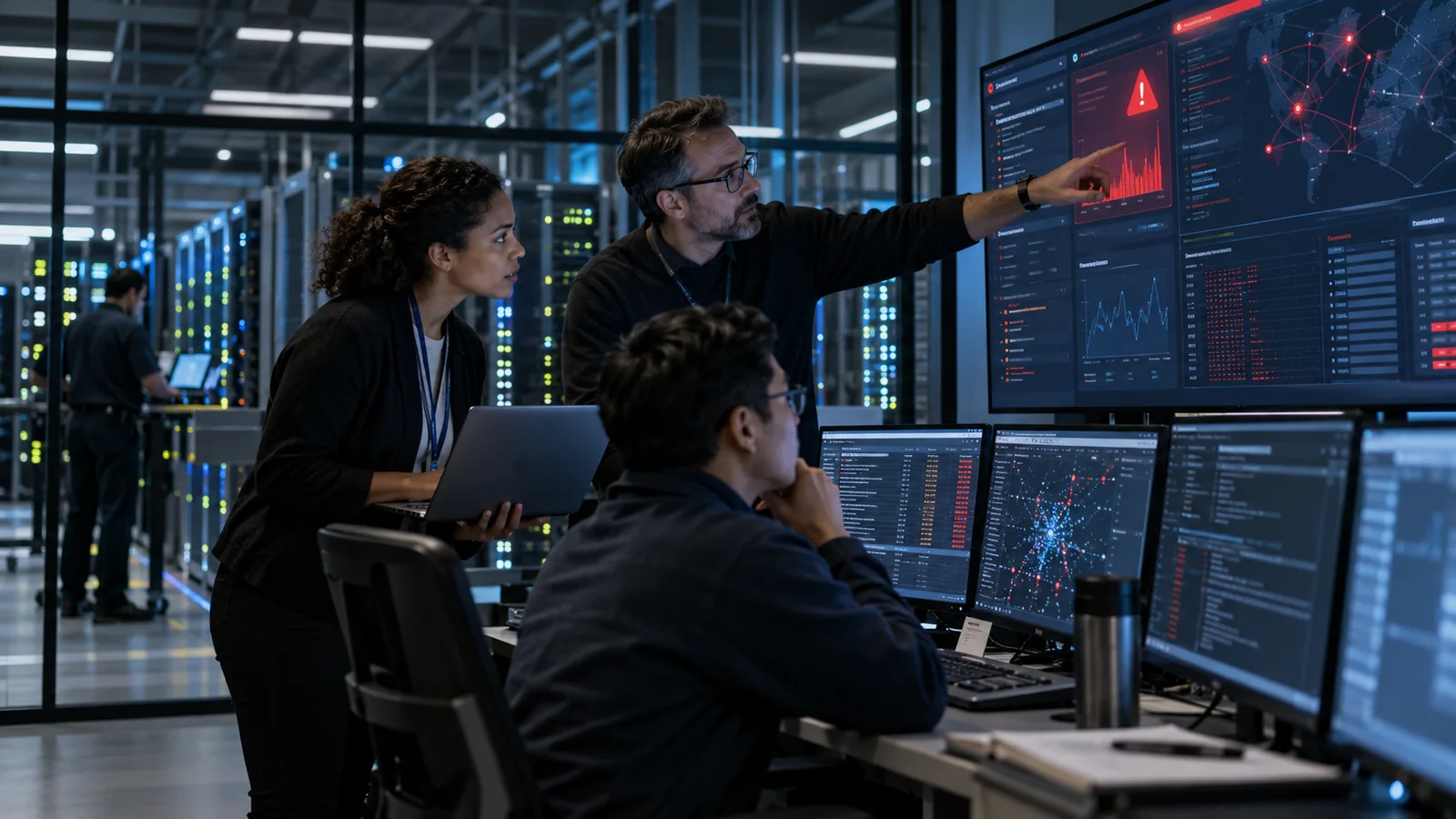
Imagine a cooling-optimization application reporting normal inlet temperatures while independent rack sensors show an emerging hot spot. The underlying issue could be a frozen sensor, a stale data feed, an incorrect command or a mechanical fault. The first response is operational: verify conditions using trustworthy measurements and prevent further unsafe changes.
This article is a planning guide for facility teams, not an instruction to operate live industrial equipment. Exact actions depend on approved operating procedures, the BMS architecture, safety interlocks and trained personnel. NIST's incident-response guidance emphasizes integration with existing risk-management and recovery processes.
Recognize an AI-related operational incident
Do not require proof that the model caused the fault before opening an incident. Treat unexplained AI commands or a mismatch between command logs and observed equipment behavior as a reason to investigate.
| Signal | What to check | Why it matters |
|---|---|---|
| Setpoint changes outside an approved range | BMS event log, approved operating envelope, command source | Shows a control-boundary problem, not necessarily a model fault. |
| AI dashboard disagrees with local instrumentation | Independent sensors, data timestamps, calibration history | Could indicate stale telemetry or mismatched data. |
| Repeated commands or unexpected oscillation | Rate-of-change logs, controller response, recent releases | Can expose feedback instability or integration issues. |
| Model behavior changes after maintenance | Equipment change record, software version, updated input mapping | The operating environment may no longer match the validated model. |
Stabilize the facility using approved control paths
Use the on-duty incident commander and qualified facilities engineer as the decision owners. An approved override may suspend AI writes while leaving local safety control and monitoring intact; the safe method must be established and tested before a real incident.
Assess active hazards and equipment condition. Follow site emergency procedures and notify the control room.
Disable AI execution through a tested, authorized path while maintaining required local control functions.
Check physical readings, redundancy, alarms and controller status rather than trusting a single dashboard.
Record when the issue began and which changes or interventions occurred.
Network isolation may be appropriate for a security incident, but it can also interrupt monitoring or produce unintended equipment responses. Neither disabling a gateway nor transferring to manual operation should be improvised. Site-approved OT response procedures take precedence.
Collect evidence that separates cause from coincidence
After the environment is stable, preserve the model identifier, configuration, update history, commands requested, commands actually accepted, sensor data and operator actions. Synchronize timestamps where possible and retain the evidence under the site's incident and retention policies.
An optimizer recommends reducing fan output while the inlet sensor stays at 22°C. A second independent source records rising rack temperatures. Investigators compare collection timestamps and discover that an integration service replayed an old reading.
The incident classification is initially telemetry integrity / unsafe recommendation; it would be misleading to conclude that the AI model itself “hallucinated.” The remediation should address the data path and the model's failure handling.
Make recovery conditional, not automatic
Repair the identified fault, validate the corrective action in a safe environment and confirm monitoring and safety limits are restored. Restart with read-only or advisory operation where appropriate. Only return to automated execution after a documented acceptance review and a clear rollback path.
Evidence of safe recovery includes passing the failed scenario in testing, an accountable approver, an identified model version and a demonstrated method for pausing execution again. A successful software restart alone is not sufficient.
A concise incident record to keep
| Field | Example entry |
|---|---|
| Incident identifier / owner | OT-INC-026 / Operations shift lead |
| Detected condition | Rack temperature disagreement; repeated optimization commands |
| Control mode after containment | Approved local control, independently verified |
| Evidence secured | Command trace, telemetry, version, operator timeline |
| Return-to-service approval | Facilities engineering + relevant security/model owner |
Keep roles and escalation contacts in the actual site runbook, including after-hours cover and vendor response arrangements. The response procedure must exist independently of the AI vendor's application.
After-action priority: operational safety, evidence and controlled restoration come before retraining. A useful incident runbook helps teams act decisively without turning uncertainty about an AI model into uncertainty about who is in charge.
Sources and further reading
Primary frameworks and reference materials. Engineering decisions require site-specific validation; legal classifications require assessment of the actual use case.