
Energy economics / Heat recovery
Data Center Waste Heat Reuse: Costs, Efficiency and ROI
Selling waste heat sounds attractive until you count the heat-pump electricity, the buyer’s seasonal demand and the cost of a pipe connection. Here is how to test viability.
Sections in this article
A data center rejects heat all day. A nearby town is considering district heating. It seems obvious that the data center should sell its spare energy. But availability of waste heat is not the same as a commercially useful heat supply.
The first project question is not “How many megawatts do our servers consume?” It is “Who needs heat, at what temperature, for how many hours, at what price and with what delivery obligations?” This worked example helps identify those constraints before commissioning an expensive feasibility study.
Find the heat buyer before designing the export system
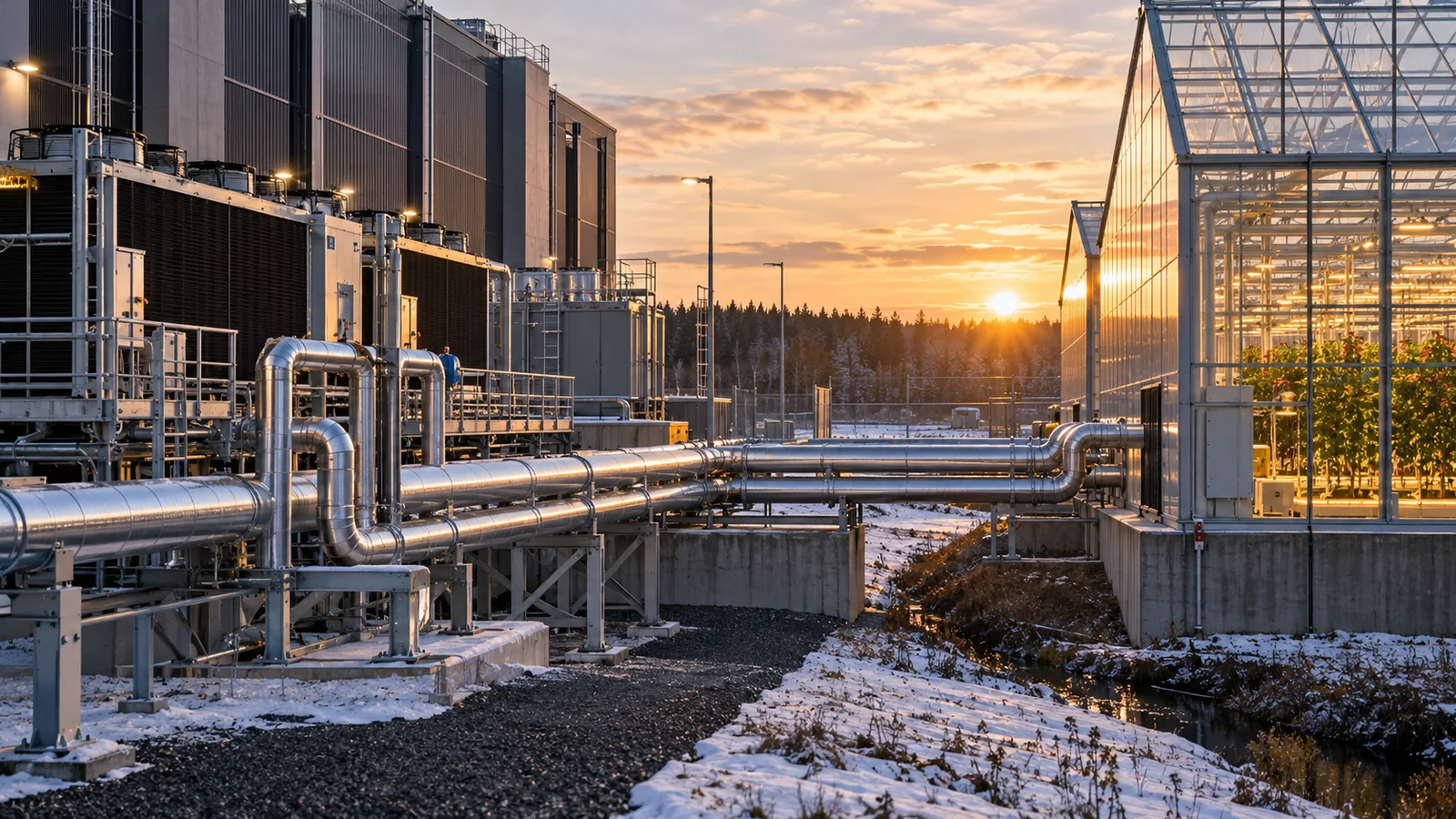
Data center heat may be useful for district heating, a neighboring building, a greenhouse or an industrial process. The buyer's load profile matters as much as the data center's. A facility may operate continuously while residential space heating demand collapses during summer.
Measured across seasons and realistic IT/cooling operating modes.
Purchaser's required supply temperature, minimum load and purchase contract.
Distance, civil works, heat losses, energy meters and maintenance access.
There is no universal maximum economic distance of two, three or four kilometers. Pipe size, route obstacles, rights of way, required temperature, heat volume and local costs determine feasibility. A short connection through expensive urban infrastructure can be less attractive than a longer but simpler route.
Heat quantity is different from heat quality
A data center can have considerable thermal energy at a temperature too low for a buyer's network. Direct recovery via a heat exchanger is possible only when the temperature difference, transfer capacity and required margins are appropriate. Otherwise, a heat pump may raise the useful delivery temperature while consuming additional electricity.
ASHRAE's data center guidance describes different liquid-cooling systems and water temperature classes. The higher-temperature loops in some designs can improve heat-reuse options, but the actual temperature depends on the installed hardware and permissible operating regime—not simply whether the servers have liquid cooling.
Worked example: 500 kW delivered by a heat pump
For a transparent illustrative calculation, assume the proposed heat pump delivers 500 kW of useful heat to the buyer while operating at a coefficient of performance (COP) of 3.6. These are project assumptions. The COP must eventually be supported by an equipment selection at the actual source and delivery temperatures.
The key heat-balance identity is delivered heat = recovered source heat + compressor electrical input (ignoring minor auxiliary losses for this example). It would be wrong to say the system extracts 500 kW from the data center, adds 138.9 kW of electricity and still delivers only 500 kW.
Assume the buyer can use that heat for 4,000 hours in a year. Delivered thermal energy is 2,000 MWh. Electricity consumed by the heat pump is approximately 556 MWh before any separately metered pumps or connection losses. The data center contributes roughly 1,444 MWh of recovered low-grade heat.
Simple payback: include operating hours and electricity
Now assume, for illustration only, an installed project cost of $525,000, heat sales at $65/MWh, electricity at $110/MWh and annual operation/maintenance costs of $22,000. None of those amounts is a vendor quotation or current market benchmark.
$525,000 ÷ $46,889, assuming stable prices and 4,000 annual sales hours. Not a discounted cash-flow result.
This example is intentionally less optimistic than a 24/7 utilization assumption. District-heating demand, minimum purchases, outages and heat-pump efficiency during part-load conditions matter. Some projects may yield a better outcome; others may fail to produce positive operating cash flow.
| Annual sale hours | Heat sales | Electricity cost | Approx. annual cash flow after $22k other OpEx |
|---|---|---|---|
| 3,000 h | $97,500 | $45,833 | $29,667 |
| 4,000 h | $130,000 | $61,111 | $46,889 |
| 5,000 h | $162,500 | $76,389 | $64,111 |
A bankable assessment should then add seasonal COP, pipe thermal losses, pumps, heat metering, taxes, financing, asset replacement, construction contingencies, price escalation and an NPV or discounted-cash-flow analysis. Include any avoided cooling cost only after it has been demonstrated and without double-counting energy flows.
What the EU Energy Efficiency Directive actually requires
Article 26 of Directive (EU) 2023/1791 addresses waste-heat utilization and feasibility for data centers above specified rated energy input thresholds. In particular, its provisions refer to data centers exceeding 1 MW and set out installation-level cost-benefit assessment requirements in the conditions described by the directive. It is not accurate to claim that a separate universal 2 MW threshold automatically governs every waste-heat study.
The applicable implementation, feasibility assessment and obligations must be checked in the relevant Member State. The directive expressly recognizes technical or economic infeasibility; it does not establish that every facility must physically build a district-heating connection regardless of local circumstances.
Investment decision: secure credible demand and a realistic temperature/cost estimate first. Only then proceed to detailed thermal engineering and the contract structure for heat volume, outages and pricing.
Sources and further reading
Primary frameworks and reference materials. Engineering decisions require site-specific validation; legal classifications require assessment of the actual use case.