
Mechanical plant / Heat rejection
Data Center Heat Rejection: Chillers, Dry Coolers and Towers
The right equipment is the one that can reject the required heat at the design outdoor conditions—not the one with the best marketing PUE.
Sections in this article
A liquid-cooled GPU hall requests 35°C facility supply water, while a second hall needs 12°C chilled water. A supplier proposes the same outdoor unit for both and quotes a single annual efficiency number. That comparison is incomplete: the water temperatures and local summer design conditions determine which systems can actually deliver the load.
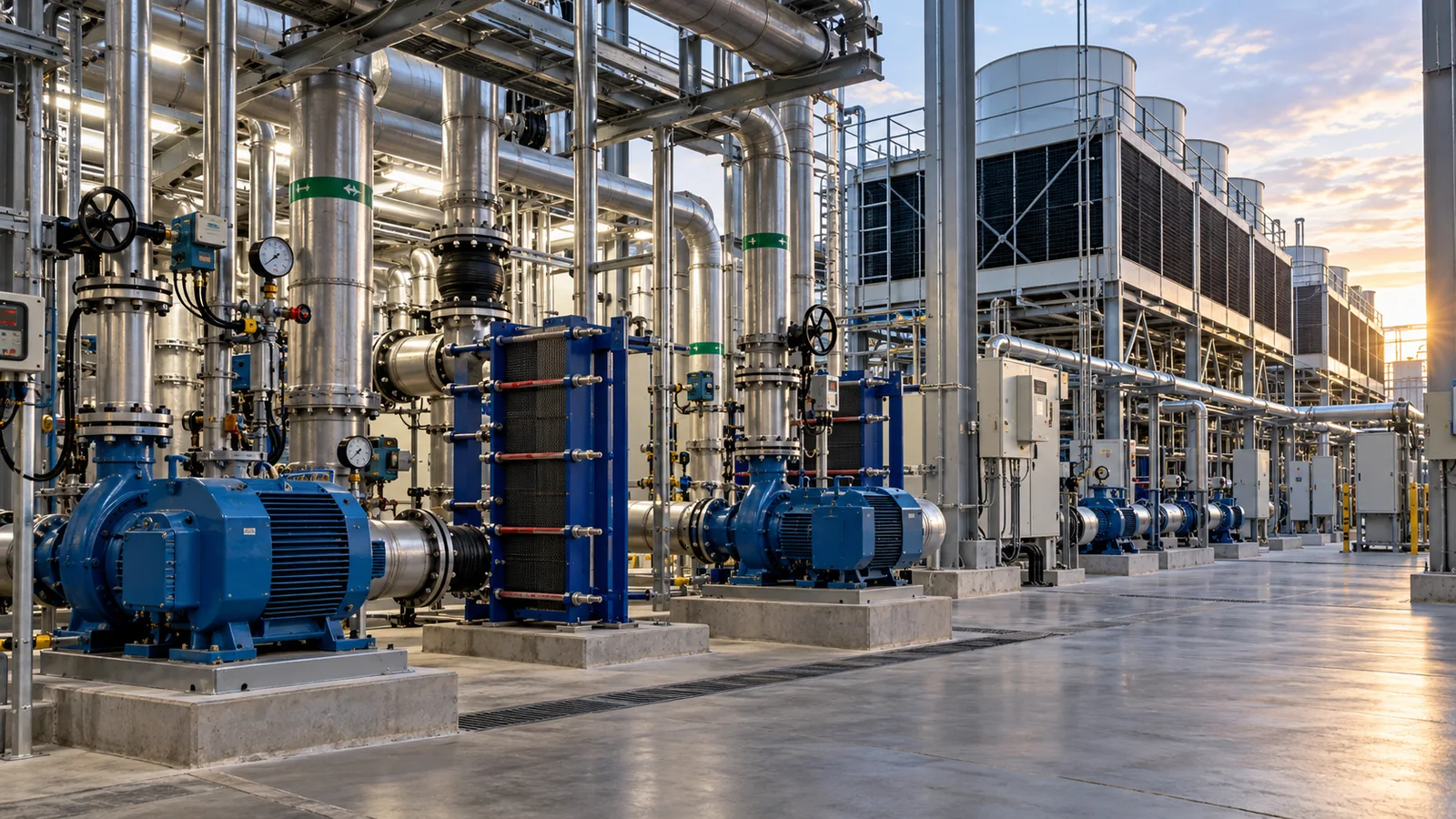
Decision first: a dry cooler rejects heat against outdoor dry-bulb temperature, an evaporative tower approaches outdoor wet-bulb temperature, and a chiller uses a refrigeration cycle to make colder water when direct rejection is insufficient. These are system roles, not mutually exclusive equipment brands. A water-cooled chiller can rely on a cooling tower for its condenser; a dry cooler may support free cooling upstream of a chiller.
Three plant architectures, three different boundaries
A pumped fluid circuit transfers heat through outdoor coils to ambient air. Fans and pumps still use power. No evaporation is needed in purely dry operation, but an adiabatic variant consumes water.
Evaporation lowers circulating water temperature toward local wet-bulb conditions. Water treatment, drift control, blowdown, winterization and public-health management become part of the design.
A compressor lifts heat from a colder process loop to a warmer condenser path. Air-cooled and water-cooled chillers have different fan, pump and water requirements; full plant efficiency matters more than one COP figure.
| Question | Dry cooler | Cooling tower | Chiller plant |
|---|---|---|---|
| Temperature reference | Outdoor dry-bulb + rated approach | Outdoor wet-bulb + rated approach | Chilled-water setpoint and certified capacity at ambient conditions |
| Major site dependency | Hot-hour capacity and outdoor coil area | Makeup water, water chemistry, wet-bulb and permits | Refrigerant cycle, condenser design and electricity supply |
| Not included in headline rating | Distribution pumps, fan curve, glycol penalties | Water treatment, blowdown, pumps and drift | Auxiliary pumps, towers, staging, part-load operation |
The same heat source can be served by several arrangements. A tower is not an automatic replacement for a chiller; it may be part of one. A “free cooling” hour still requires fans and pumps. Do not accept annual PUE comparisons unless they use the same building, IT load, weather file and measured boundary.
Use the facility supply temperature and hourly weather
ASHRAE's liquid-cooling water classes use the maximum facility supply temperature as a key identifier. A W32-class-compatible equipment selection is different from a W45-compatible one. It is incorrect to assume every direct-to-chip server accepts 40°C water simply because it has cold plates. Verify the exact equipment class, allowable coolant temperature, flow and pressure limits with its supplier.
At hotter outdoor conditions, that hypothetical dry cooler cannot provide the required 35°C water at its quoted approach. Options might include extra coil surface, different supply setpoints, an adiabatic stage, supplementary refrigeration or limited-load operation. Model every hour of a representative weather year, then verify the summer design peak.
Approach temperatures are equipment performance data, not a universal 3°C or 5°C law. Pump energy, glycol concentration, altitude, fouling margin, coil selection and redundancy all change the answer. For towers, use design wet-bulb rather than regional average humidity. Where the facility has both liquid-to-chip and residual air cooling, calculate those duty profiles separately.
Cooling tower evaporation and makeup-water estimator
This calculator estimates an idealized evaporative component of tower water demand using latent heat, then estimates blowdown from a selected number of cycles of concentration. Enter heat actually rejected by the tower; for a chiller condenser, that can exceed the IT heat transferred at the evaporator because compressor work also becomes heat. It excludes drift, leaks, biological treatment and auxiliary water users.
No drift or on-site water-treatment losses included.
Energy conservation gives approximate evaporated water mass = rejected heat energy / latent heat of evaporation. Ignoring drift, blowdown is approximately evaporation divided by (cycles − 1); total makeup is evaporation plus blowdown. The DOE explains how raising cycles can reduce blowdown, but permissible cycles depend on source-water quality and water-treatment design.
Compare lifecycle cost, not equipment price alone
Include thermal plant, dry or wet coils, pumps, electrical service, supports, sound attenuation, controls, piping and downtime during changeover.
Use an hourly weather-and-load model for fan power, compressor power, pumping, treatment chemicals, water, blowdown disposal and labor.
Test water restrictions, permitted discharge, heat waves, freeze protection, failure modes and spare equipment availability.
A dry cooler can reduce direct water use while increasing electrical demand at certain design points. A tower may achieve excellent heat rejection but carries ongoing water and public-health requirements. Neither technology is inherently the “lowest total cost” in every region. If heat reuse is contemplated, the return temperature and heat delivery schedule must also be valued; see the waste heat reuse economics guide.
What a defensible heat-rejection bid includes
- Specify duty heat, entering and leaving water temperature, site climate and a full load profile; do not buy from nominal tonnage alone.
- Ask for certified capacity and fan/pump/compressor draw at design outdoor dry-bulb or wet-bulb conditions, plus part-load points.
- Separate WUE and PUE measurement boundaries; require makeup, blowdown, drift and treatment assumptions for evaporative proposals.
- Obtain redundancy and maintenance sequences showing the plant's behavior when one fan bank, pump, control link or tower cell is unavailable.
- Compare at least a 10-year cash-flow scenario with transparent rates and replace speculative “guaranteed savings” with measured commissioning acceptance criteria.
A credible recommendation is a system drawing and hourly performance estimate under one clearly stated set of assumptions. A categorical winner based only on PUE or hardware purchase price is not an engineering conclusion.
Sources and further reading
Primary frameworks and reference materials. Engineering decisions require site-specific validation; legal classifications require assessment of the actual use case.
- Liquid-cooling temperature classesASHRAE Handbook, Data Centers and Telecommunication Facilities
- Cooling tower water efficiency and cycles of concentrationUS Department of Energy, FEMP
- Cooling Environments technical libraryOpen Compute Project