
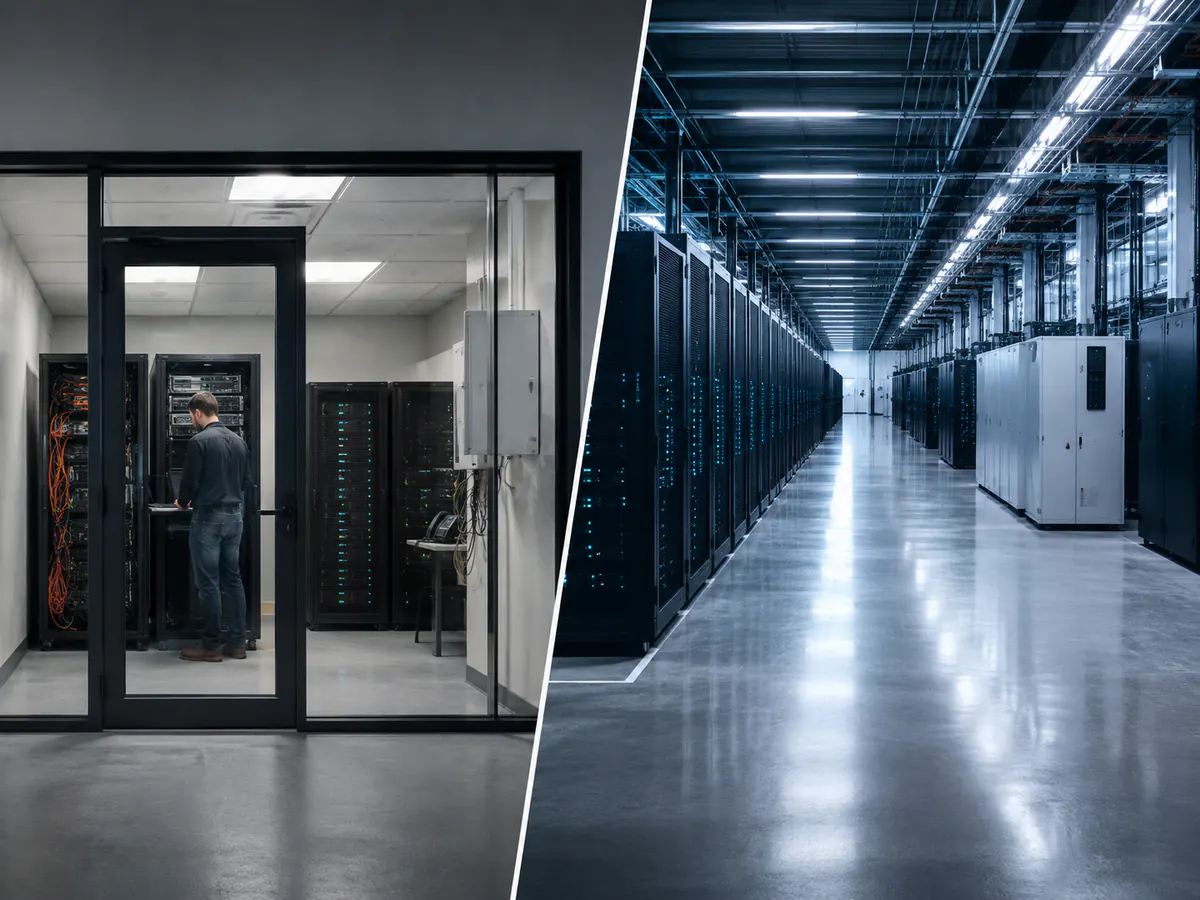
If colocation were automatically cheaper than owning a data center, operators would not still be arguing about it.
Uptime Institute's latest spending survey makes that disagreement unusually visible. Among organizations that compared their own data center with colocation, 42% said provisioning workloads was cheaper in their own facility, while 28% said colocation was cheaper. Another 19% said the costs were roughly equivalent.
That is not a frustratingly inconclusive result. It is probably the most useful answer available.
Colocation removes a large construction and operating burden, but the provider has to recover its own capital, operating costs and return through the lease. An existing, heavily utilized enterprise data center can therefore be cheaper than colo. A company that would otherwise need to spend hundreds of millions of dollars building capacity it may not fully use can reach the opposite conclusion.
The survey had 850 industry respondents overall; this question was answered by 231 owner/operators. Percentages do not form a forced-choice total because respondents could select all applicable answers.
Uptime's December 2025 report also found something procurement teams should pay attention to: 44% of respondents using colocation said it was costing more than initially expected, while only 10% said it was costing less. That does not mean colocation is bad value. It means the first quoted monthly rate is often not the same thing as lifetime TCO.
The economic difference starts before the first server arrives
Owning a facility begins with capital.
JLL's 2026 Global Data Center Outlook puts shell-and-core construction for its standard U.S. 50 MW air-cooled facility at roughly $10M–$14M per MW depending on market. Dallas, Phoenix and Atlanta sit around $10M–$11M/MW; Northern Virginia around $11M–$12M; Chicago around $12M–$14M. Land and active IT equipment are excluded. JLL forecasts a global 2026 average of $11.3M/MW for this construction scope.
Put that into a 50 MW Dallas example and the shell-and-core construction envelope alone is roughly $500M–$550M. Before the company has installed its servers, it has committed half a billion dollars to a specialized asset.
Colocation turns much of that upfront investment into a recurring payment. The tenant still buys its IT equipment and may incur installation, connectivity and migration costs, but it does not have to finance the entire building, utility infrastructure and base mechanical/electrical plant itself.
Construction followed by years of power, staffing, maintenance and reinvestment.
Capacity, space and facility services are purchased from the provider over time.
Neither cash-flow shape is inherently cheaper. They allocate risk differently.
Utilization can decide the entire comparison
A purpose-built facility has a brutal economic characteristic: unused capacity still cost money to build.
Take the $500M–$550M Dallas construction example and spread only that shell-and-core CAPEX evenly over 15 years, with no financing cost and no residual value. At 100% utilization, the simple capital allocation is about $56–$61 per usable kW per month.
That number might look impressively low beside current colocation pricing. It should not be compared yet. It contains no electricity, staff, maintenance, security, taxes, network, land, insurance, financing or future capital replacement. More importantly, it assumes every one of the 50 MW is economically productive for the full period.
At only 60% utilization, the same simplified construction CAPEX is spread across 30 MW of used capacity. The capital allocation rises to roughly $93–$102 per used kW per month. At 40% utilization it rises to about $139–$153.
This is one of the strongest economic arguments for colocation. A tenant can contract closer to the capacity it needs rather than carrying the capital burden of an underfilled building.
The reverse is also true. If a company already owns a facility, has sunk the construction cost and can keep it highly utilized for many years, the marginal cost of continuing to operate it can be lower than paying a colo provider's full commercial rate.
Current colocation pricing is not especially cheap
The idea that colo always wins because providers have economies of scale has become less reliable as power scarcity has tightened the market.
Lightyear's 2026 colocation pricing guide reports a median retail all-in rate of $380 per usable kW per month in the second half of 2025, up from $324 in the first half. Its 90th percentile reached $663/kW. The all-in measure combines space and power but excludes cross-connects and connectivity. Lightyear also says primary-market vacancy has fallen below 2% and that traditional volume discounts for requirements above 1 MW are becoming harder to obtain.
Retail pricing is not the right benchmark for every deployment. Larger wholesale requirements have traditionally been materially cheaper. Colliers' 2025 U.S. marketplace report placed wholesale and hyperscale capacity above 500 kW at roughly $150–$200/kW/month in primary markets, net of electricity, with secondary locations around $125–$160. Those figures are contract rent before electrical consumption, so they should not be compared directly with Lightyear's all-in retail number.
Colliers' 2026 report shows why the pressure has persisted: more than 90% of new capacity was being pre-leased before delivery, power availability had overtaken location as the primary driver of site selection, and utility deposits of $25M–$75M+ had become common in major development programs. Those capital requirements ultimately influence the economics providers need to recover from customers.
The comparison fails if electricity is treated differently on each side
One of the easiest ways to make colocation look artificially cheap is to compare colo rent net of electricity with an owned-facility number that includes power.
The reverse happens too. A retail colo quote may bundle electricity while an internal facilities budget shows only building operating expense and leaves IT power in another department's cost center.
A defensible TCO model should normalize both options to the same boundary: IT electricity, facility overhead, demand charges or power pass-throughs, and the treatment of PUE.
At 1 MW of steady IT load, every one-cent difference in effective facility electricity price can be worth well over $100,000 per year once PUE is considered. At 10 or 50 MW, electricity can overwhelm relatively small differences in rent or maintenance cost.
Our electricity-cost guide covers that calculation separately because hiding power inside a generic “OPEX” percentage makes data center comparisons less useful.
Staffing is where small on-premises facilities often lose scale
A large colocation provider spreads facilities engineers, security personnel, operations centers, maintenance contracts, tooling and spare-parts processes across many customers.
A company running one small or medium-sized private data center may still need 24/7 coverage, escalation procedures and specialized electrical/mechanical expertise even though the facility is too small to use those resources efficiently.
This does not make the provider's staffing free. The cost is embedded in the colocation rate and support charges. What changes is utilization: the operator can spread fixed operational resources across a much larger installed base.
For a very large owner/operator, that advantage can reverse. Hyperscale or major enterprise operators may have enough facilities scale to run internal teams efficiently and negotiate equipment, maintenance and electricity directly.
Remote hands and cross-connects are where the “simple monthly fee” starts growing
Colocation invoices tend to accumulate small-looking items.
Cross-connects can carry installation and recurring fees. Network services sit outside the cabinet rent. Remote hands may be charged hourly. Expedite fees, after-hours work, shipping, storage, extra power circuits and one-time installation charges can all sit around the headline $/kW figure.
Lightyear's 2026 guide explicitly excludes connectivity and cross-connects from its all-in $/kW benchmark. That is important: “all-in” in one source does not necessarily mean “every cost the customer will pay.”
Uptime's finding that 44% of organizations said their colocation environment cost more than initially expected is consistent with this broader TCO problem. It does not identify one universal source of the overrun, so I would not blame cross-connects alone. The lesson is to model the complete operating relationship rather than only the first rate card.
On-premises has its own hidden invoices — they just arrive differently
Owning the building avoids the provider's monthly margin and retail service charges, but it creates expenses that can disappear inside corporate budgets.
Generator overhauls, UPS battery replacement, switchgear maintenance, chiller work, controls upgrades, security systems, roof repairs, property insurance and compliance work are not one monthly “data center fee.” They appear as labor, contracts and capital projects over the facility's life.
This is one reason comparing a colo invoice with the internal electricity bill of an owned facility will almost always make ownership look cheaper. The owned side is missing most of its own TCO.
The cost of capital matters more now than it did in older colo-versus-build models
A $500M facility is not economically equivalent to spending $500M gradually over fifteen years.
The company either uses cash that could have been invested elsewhere or raises capital and pays for it. Construction also starts before the facility produces useful compute, meaning capital is tied up during development and commissioning.
Colliers' 2026 market report says capital is moving earlier in the development cycle and that private credit now accounts for roughly 60%–75% of early-stage funding in major data center programs. The report describes the sector as increasingly underwritten like energy infrastructure rather than ordinary real estate.
For an enterprise deciding between building and leasing, that means the discount rate and balance-sheet effect deserve their own assumptions. A simple “construction cost divided by years” calculation is only a screening tool.
Then there is the cost of waiting for the building
Colocation can be more expensive per kW and still be the cheaper business decision if it gets the workload online substantially earlier.
JLL says speed to power is now the primary site-selection criterion for data center development. Colliers reaches the same broad conclusion in 2026: power availability, delivery timing and contractual certainty are the main determinants of project feasibility.
An on-premises build has to secure the site, utility capacity, permits, equipment, contractors and commissioning. In constrained markets, some of those timelines are measured in years.
A colo provider with already-deliverable capacity effectively sells time as well as power and space.
I would put “months until usable capacity” next to $/kW in any serious TCO comparison. A cheaper data center that delays a revenue-generating platform by eighteen months may not be cheaper in any business sense.
But current colo scarcity weakens the speed advantage if capacity is not actually available
The old comparison often assumed colocation could be bought quickly because the provider already had space. That assumption needs checking in 2026.
Lightyear reports primary-market vacancy below 2% and says some customers are planning colo procurement as much as two years before deployment. Colliers says more than 90% of new capacity is pre-leased before delivery.
A provider proposing future capacity is therefore not offering the same risk profile as a live, powered hall. Delivery dates, utility commitments and contractual remedies become part of the colo side of the model.
The decision is no longer always “build slowly versus lease immediately.” In a constrained market it can be “build our own project versus commit early to someone else's project.”
Expansion is where colocation can be either extremely flexible or surprisingly rigid
A company needing 250 kW today and 500 kW in three years might prefer not to build a multi-megawatt private facility just to reserve growth capacity.
Colocation can solve that problem if the contract gives credible expansion rights. The tenant starts smaller and grows into provider capacity as the workload demands it.
But expansion rights have become more valuable precisely because capacity is scarce. If the adjacent power block is leased to another customer, the original tenant may have to expand into another hall or another facility entirely.
On-premises shifts this risk back to the owner. Building spare capacity is expensive, but if the utility and site plan are secured, the company controls when that reserved envelope is filled.
Control has an economic value even when it is difficult to price
An owned facility gives the operator more control over maintenance windows, cooling design, hardware density, physical access, network architecture and long-term upgrades.
Colocation trades some of that control for shared infrastructure and outsourced operations. The provider decides how the base building evolves, which maintenance procedures apply and what physical changes are permitted.
For ordinary enterprise workloads this can be an advantage: the customer has no reason to become an expert in generators or chillers. For specialized HPC and AI deployments, facility design can become tightly coupled to the hardware roadmap, making control more economically valuable.
A 15-year TCO model should not pretend the workload is known for 15 years
This is one of the biggest conceptual problems with build-versus-lease models.
A private data center can have a useful life measured in decades. IT hardware turns over far faster. Rack density, cooling technology, cloud strategy and business demand can all change several times during the economic life of the building.
The more uncertain the future workload, the more valuable flexibility becomes. Colocation transfers some obsolescence risk to a provider whose business is adapting infrastructure for multiple customers.
Ownership becomes more attractive when the company has a stable, large and predictable requirement that can keep the facility economically full for many years.
A better TCO model has three scenarios, not one answer
I would not build one spreadsheet that says “colo wins by 8%.”
I would build a high-utilization ownership case, where the private facility fills quickly and remains heavily used. Then a slow-growth case, where capacity sits empty for several years. Finally, a technology-change case, where a material share of the building requires new cooling or power infrastructure before the end of the model.
The colocation side should get the same treatment: current contract price, renewal or escalation assumptions, expected expansion pricing, cross-connects, remote hands and a downside case where the required adjacent capacity is unavailable.
If ownership wins only at 95% utilization from year one, that is useful information. If colocation wins only by assuming today's rate never escalates, that is equally useful.
Utilization? Power price? Cost of capital? Deployment timing? Staffing? Expansion? Once the crossover variable is visible, management can debate the real risk instead of arguing about one headline TCO number.
When colocation usually has the stronger economic argument
Colocation tends to become attractive when the required capacity is small relative to a viable standalone facility, when demand is uncertain, when the company needs capacity sooner than it can build, or when it does not want to maintain specialized facilities staff.
It also has a strong case when geographic diversity matters. Leasing smaller deployments in multiple existing facilities can be more capital-efficient than constructing multiple private sites purely for resilience.
The case weakens when a customer needs enormous, stable capacity for a long time and has the operational scale to run infrastructure efficiently itself. At that point the provider's margin and lease economics can outweigh the benefits of outsourcing.
When ownership usually has the stronger economic argument
Ownership becomes more compelling when the company already has a suitable facility with significant remaining life, when utilization is consistently high, when the workload is large and predictable, or when specialized infrastructure provides a competitive advantage.
It can also make sense where the organization can secure electricity or land on unusually favorable terms and has enough scale to spread staff and maintenance costs efficiently.
The important qualifier is “enough scale.” JLL's $10M–$14M/MW benchmark is based on a 50 MW single-tenant facility. Small private facilities do not automatically inherit hyperscale construction economics simply because someone divided a big project by MW.
The Uptime survey makes more sense after looking at the cost structure
Why did 42% of respondents say their own facility was cheaper while 28% favored colo?
Because both outcomes are plausible.
An owner with an existing, well-utilized facility is comparing colo rent with the operating and incremental capital cost of an asset it already controls. A company facing a greenfield build is comparing colo with hundreds of millions of dollars of new capital, construction risk and years of fixed capacity.
Those are not the same economic decision even though both are described as “colo vs on-prem.”
The most useful TCO question is therefore not “Which is cheaper, colocation or on-premises?” It is which option leaves the least expensive unused capacity, operational burden and timing risk for this particular workload. When those three costs are modeled honestly, the answer usually becomes much clearer — and it can legitimately be different for two companies buying the same number of kilowatts.