
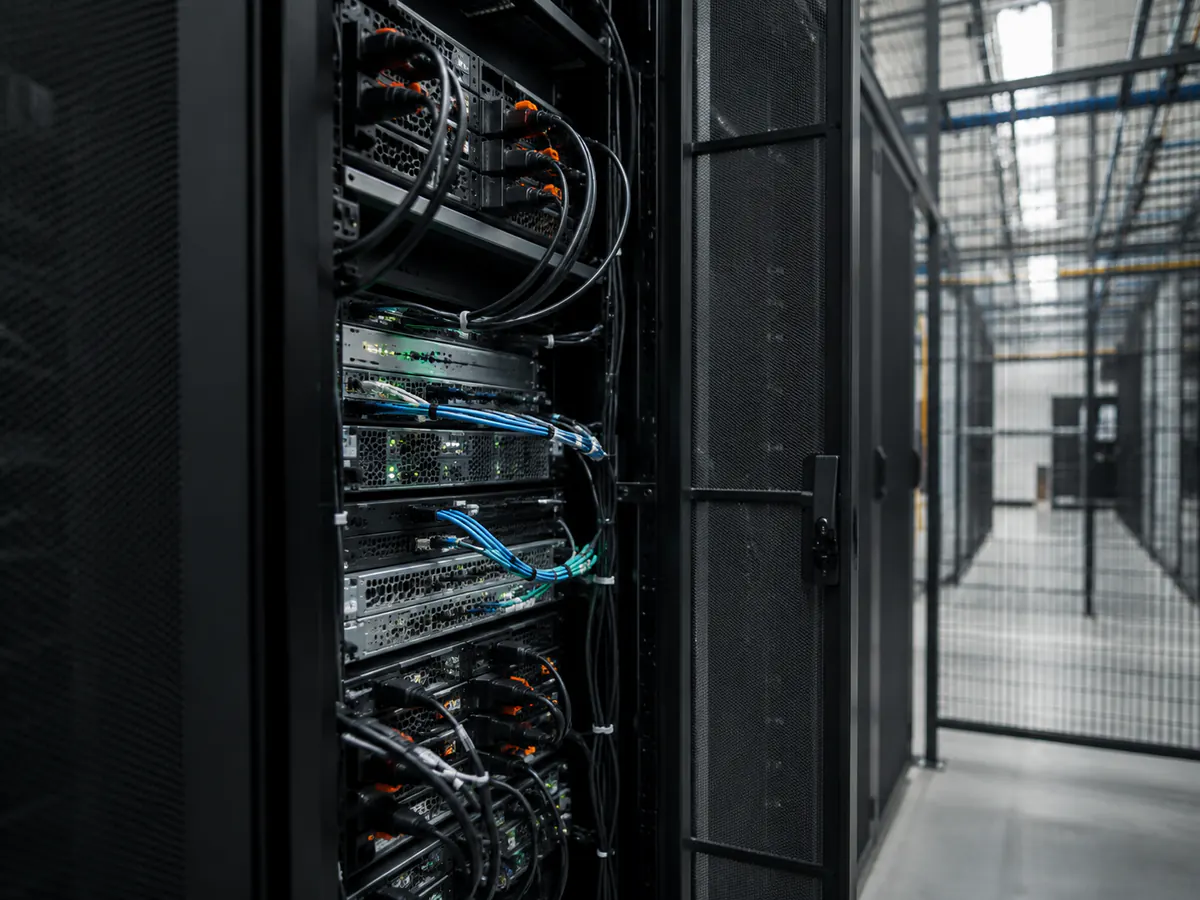
A full cabinet advertised at $699 per month and another advertised above $2,000 per month can both be perfectly real offers. The difference is not necessarily that one data center is wildly overpriced. The products behind the word “rack” may be completely different.
Public U.S. pricing in 2026 illustrates the spread clearly. Some providers advertise full 42U cabinets below $1,000 per month, regional facilities commonly sit around $1,100–$1,300, and highly interconnected facilities can exceed $2,000 before every optional service is added. The cabinet itself is rarely what creates that difference. Usable power, redundancy, network, location and service scope do.
What full-rack pricing actually looks like in public offers
There is no centralized rate card for U.S. colocation, and many enterprise providers quote privately. Still, several operators publish enough information to show the shape of the market.
42U cabinet, advertised 15A 120V circuit, 1Gbps unmetered port and IPv4 allocation.
View public offerFull-rack standard configuration at its Buffalo facility; the provider publishes smaller cabinet tiers as well.
View public offer42U cabinet with advertised A/B redundant 20A 120V power, 1Gbps unmetered bandwidth and facility access.
View public offerPublished full-rack offer in Dallas at Equinix DA3. Product scope and facility ecosystem differ materially from lower-cost regional offers.
View public offerThese are examples, not a market average. They are deliberately not averaged because the included power, network, redundancy and facility characteristics are different. Public advertised pricing is useful for understanding the spread; it is not enough to rank providers on value.
The rack is cheap. The infrastructure behind it is not.
A steel 42U cabinet occupies roughly the same footprint whether the servers inside draw 2 kW or 15 kW. The data center does not see those two racks as equivalent. The denser rack needs more electrical capacity, UPS and generator headroom, more heat rejection and often a different approach to airflow or liquid cooling.
That is why the colocation price per kW becomes more informative as deployments become larger or denser. The rack remains useful for describing physical space; power becomes the economic unit.
The cabinet or cage footprint and the U-space available.
Committed circuit capacity, usable load, metering method and A/B configuration.
The thermal capacity required to support the actual rack density.
Internet transit, cross-connects, cloud connectivity and carrier access.
Remote hands, installation, access, monitoring and other facility services.
From one server to a full cabinet: the pricing ladder
Smaller deployments are often sold by rack unit or by fractional cabinet rather than by committed kW. Current public packages show why this works for a few servers and starts to break down as the deployment grows.
Useful when only one appliance or server needs facility-grade power and network.
More private space, but power allocation often remains modest.
At this point the power entitlement matters at least as much as the number of U.
The phrase “full rack” is now too broad to compare without the electrical specification.
Managed Colocation Hosting, for example, currently publishes $59 for 1U, $279 for a quarter cabinet, $449 for a half cabinet and $699 for a full 42U cabinet. Elm Data Center advertises $50 for a single server, $400 for a quarter cabinet, $650 for a half cabinet and $1,100 for a full cabinet.
The progression is not simply “twice the rack space costs twice as much.” Providers package different power and bandwidth allocations at each step, and the economics of shared versus dedicated space change as well.
Four full racks can have four very different power profiles
Conventional enterprise equipment, network hardware or lightly populated cabinets.
Common server workloads where power starts to dominate the commercial comparison.
Denser compute that may require specific hot-aisle, containment or enhanced cooling capability.
GPU-heavy racks where the cabinet count tells very little about the infrastructure requirement.
These density bands are descriptive rather than a provider tariff. Their purpose is to show why a “rack price” becomes less meaningful as load rises. Two customers can lease one cabinet each while consuming radically different shares of the facility's power and cooling capacity.
A cheap cabinet can become the expensive choice
Consider two hypothetical offers. Provider A advertises a lower cabinet charge. Provider B is more expensive at first glance but includes a more suitable power configuration and network allowance.
- Rack
- 42U
- Usable power
- 3 kW
- Bandwidth
- Extra
- Cross-connect
- Extra
- A/B power
- Extra
- Rack
- 42U
- Usable power
- 5 kW
- Bandwidth
- Included
- Cross-connect
- 1 included
- A/B power
- Included
If the deployment needs 5 kW and redundant feeds, Provider A's $400 headline advantage may disappear once the required upgrades are added. This is exactly why procurement should compare the configuration needed on day one, not the cheapest version each provider is willing to advertise.
The four questions that usually expose a misleading rack quote
How much power can actually be used continuously? Circuit size and usable continuous load are not always the same thing.
Is the electrical cost included? A low cabinet fee can sit beside a separate metered-power bill.
Is redundancy included in that price? One feed and A/B feeds are different products even if both occupy one rack.
What happens at the next density step? A cheap cabinet is less useful if moving from 5 kW to 8 kW requires relocation.
When buying by rack stops making sense
Rack-based pricing is intuitive for one or a handful of cabinets. Once a deployment becomes power-heavy or expands into multiple racks, a per-kW comparison usually produces a cleaner economic picture.
Physical space, bundled network and operational convenience can still dominate the decision.
Committed kW, usable capacity, redundancy and expansion rights become the better comparison basis.
There is no universal cabinet count at which every provider changes pricing methodology. A 40 kW AI rack can become power-led immediately, while several low-density network cabinets may remain commercially simple. The switch point is driven by infrastructure demand, not just floor space.
Do not annualize the rack fee and call it TCO
A $1,200 monthly cabinet produces a neat $14,400 annual figure. That calculation is correct and often economically incomplete.
The right annual comparison captures every recurring charge plus the one-time costs allocated over the expected contract term. It should also account for escalation. In the current constrained market, renewal and expansion economics can matter just as much as the initial cabinet price.
For a simple planning assumption in 2026, public offers suggest that a conventional U.S. full cabinet can start below $1,000 per month in some regional or aggressively priced facilities, while $1,000–$2,000+ per month is entirely normal once location, power, redundancy and network ecosystem improve. Higher-density enterprise requirements can move beyond cabinet pricing altogether and into negotiated $/kW contracts.
That is the useful boundary of “cost per rack.” It works as a shopping unit only while the rack specification is comparable. Once power and service scope diverge, the cheaper rack is simply the rack with fewer things inside the price.