
Cooling technology / Architecture comparison
Direct-to-Chip vs. Immersion Cooling: Costs and Trade-Offs
Both liquid-cooling approaches can support high-density computing, but they change different parts of the facility. Start with the server support model—not a promised PUE.
Sections in this article
An operator has room for another GPU deployment. The servers can be ordered with cold plates, or the project can use immersion tanks. Both proposals promise lower cooling overhead. One keeps the familiar rack and replaces part of its cooling path; the other changes how servers are packaged, serviced and sometimes warranted. The cost difference may be far larger than the price of a heat exchanger.
The practical answer: direct-to-chip usually fits an existing rack-centric operating model more readily; immersion deserves serious consideration when server hardware, floor design, fluid handling and service workflow are specified together. Neither is inherently the better option for every AI facility, and neither has a guaranteed PUE.
What is actually cooled by each method?
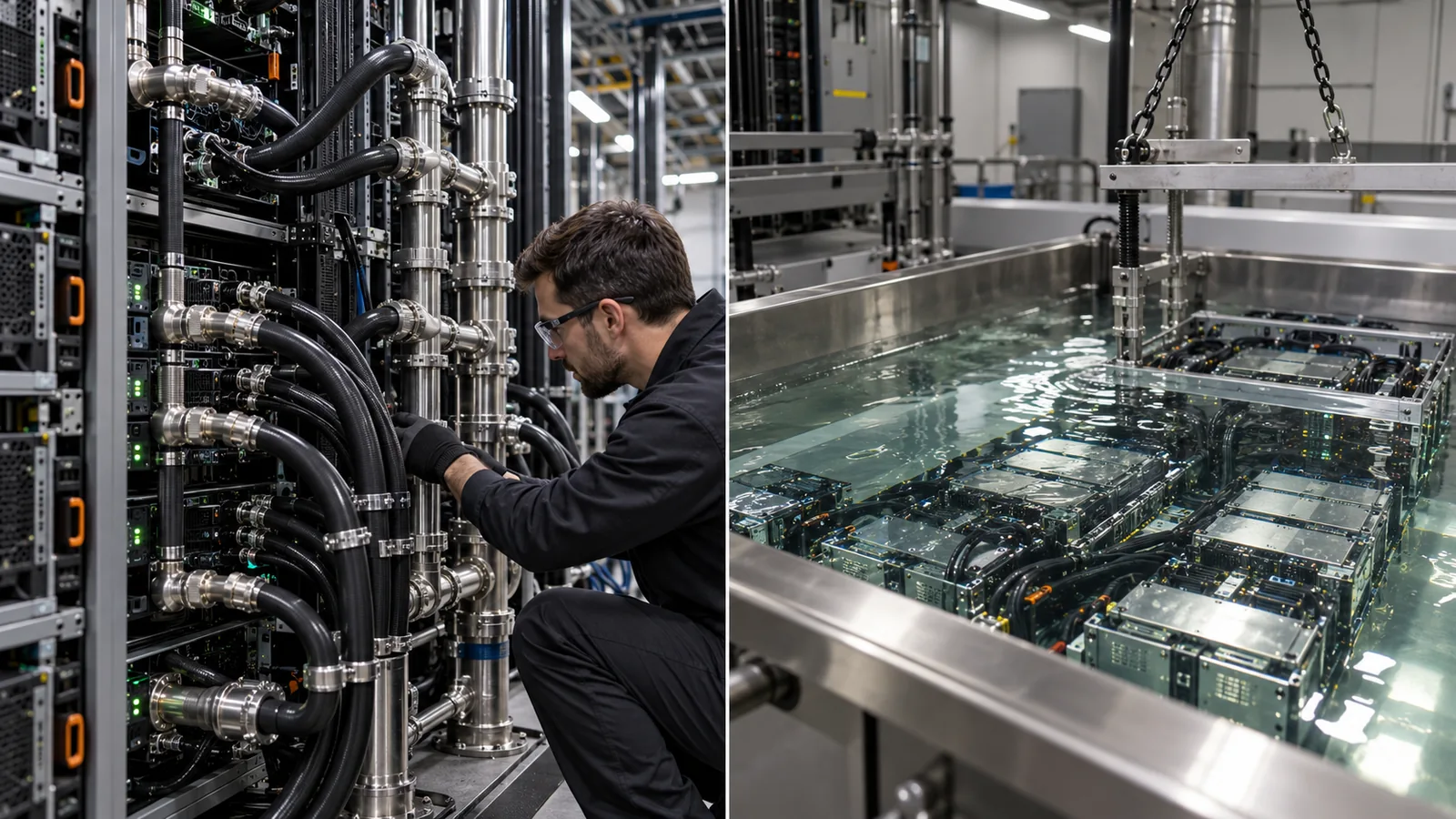
Coolant passes through cold plates attached to processors or other specified components. A CDU links the technology loop to facility heat rejection. Fan power and residual air cooling may still be required.
Preserves server racks and much of the normal maintenance workflow.Supported IT equipment is submerged in a tank. Single-phase systems circulate liquid; two-phase designs use evaporation and condensation. The immersion system still needs heat rejection outside the tank.
Requires a validated fluid, equipment and service ecosystem.Do not assume cold plates always capture exactly 80% of rack heat, or that immersion eliminates every air-handling requirement. Power supplies, networking, tank pumps, liquid distribution and room occupants still affect the heat balance. Ask each vendor for the heat-rejection split at the actual rack specification.
The Open Compute Project cold-plate workstream covers the cooling system from cold plates and manifolds through connectors and CDUs. Its immersion workstream addresses immersion requirements, material compatibility and serviceability. These are useful starting points for specifying interfaces without assuming vendor interchangeability.
A like-for-like comparison needs a wider cost boundary
A quote for a CDU compared with a quote for a tank is not a fair comparison. For a direct-to-chip retrofit, include cold-plate-equipped servers, CDUs, primary and secondary manifolds, fittings, leak detection, residual air cooling, commissioning and ongoing water treatment. For immersion, include supported servers, fluid inventory, tanks, heat exchangers, containment, lifting facilities, spill handling and the cost of replacing or reclaiming fluid.
| Cost or design question | Direct-to-chip | Immersion |
|---|---|---|
| Existing rack layout | Often adaptable with pipe, manifold and power changes | Tank arrangement and service aisles may require a redesign |
| Cooling equipment | CDU plus facility heat rejection and residual air cooling | Immersion circulation / condenser plus facility heat rejection |
| Server qualification | Cold plate and connection approval per platform | Entire component/fluid compatibility and warranty approval |
| Consumables | Coolant monitoring, filters, approved inhibitors | Dielectric fluid, filters, potential loss and replacement |
| Servicing | Quick disconnects and rack-oriented repair | Lift, drain, handle and return compatible components |
| Vendor lock-in | Check connectors, cold plate fit and TCS specifications | Check tank, fluid, server and component qualification |
For a procurement model, request a five-year total cost of ownership (TCO) for exactly the same useful compute capacity and availability target. Include energy measured at the facility boundary, not an isolated pump efficiency or hypothetical fan-power reduction.
Compare IT throughput, facility energy, failed-job rate, technician time and upgrade costs under the same workload. A lower PUE cannot compensate automatically for reduced service availability or incompatible hardware.
Imagine replacing a failed module at 2 a.m.
That is a useful acceptance test for either design. In cold-plate systems, the technician needs an approved disconnect procedure, clean access to the server, confirmation of leak-free reconnection and a plan to refill or purge the branch if required. In immersion, the team may need lifting and dripping equipment, fluid-compatible tooling, appropriate handling controls and a vendor-approved cleaning or return-to-service process.
A maintenance demonstration should record median service time and the exceptions. An immersion installation with built-in automated handling may outperform an awkward cold-plate deployment; a familiar rack layout is not a guarantee of serviceability. Ask whether a failed power supply, memory module and NIC can all be replaced within the intended service window.
Detect: what fault identifies the failed server?
Isolate: which cooling and power boundaries apply?
Service: what tools, fluid handling and access are required?
Validate: which tests allow the node back into production?
Fluid compatibility, environmental exposure and warranties
Neither system is chemistry-free. Cold-plate loops require compatible wetted materials, approved water or glycol mixtures, contamination control and monitored corrosion protection. Immersion demands evaluation of dielectric fluid properties, seals, adhesives, plastics, warranties, handling and end-of-life management. A fluid that works for one platform should not be presumed suitable for another.
For two-phase immersion, environmental review depends on the chosen fluid and local rules. It would be inaccurate to claim that every two-phase product uses PFAS or that all such systems face the same ban. Get the fluid's chemical identity, safety data, regulatory status and service-life assumptions in writing.
Request an evidence pack containing server manufacturer approval, tested thermal performance, fluid materials register, leak/spill response, service procedures, failure tests and decommissioning provisions. These documents are more useful than a universal claim of 1.02 PUE or a standard 15–25% hardware premium.
Which architecture is the better fit?
Shortlist direct-to-chip where conventional racks, mixed tenants and frequent server replacements dominate. Validate remaining room-air heat and CDU constraints.
Shortlist immersion when a compatible server fleet, operational handling method and qualified fluid supplier are part of the original architecture.
Compare hardware warranties and refresh compatibility first. Architectural reversibility may be worth more than small modeled energy gains.
Before signing: require a side-by-side commissioning plan and a five-year workload-based TCO. For an engineering team, a maintainable system with proven component support is a stronger investment than a cooling design selected from an isolated efficiency claim.
Sources and further reading
Primary frameworks and reference materials. Engineering decisions require site-specific validation; legal classifications require assessment of the actual use case.
- OCP Cold Plate project: technical interfaces and guidelinesOpen Compute Project
- OCP Immersion project: requirements and material compatibilityOpen Compute Project
- ASHRAE datacom liquid-cooling reference collectionASHRAE