
Liquid cooling / Fluid maintenance
Liquid Cooling Water Quality: Testing and Maintenance
The best coolant target is the one approved for your actual metals, seals and server cold plates. Track the trend, not an internet-wide pH number.
Sections in this article
A CDU dashboard shows rising conductivity in a liquid-cooled rack loop. There is no thermal alarm, and all pumps appear healthy. Should someone add chemicals, replace the filter or dump and refill the loop? Not on that evidence alone. An unexpected trend can reflect sensor drift, makeup fluid, contamination, inhibitor chemistry or corrosion. Each requires a different investigation.
For technology cooling systems (TCS), the right water-quality plan begins with approved fluid chemistry and material compatibility. It is not safe to copy a generic pH of 6.8–8.2, a universal conductivity of 5 µS/cm or a fixed biocide schedule from an unrelated system.
Begin with the coolant and wetted-material register
Map every material touching the secondary coolant: CDU heat exchanger, pumps, valve seats, metals, seals, flexible hoses, manifolds, quick connectors and cold plates. Cross-check the manufacturer-approved coolant type and additive package. Mixed metals can sometimes be used successfully under a validated corrosion-control strategy; blanket bans on every brass part or every material pairing are not technically reliable.
Water-based, glycol-based and dielectric coolants have different properties. Some use corrosion inhibitors; some have very different requirements for filtration or additive management. Highly purified water is not automatically safer if it is incompatible with system materials or lacks the manufacturer-required protection.
- Fluid identity
- Approved product, concentration and batch
- Wetted materials
- Validated metals, polymers and seals
- Operating envelope
- Supplier-defined temperature and chemistry limits
- Service ownership
- Sampling, dosing, laboratory and escalation contacts
The OCP coolant-fluids and wetted-material workstreams collect guidance on fluid specification, material compatibility and liquid-cooled rack operation. Use the applicable workstream material alongside your system's manufacturer documents, rather than assuming one industry-wide fluid recipe.
Which fluid measurements are useful?
| Metric | What it can reveal | What not to infer |
|---|---|---|
| Conductivity | Changes in dissolved ionic content or additive state | Not a standalone corrosion diagnosis; some approved fluids conduct |
| pH | Acid-base trend relative to approved formulation | No universal safe band for all coolants and materials |
| Corrosion inhibitor | Whether required additive remains in specified range | Cannot be topped up with an arbitrary dose |
| Particles / filter differential pressure | Fouling, installation debris or corrosion products | Filter restriction does not identify the contaminant |
| Microbial indicators where relevant | Possible biological contamination in susceptible loops | A rapid ATP test is not an interchangeable bacterial count |
| Fluid temperature and flow | Thermal and hydraulic context for the sample | Normal temperature does not prove chemical stability |
A measurement is meaningful only when its sensor accuracy, sampling position, fluid compatibility and temperature compensation are understood. Use the first validated commissioning results to establish the baseline. Record changes in operating conditions when comparing samples.
An operating routine people can actually follow
The sampling cadence should follow system supplier instructions, water-treatment assessment and observed stability. A two-week sampling plan may be appropriate at one site and unnecessarily frequent—or insufficient—at another. Startup, post-maintenance and after-fluid-change sampling often deserve special attention because contamination risk differs from steady operation.
Conductivity, supply temperature, flow, differential pressure and leak alarms against documented limits.
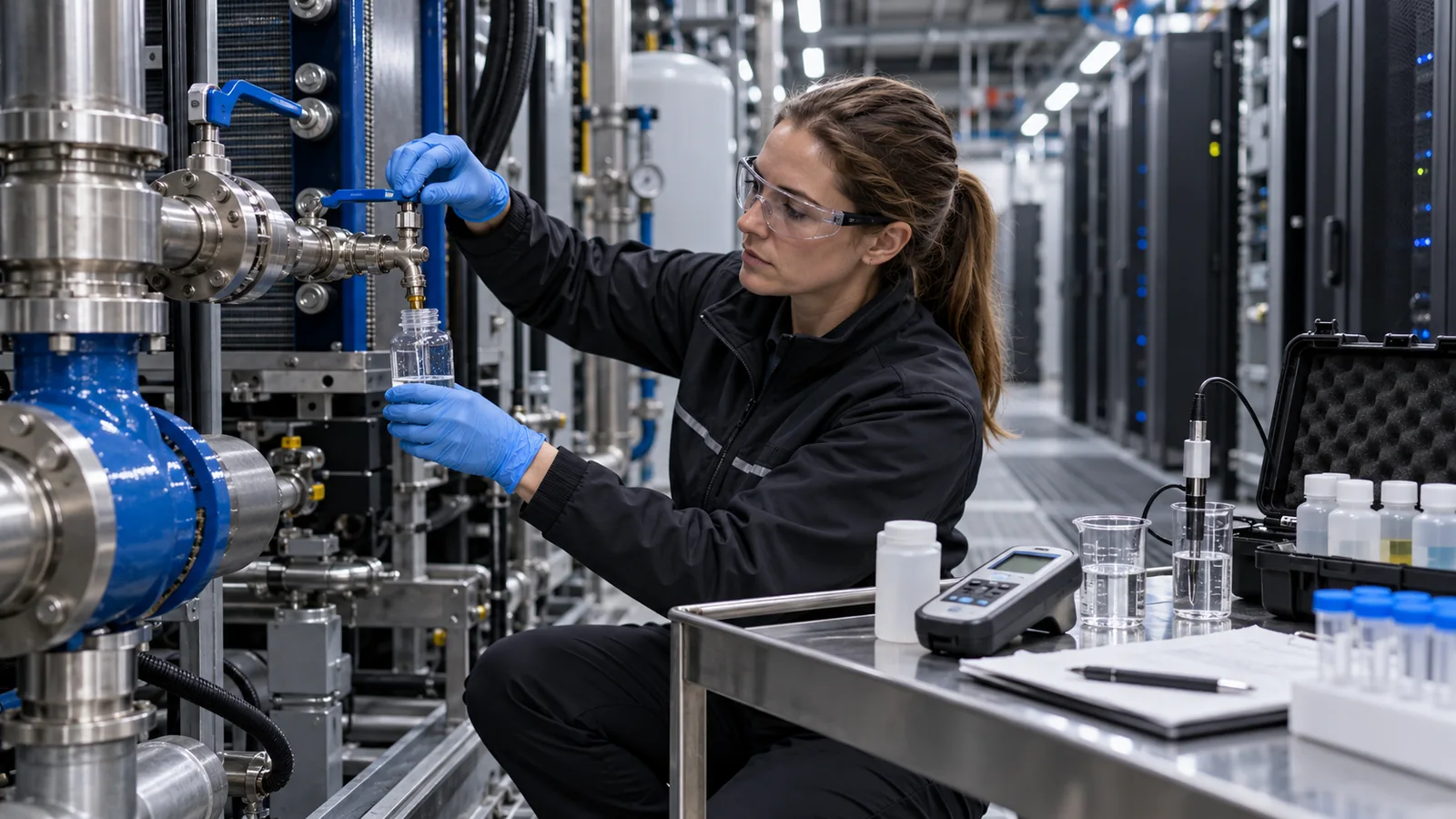
Use the specified ports, clean containers, calibrated instruments and chain of custody.
Investigate after coolant top-up, component change, major service or an unexplained alarm.
Choose appropriate analysis for corrosion metals, inhibitors, suspended solids or organisms.
Document exactly how sampling ports are flushed and samples stored using the approved laboratory method. An instruction to drain a fixed one or two liters is not valid for every port, fluid or system volume. Sampling procedures should not introduce air, new contamination or an electrical hazard.
What to do when a result moves outside the envelope
Step one: verify the result. Confirm the instrument's calibration, sample point, temperature correction and recent chemical additions. Compare with another approved point if available. Do not try to correct a faulty inline reading with immediate dosing.
Step two: assess consequences. Review related pressure drop, filter loading, temperatures, leaks and rack performance. A conductivity increase with no other changes still matters, but the correct response is investigation rather than an automatic chemistry intervention.
Step three: coordinate remediation. Use the coolant provider and equipment manufacturer's approved procedures for treatment, filtration, flushing or replacement. Unplanned biocide shock, partial drain-and-fill, DI resin bypass or additional inhibitor may damage seals, disturb the approved additive balance or affect warranties. The corrective action depends on the identified cause.
- Confirm sample and temperature compensation.
- Review makeup events, supplier additions and maintenance log.
- Check fluid analysis for ions, metals or additive effects as appropriate.
- Agree a controlled action with the fluid and CDU specialists.
- Sample again and update the baseline after verification.
The small record that prevents recurring problems
Each measurement entry should identify circuit, exact sample port, date, operating state, fluid name and batch, instrument, result, applicable vendor limit and next action. Link it to any component replacement and the latest material-compatibility list. The purpose is to see trends and distinguish a changed fluid from a failing sensor.
The records should allow a new shift engineer to find the authorized chemistry limits and explain why a correction was made. An unexplained green dashboard number is not enough.
As a final review, ask whether the site can identify the approved fluid, show recent trends, locate the sampling procedure and demonstrate that any treatment change is authorized. Those four answers do more to protect an operating TCS loop than publishing a universal table of chemical thresholds.
Sources and further reading
Primary frameworks and reference materials. Engineering decisions require site-specific validation; legal classifications require assessment of the actual use case.
- OCP Cold Plate: coolant fluids and wetted-material workstreamsOpen Compute Project
- OCP Liquid Cooling Integration and Logistics resourcesOpen Compute Project
- ASHRAE Datacom Series: liquid-cooled IT guidanceASHRAE