
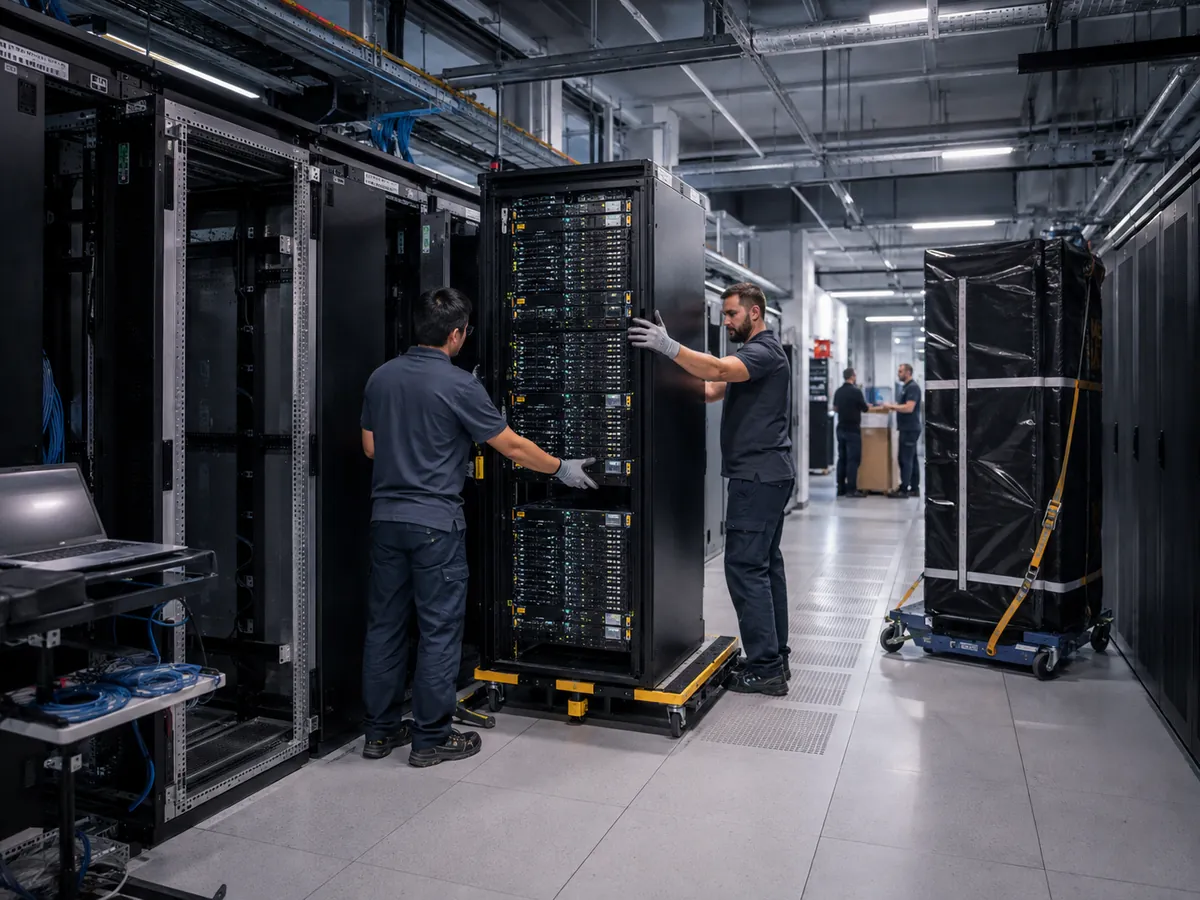
Moving 40 racks twenty miles is not really a 40-rack freight job. For a period of time, it is a two-data-center problem.
That distinction is the starting point for a useful relocation budget. The visible activity is physical: equipment is shut down, handled, transported, reinstalled and brought back online. The economic project is wider.
A live relocation can also require discovery, destination preparation, duplicate network services, temporary capacity, parallel operation, testing, vendor coordination and a plan for what happens if the cutover does not work as expected.
That is why I would not begin with only one question: “What does it cost to move a rack?” I would begin with: “What does it cost to move the service safely from one operating environment to another?”
Shutdown, handling, packing, transport, re-racking and specialist moving labor.
Discovery, destination preparation, duplicate connectivity, temporary capacity and parallel operation.
Failed cutovers, unexpected downtime, rollback, delayed exit and remediation.
A useful relocation model keeps these three boundaries separate. Combining them into one per-rack number can hide the part of the project that actually creates the cost or the risk.
There is no defensible universal 2026 relocation price per rack
Public benchmarks are useful here, but mostly because they show why relocation cost needs a clearly defined scope.
Info-Tech Research Group publishes an average of $120,000 per data center relocation, or about $10,000 per rack, based on a survey cited in its relocation budget tool. The figure is a useful reference point, but the public page does not establish it as a 2026 market benchmark. I would not simply apply inflation to it and call the result a current industry average. Info-Tech's relocation budget tool also makes the more important point: a move includes many one-time and ongoing expenses beyond transportation.
A specialist migration guide published in May 2026 gives a much wider $5,000–$25,000 per rack range for physical relocations. That is useful as a current practitioner benchmark, but it comes from a business operating in the data center migration market rather than from an independent statistical agency. The 2026 migration guide also argues that planning, dependency mapping and professional services can matter more than the trucks themselves.
Survey-based reference published in its relocation budgeting material. Useful context, but not presented here as a verified 2026 market average.
Current specialist guidance. Useful for scale, but not an independent market index.
The dates, samples and cost boundaries are not sufficiently aligned. Averaging them would create precision that the underlying evidence does not support.
Per-rack pricing can still be useful during an early screen. Rack count gives physical scale. It does not tell us how difficult the applications are to separate, whether the destination is ready, how long two environments must operate in parallel or what an unsuccessful cutover would cost the business.
First decide what the word “relocation” includes
A physical relocation, a workload migration and a modernization program can all be described casually as a data center migration. Their economics are very different.
Existing servers, storage and network equipment are moved to another physical environment and recommissioned.
Applications, data or virtual machines move while some existing hardware may never leave the source facility.
Workloads are consolidated, replatformed, replaced or retired as part of the exit.
This article focuses primarily on a physical enterprise data center relocation. If the same program also includes a major cloud migration, application redesign or hardware refresh, those elements should be identified separately rather than silently loading every transformation cost into the word “move.”
Discovery belongs inside the relocation economics
Discovery can look like project overhead until the team finds a server nobody needs, an application with an undocumented dependency or a network path that cannot be reproduced at the destination.
IBM's consolidation guidance starts with inventorying data assets, then defining the physical requirements of the data center and mapping software and hardware configurations. It specifically includes space, cabling, bandwidth, connectivity and required power among the physical parameters that should be understood before migration. IBM's consolidation methodology also emphasizes having a defined discovery and dependency map.
Undocumented dependencies, destination remediation and missing network services can reveal work that was absent from the initial budget.
Obsolete hardware, unused circuits and applications ready for retirement do not necessarily need to be relocated at all.
That is why I would perform the inventory and dependency work before treating a mover's quote as the project budget. The quote can price the movement of known equipment very well while still answering only one part of the relocation question.
A relocation budget is easier to control as seven separate cost lines
I would build the first project budget as a ledger rather than as one cost-per-rack estimate. The seven lines below are a Data Center Scope editorial framework: they are intended to expose scope, not to imply that every relocation uses the same procurement structure.
Asset inventory, dependency mapping, sequencing, ownership, change control, move groups, runbooks, vendor coordination and rollback planning.
Rack positions, power, cooling, structured cabling, cages, cross-connects, access controls, staging space and remediation required before equipment arrives.
New carrier circuits, cross-connects, temporary connectivity, duplicated services and the time during which source and destination networks must coexist.
Shutdown support, labeling, packing, anti-static handling, insured transport, specialist labor, re-racking and physical verification at the destination.
Duplicate colocation space, temporary hardware, cloud capacity, overlapping support contracts or another continuity layer used while the estate is split between two environments.
Power-on testing, network validation, application acceptance, vendor engineers, out-of-hours support and post-cutover troubleshooting.
Asset disposal, secure data destruction, contract exit, decommissioning, remediation and a reserve for scope that cannot be fully known during initial planning.
This structure makes a common budgeting mistake easier to see. A moving company may quote line 04 very accurately while the business still has substantial exposure in lines 01, 02, 03, 05, 06 and 07.
The physical move and the transition should not share one denominator
Rack count is a sensible denominator for some physical activities. Forty racks generally require more handling than ten racks.
It is a much weaker denominator for network complexity, application dependency, destination remediation or business-continuity requirements. A ten-rack environment with tightly coupled legacy systems can create a harder transition than a much larger standardized estate.
- Physical handling
- Packing materials
- Transport capacity
- Re-racking labor
- Application dependencies
- Network redesign
- Parallel operating time
- Downtime exposure
A useful concept-stage equation
Before vendor quotes replace assumptions, I would describe the project with this equation:
Business-interruption exposure is modeled separately because its value depends on the services being moved rather than on the amount of physical equipment.
Why I would keep downtime outside the headline project total
Downtime matters economically, but adding a generic “cost per minute” to every relocation can make the model less credible rather than more complete.
A payment platform, an internal reporting environment and a development lab can occupy similar rack space while creating completely different financial consequences when unavailable.
The infrastructure team can estimate transition mechanics. The business owner is better placed to determine what an hour of service interruption actually means.
This is an expected-risk framework, not an instruction to add the maximum theoretical outage loss directly to the relocation budget.
The duration of overlap can matter as much as the move weekend
A relocation may have one highly visible cutover weekend but several months of less visible duplicated spending.
If the destination needs to be operational before the source can be retired, the project can temporarily pay for two sets of space, connectivity, support or compute capacity.
That overlap is not automatically waste. It may create time to test the destination, move services in controlled groups and preserve a rollback option. The economic question is whether the reduction in transition risk justifies the cost of operating both environments.
A worked 40-rack relocation scenario
A model becomes more useful when every important assumption can be inspected. Consider a hypothetical 40-rack enterprise environment moving to another facility in the same region.
The destination already exists, but it needs cabling and network work. The project also keeps both environments operating for three months while services are moved and validated.
Every dollar value below is a Data Center Scope editorial assumption created for this example. These figures are not a contractor quote, survey result or claimed 2026 market average.
The useful result is not simply the $1.09 million headline. It is the composition of that number.
The physical relocation accounts for $320,000, or approximately 29.3% of the total planning budget. In this scenario, more than 70% of the budget exists outside the physical rack move.
This split belongs only to the worked example. A different project can have a much larger or smaller physical-move share.
Three months of overlap is an assumption worth testing
Parallel operation is especially useful for sensitivity analysis because its cost grows with time. Using the same example, assume that duplicated infrastructure and services cost $65,000 for each month of overlap.
Extending the overlap assumption from one month to six months increases this illustrative planning budget from $943,000 to $1.317 million. Nothing about the rack count changed.
That is exactly why a relocation budget cannot be explained completely by cost per rack. Transition duration can materially change the economics even when the same equipment travels the same distance.
The model should become less hypothetical as procurement progresses
At concept stage, assumptions make the boundary visible. They should not survive unchanged simply because they were used in the first spreadsheet.
Establish order of magnitude and identify which variables matter.
Replace rack counts, dependencies and overlap assumptions with actual inventory and transition plans.
Replace assumed physical, network and destination costs with comparable commercial proposals.
Track actual spend, contingency consumption and changes against the agreed scope.
The purpose of the early model is therefore not to predict the final invoice to the dollar. It is to prevent important categories from disappearing before the real quotes arrive.
Two 40-rack relocations can be completely different projects
Rack count is useful because it gives the physical estate a scale. It becomes misleading when it is treated as a proxy for transition difficulty.
- Destination is in the same metropolitan area.
- Power and cooling capacity are already available.
- The asset register is current.
- Applications tolerate planned maintenance windows.
- Network architecture changes very little.
- Hardware is still within its planned lifecycle.
Most of the uncertainty is concentrated in execution.
- The destination is in another region.
- Some infrastructure must be remediated before arrival.
- Service interruption has to be kept close to zero.
- Legacy dependencies are incompletely documented.
- Carrier and IP architecture will change.
- Several systems are already near replacement age.
Most of the uncertainty exists before a truck is booked.
A per-rack benchmark sees two 40-rack relocations. A project model sees two different risk profiles, two different transition architectures and potentially two very different budgets.
The cheapest moving quote may simply contain the smallest scope
Relocation proposals become difficult to compare when one supplier includes technical validation and another stops when the equipment is physically installed.
I would normalize proposals before comparing their totals. The objective is not to force every supplier into the same delivery model. It is to understand which costs have moved outside each quote.
Who validates the device list, serial numbers, ownership and final move scope?
Who performs or supervises the controlled shutdown and records the pre-move state?
What packaging, anti-static protection, security and insurance are included?
Are distance, secure storage, after-hours access and specialist vehicles inside the price?
Who owns rack readiness, structured cabling, cross-connects and physical remediation?
Does the engagement stop at installation, or does it include power-on and technical validation?
What capability remains if the destination cannot accept the workload after the source has begun to shut down?
Who is responsible for disposal, secure destruction and final source-site closeout?
Only after these boundaries are visible does the lowest headline price become meaningful.
Moving old hardware is not automatically cheaper than replacing it
A relocation creates an unusual decision point. Equipment that would normally remain in place has to be disconnected, handled, transported, recommissioned and exposed to another change event.
That does not mean an organization should use the move as an excuse to refresh everything. Combining a relocation with a large modernization program can multiply execution risk.
It does mean that old equipment deserves a deliberate move-versus-replace decision.
- Substantial remaining useful life
- Current vendor support
- Known configuration and dependencies
- Replacement would create additional migration work
- Low physical relocation risk
- Near end of planned lifecycle
- Limited or expired vendor support
- Replacement already budgeted soon
- High handling or recommissioning risk
- New hardware can be staged before cutover
The accounting boundary matters here too. Suppose $500,000 of hardware was going to be replaced next year whether the facility moved or not. Buying it earlier can create incremental cost because of timing, financing or accelerated depreciation. It does not necessarily make the entire $500,000 a cost caused by relocation.
Separating relocation-driven expenditure from accelerated lifecycle expenditure makes the business case easier to compare with the alternative of remaining in the current facility.
A relocation can also be an opportunity to reduce the estate
Discovery should not automatically end with a list of everything that must be transported.
Some assets can be retired. Some applications can be consolidated. Some circuits may no longer have a valid dependency. Some hardware may be replaced directly at the destination instead of making the journey.
This is one reason detailed discovery can reduce cost as well as add it. The project may uncover hidden dependencies, but it can also prevent the organization from paying to reproduce infrastructure it no longer needs.
How I would move from an early estimate to an approved budget
Separate physical relocation, workload migration, modernization and lifecycle replacement.
Build the inventory and dependency map before treating rack count as final scope.
Price how long duplicate space, connectivity and support will coexist.
Normalize scope so that excluded work does not make one proposal look artificially inexpensive.
Keep project contingency inside the budget while modeling business-interruption exposure separately.
As execution approaches, substitute measured quantities and commercial prices for the initial planning model.
So what does a data center relocation cost in 2026?
The available public evidence does not support one universal answer that I would trust for every project.
Public references can establish rough physical-moving order of magnitude. Info-Tech publishes a survey reference around $10,000 per rack, while a 2026 specialist guide publishes a much broader $5,000–$25,000 per-rack range. Those figures are useful as context, but their boundaries are not aligned well enough to manufacture a new universal average from them.
A more defensible estimate starts with the actual estate and builds the project from discovery, destination readiness, network overlap, physical relocation, parallel operation, validation and contingency.
Then the assumptions are replaced one by one as inventory becomes reliable and vendor proposals arrive.
A data center relocation is expensive because the business is not simply paying to transport equipment. It is paying to preserve services while the infrastructure beneath those services changes location. The physical move is the visible event. Discovery, overlap, validation and transition risk are much of the economic project.
Sources and research notes
- Info-Tech Research Group — Data Center Relocation Budget Tool . Used for its published survey reference of $120,000 per relocation and approximately $10,000 per rack, and for the broader categories included in relocation budgeting. The public page does not establish that survey figure as a 2026 market average.
- Info-Tech Research Group — Data Center Relocation Data Collection and Bundling Workbook . Used for discovery, infrastructure inventory, application inventory, migration bundling and identification of upgrade or consolidation opportunities before the move.
- Info-Tech Research Group — Move a Data Center . Used for the overall project sequence: project management, discovery, move-day planning, execution, testing and closeout.
- IBM — Data Center Consolidation: Strategy and Best Practices . Used for inventory, physical destination requirements, power and connectivity considerations, workload mapping, dependency mapping and post-migration testing.
- The Uptime Expert — Data Center Migration: An Operator's Guide to Planning, Cost, and Risk . Published May 22, 2026. Used as a current specialist reference for the $5,000–$25,000 per-rack physical-relocation range and for its discussion of parallel operation, planning and cutover risk. Data Center Scope treats this as practitioner guidance rather than as an independent statistical market index.
Research approach: published figures were not averaged when their dates, samples or cost boundaries could not be normalized reliably. The worked 40-rack model in this article uses explicitly labeled Data Center Scope assumptions and is intended to demonstrate budgeting structure rather than report a market average.