
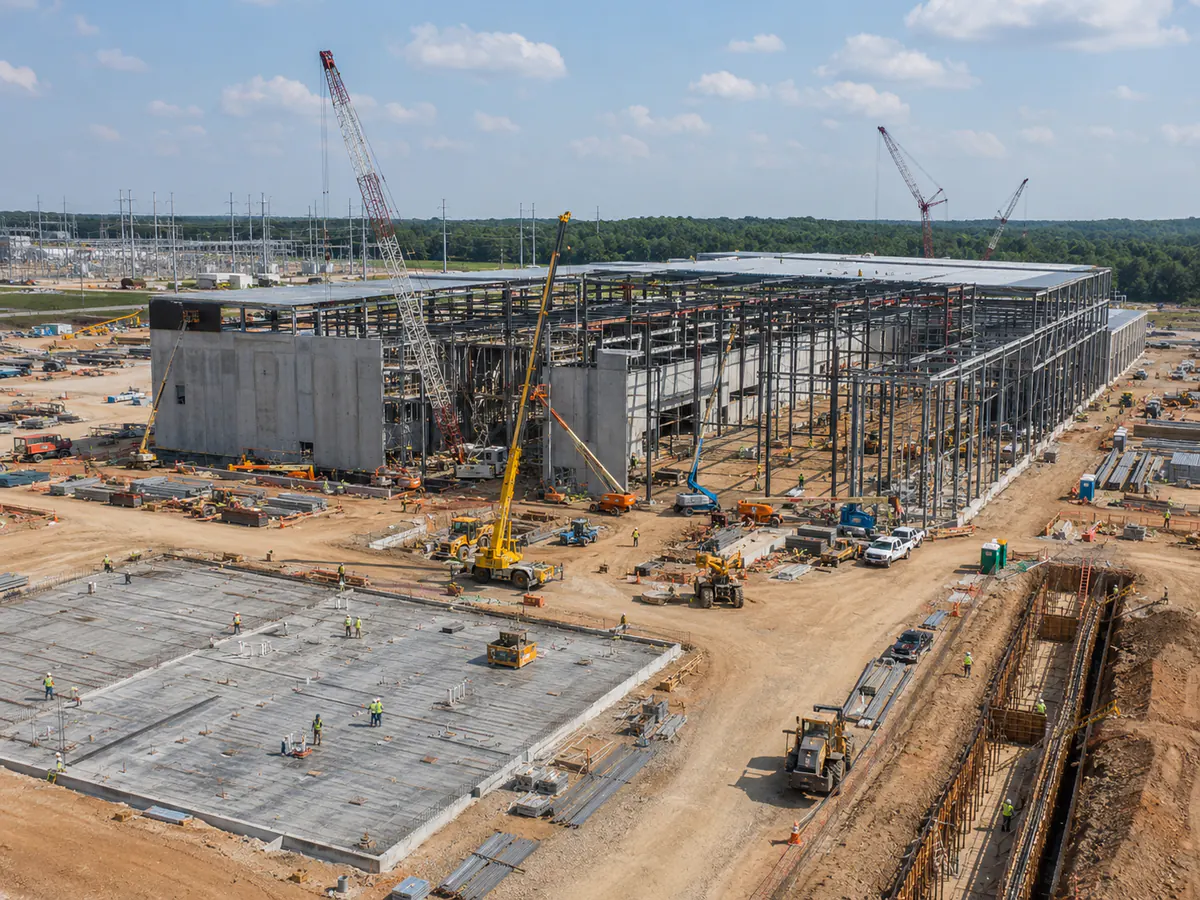
A data center can take 18 months to build and four years to become usable.
Those statements are not contradictory. One describes the physical construction program. The other can describe the time required to secure power, move through development, procure long-lead equipment, build the facility, commission it and finally energize the IT load.
This distinction has become much more important in 2026 because the building is no longer necessarily the slowest part of a data center project.
JLL's 2026 Global Data Center Outlook puts the average global build time for a 50 MW facility at roughly 18 months. At the same time, CBRE says the traditional 12-to-18-month schedules associated with smaller buildings no longer describe many large AI developments. Projects requiring major transmission work or new generation can face 24-, 36- or even 48+ month interconnection timelines.
Site control, utility studies, zoning, permits, design and financing.
Building, electrical and mechanical infrastructure, installation and fit-out.
Utility infrastructure, commissioning and the point when usable IT capacity actually exists.
The clocks overlap rather than run neatly one after another. Developers order transformers before the building is ready. Utility studies run while permits are being processed. Construction can start while other parts of the campus remain in design. The project finishes when the critical path finishes, not when every workstream has spent the same number of months.
The 18-month number is real — and easy to misuse
JLL's latest global research says the average build time for a 50 MW data center is 18 months. That is a useful construction benchmark. It should not be read as “find a site today and turn on 50 MW eighteen months from now.”
JLL also reports that 57% of data center projects experienced a construction delay of three months or more in 2025. Developers are preordering selected materials as much as 24 months in advance and larger operators are holding six to twelve months of strategic inventory for critical equipment. Those figures come from the same 2026 outlook that publishes the 18-month average.
In other words, even the industry average already assumes a procurement environment that requires decisions well before concrete is poured.
When someone says “18-month build,” I would ask what had already happened before month one. Site control, utility commitment and long-lead procurement can make an 18-month construction schedule the middle of the project rather than the beginning.
Power has become the timeline that can dominate all the others
CBRE's 2026 U.S. outlook says the ability to secure 300 MW or more in under 36 months has become more important to large projects than pure connectivity considerations. The same report says traditional 12-to-18-month timelines for sub-50 MW buildings no longer apply cleanly as the market shifts toward 500 MW-plus AI campuses.
The reason is physical. A very large campus may need multiple on-site substations, upgrades to utility substations, new transmission, new generation or some combination of those systems. CBRE says any requirement for new high-voltage transmission or incremental generation can extend interconnection to 24, 36 or 48+ months. That makes power delivery a development schedule in its own right.
Colliers reaches the same conclusion from the investment side. Its 2026 U.S. Data Center Marketplace report says power availability, delivery timing and contractual certainty have become the primary determinants of project feasibility and valuation. Power has overtaken location as the main driver of site selection in its market analysis.
The building can be waiting for the grid
Consider a simplified 50 MW project whose physical construction starts in January 2027 and follows JLL's 18-month average. The building could be substantially complete around mid-2028.
If the required utility delivery is not available until January 2029, the facility does not have 50 MW of usable IT capacity in mid-2028 simply because the construction crews are nearly finished.
The bars above are an illustrative critical-path example, not published industry phase durations. JLL's 18-month average build time and CBRE's 24–48+ month interconnection range are separate current benchmarks.
This is why “time to power” has become a more commercially important phrase than “time to build.”
Pre-construction itself has stretched
Colliers says pre-construction timelines expanded to roughly 18–24 months in 2025, compared with cycles closer to six months in earlier years. That period can include site work, utility negotiations, design development, entitlement, procurement planning and other steps that determine whether construction can begin cleanly.
Some of this longer timeline is a consequence of project size. A 20 MW extension to an existing powered campus is fundamentally different from assembling land and utility infrastructure for a greenfield 500 MW AI development.
Some of it is also strategic. Developers are committing capital earlier because waiting for every commercial condition to become certain can mean losing the equipment, contractor slot or utility position needed to meet the target delivery date.
Colliers reports that 60%–75% of early-stage funding in major programs is now coming from private credit and structured capital sources, while utility deposits of $25M–$75M+ have become common. The schedule is increasingly being financed like infrastructure before the building itself is fully underway.
The transformer may be ordered before the project feels “real”
Electrical equipment remains one of the clearest supply-chain risks.
JLL says average U.S. data center equipment lead time is about 42 weeks in 2026, still 83% above 2019 levels. Its detailed U.S. figures put generators at roughly 51 weeks, transformers and switchgear around 43 weeks, PDU/STS equipment around 41 weeks, and batteries/UPS and ATS equipment around 35 weeks.
On the mechanical side, JLL's U.S. benchmark is about 35 weeks for chillers, 19 weeks for rear-door heat exchangers/direct-to-chip equipment, 14 weeks for cooling towers and 11 weeks for CRAH/fan-wall units.
Those are regional averages, not guaranteed vendor delivery dates. A custom transformer, unusual voltage, large quantity or sudden market shortage can move differently.
The planning implication is more important than the exact week count: critical electrical equipment can require procurement decisions before the rest of the project would traditionally have reached full design maturity.
Buying early moves schedule risk into design risk
Preordering equipment protects a delivery date only if the project ultimately needs what was ordered.
A transformer or generator package committed twenty-four months early can become a constraint if the IT load changes, the utility voltage changes, the site plan moves or the cooling architecture evolves.
AI makes that tension sharper. Hardware generations are moving quickly from conventional density toward 120, 140 and 200+ kW racks. A facility whose electrical and cooling assumptions were frozen two years before IT deployment may discover that the workload has changed more quickly than the building.
This is one reason modular electrical and cooling architectures have become attractive. They cannot eliminate long lead times, but they can reduce the amount of the final configuration that has to be predicted perfectly at the beginning.
Permitting and community support can become a real critical path
The market used to talk about data center development as if the hard part were engineering. In 2026, community and regulatory approval can be just as important.
Colliers says community opposition, zoning constraints and environmental reviews have contributed to more than $64 billion of U.S. data center projects being delayed or canceled since 2023. Its 2026 outlook treats community and regulatory risk as a core investment consideration rather than a secondary permitting issue.
JLL's August 2026 North America report gives the political pressure more context. It found 79% of Americans surveyed support U.S. leadership in AI, but only 14% support data center development in their own community. That 65-point gap is now a development-timeline issue.
Electricity, water, noise, backup generation, land use and tax incentives can all become part of local review. A technically viable site is not a buildable site until those issues have a path to approval.
The 500 MW campus is not a 50 MW building repeated ten times
Large AI campuses create different dependencies.
Multiple substations may have to arrive in phases. Transmission upgrades can serve several buildings at once. The first 50 MW may be energized while another 200 MW is still under construction and the final phase is years away.
CBRE says the shift toward 500 MW-plus AI campuses is one reason construction schedules have entered multi-year territory. A campus should therefore be discussed as a sequence of capacity deliveries rather than one grand opening date.
“500 MW planned” can mean 50 MW online next year, another 100 MW a year later and the remainder dependent on later utility phases. The headline capacity tells us very little about when the compute can actually run.
Phasing can turn a four-year campus into an 18-month first delivery
This is the constructive side of the timeline problem.
A project does not always need to wait for the final campus phase before creating value. Developers can energize one building or one power block while later phases continue through utility and construction work.
That can be economically superior to optimizing only for the shortest final-completion date. The first 20 or 50 MW starts generating compute or rent while the rest of the investment remains under development.
A schedule should therefore track at least two milestones: first usable capacity and full planned capacity. They can be separated by years.
Commissioning is part of construction, but it deserves its own calendar
A data center is not ready when the last piece of electrical equipment is installed.
Power and cooling systems have to be started, integrated and tested under the intended sequences. Controls have to respond correctly. Redundant paths and failure states have to behave as designed. IT-ready handover depends on the facility operating as a system rather than as a collection of installed components.
The amount of commissioning depends on project scale, topology and certification requirements. A Tier IV fault-tolerant facility has more operating states to demonstrate than a simpler building.
Compressing commissioning to recover earlier delays can therefore transfer schedule pressure into operational risk. The last weeks of a project are a poor place to discover that two independently specified systems do not behave correctly together.
Delays are expensive even before a single customer SLA is missed
A three-month delay means more than three extra months of contractor overhead.
Capital remains tied up without producing revenue. IT equipment may be waiting for a powered facility. A customer may need interim colocation capacity. Financing costs continue. Procurement teams may have to store hardware or renegotiate delivery.
For AI infrastructure, the opportunity cost can be particularly severe because expensive accelerators depreciate economically very quickly as newer hardware generations arrive.
This is why a project with a higher construction $/MW can still be economically superior if it delivers usable power substantially earlier.
Our cost-per-MW analysis treats construction cost as one side of the decision. Schedule is the other side because a cheap MW that arrives too late can have lower business value than an expensive MW available now.
Schedule certainty now has a market price
JLL says North American vacancy remained around 1% for the third consecutive year in its August 2026 report, and most tenants securing capacity today are contracting for 2028 delivery. Available inventory is often small and fragmented.
Colliers says more than 90% of new capacity is pre-leased before delivery. CBRE raised its 2026 forecast for preleasing of projects under construction in primary markets to 80%.
In that environment, a credible delivery date is part of the product. Customers are not only paying for future MW; they are paying for confidence that the MW will exist when the hardware is ready.
“Shovel-ready” does not mean “power-ready”
Real-estate language can hide one of the most important schedule distinctions.
A site may have zoning, land control and permits sufficient to begin construction but still lack a firm utility delivery date for the required load. Another site may have a credible power reservation but still face difficult entitlement or community review.
I would treat site-ready, construction-ready and power-ready as three separate statuses.
Land, access and basic physical feasibility are under control.
Design, permits, procurement and contractors are sufficiently advanced to build.
The required electrical capacity has a credible, contractual delivery path.
Commissioned power and cooling can support the intended workload.
A project can be advanced in one category and immature in another.
Temporary and on-site power can shorten one timeline while creating another
Grid delays are encouraging developers to explore on-site generation, particularly natural gas, fuel cells and other bridge strategies.
Colliers says alternative power strategies have become central to project economics, with natural gas emerging as a near-term bridge while nuclear and small modular reactor partnerships remain longer-term possibilities. CBRE similarly expects on-site power to proliferate where grid connections are slow.
That does not make the schedule problem disappear. On-site generation creates its own fuel supply, permitting, emissions, interconnection, equipment and operating questions.
The useful comparison is not “grid takes four years, generator takes one.” It is the complete time and cost required to deliver acceptable, reliable power under the site's regulatory and operational conditions.
What I would put into a real construction schedule
I would start with the power delivery date, because in many 2026 projects it is the least flexible milestone.
Then I would map zoning and environmental approvals, design completion, utility milestones, long-lead equipment release, civil/site work, building enclosure, electrical and mechanical installation, controls integration, commissioning and IT handover.
For each long-lead component I would track more than the manufacturer's quoted lead time. The schedule needs the date the specification is stable enough to order, factory testing, shipping, customs where relevant, site delivery and the date the building is physically ready to receive the equipment.
Finally, I would separate the first capacity block from full-campus completion. That prevents a four-year master plan from obscuring a commercially important 18- or 24-month first delivery.
What is the longest non-compressible dependency?
Which equipment has to be ordered before final design?
What event would move the energization date?
When is the first MW usable, not just the building complete?
Which later phases depend on utility infrastructure not yet delivered?
So how long does it take?
For the physical construction of a roughly 50 MW facility, 18 months is a defensible current global benchmark from JLL. It is also an average in a market where more than half of projects experienced delays of at least three months in 2025.
For a complete greenfield development, the answer can be substantially longer. Colliers describes 18–24 month pre-construction cycles. CBRE says major power interconnections can take 24–48+ months, and 500 MW-plus AI campuses have moved into multi-year development schedules.
A smaller expansion at an existing powered campus can move much faster because the hardest development work has already been done. A new project requiring transmission and local political approvals can take years before the building schedule becomes the controlling factor.
The most useful construction question in 2026 is therefore not “How many months does the building take?” It is which dependency controls the date of the first usable megawatt. Sometimes that is construction. Increasingly, it is power, equipment or permission to build. The schedule belongs to whichever of those finishes last.