
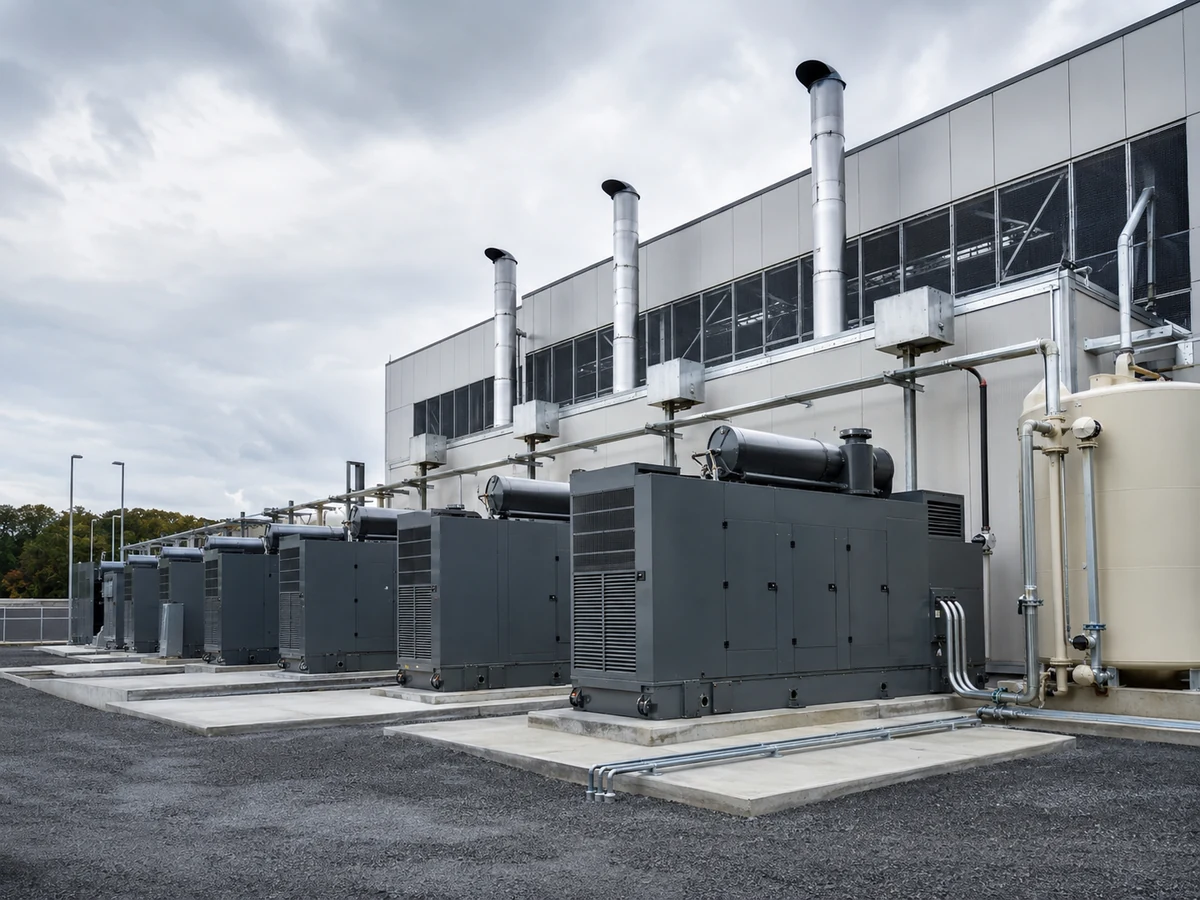
A data center generator budget is not the price of an engine multiplied by the number of megawatts.
The generator sets are only the visible part of a standby-power plant. A real project can also require paralleling switchgear, controls, medium-voltage distribution, fuel storage, exhaust, acoustic treatment, civil works, cabling, testing, permitting and enough redundant capacity to maintain the required resilience.
That distinction matters even more in 2026. Data center construction costs are rising while power infrastructure has become one of the largest parts of the development budget.
Equipment price alone hides redundancy, installation and the infrastructure required to make the set usable.
Define the load that must survive a utility outage, then build the generator topology around that requirement.
Reliability architecture can change installed generator capacity much faster than IT load changes.
There is no defensible universal turnkey generator price per MW
Public cost data can still give us useful reference points, but the scope has to be treated carefully.
Cushman & Wakefield's 2026 Data Center Development Cost Guide says modern greenfield facilities in the United States and Canada average about $17.6 million per MW, excluding chips and GPUs. It identifies power infrastructure as the largest cost category at an average 21% of total greenfield development cost.
On that basis, the complete power-infrastructure category represents roughly $3.7 million per MW at the guide's average. That is not a generator number. It includes a much wider electrical system
A widely circulated BofA Global Research infrastructure benchmark from September 2024 separated generator equipment at approximately $0.6 million per MW. I would use that number only as a historical screening anchor.
It would be misleading to call $0.6 million per MW a universal 2026 turnkey generator price. Equipment pricing, project scale, tariffs, redundancy and installation conditions have moved, and the benchmark does not represent every cost around the generator plant.
The first number to establish is protected load, not IT load
A 20 MW data center does not automatically need exactly 20 MW of generator nameplate capacity.
First decide what the 20 MW number means. It may refer to IT design capacity, actual IT load, critical facility load or total utility demand.
During an outage the generator plant may have to support more than the servers. Pumps, cooling equipment, controls, lighting and other infrastructure can remain essential to continued operation.
Servers, storage and network equipment.
IT plus infrastructure required to keep the environment operating.
Required capacity plus the selected redundancy margin.
Redundancy can add more generator capacity than the workload itself
Uptime Institute's Tier framework makes engine generators part of the resilient power architecture rather than an optional emergency accessory.
Uptime also makes an important distinction around generator ratings: for Tier III and Tier IV requirements, the generator rating has to support the required operating duty rather than rely on a conventional standby rating with restrictive runtime limitations.
That means two generator plants with the same headline MW can have very different economics.
Installed generators collectively meet the defined required load, with little or no unit-level redundancy.
The plant can lose one defined generator module while maintaining the design requirement.
Much more installed capacity can be required, depending on the topology and distribution design.
A 24 MW protected-load example shows why unit size matters
Consider a concept-stage project where the engineering team determines that 24 MW of load must remain protected during a utility outage.
Assume, purely for screening, that the project uses nominal 3 MW generator modules.
Change the module size and the result changes. Change the topology and it changes again.
This is why a generator budget should normally be built from a one-line electrical concept and an operating philosophy before anyone tries to apply a flat cost per MW.
The generator set may be only half the budgeting problem
A concept budget should separate the equipment itself from everything required around it.
Engines, alternators, local controls and the specified generator rating.
Switchgear, synchronization, protection, controls and connection to the facility electrical system.
Bulk tanks, day tanks where applicable, pumps, piping, containment and monitoring.
Exhaust routing, aftertreatment where required, ventilation and acoustic mitigation.
Pads, enclosures, cabling, grounding, buswork and site integration.
Factory testing, site acceptance, load testing, controls verification and integrated-system testing.
Fuel storage is part of CAPEX even if the generators rarely run
Diesel generators spend most of their life waiting, but the fuel system cannot be designed as an afterthought.
Storage duration affects tank volume, site layout, containment, logistics and replenishment strategy. The economically correct amount of on-site fuel depends on the facility's resilience objective, contracts, local risks and applicable requirements.
I would not assume that a Tier label by itself gives every project a universal number of fuel-storage hours. The resilience topology and the fuel logistics model should be verified separately.
Underground storage can also create its own regulatory obligations. The U.S. Environmental Protection Agency maintains specific federal requirements for emergency-power-generator underground storage tank systems.
Air permitting is becoming a larger development issue
Generator cost is no longer purely an electrical-procurement question.
EPA's 2026 data center resources specifically identify stationary engines and combustion turbines used for primary and backup power as regulated emission sources under several Clean Air Act programs.
At a large campus, dozens of engines can turn what looks like a resilience package into a material permitting issue.
That can affect equipment selection, allowable operating hours, emissions controls, testing strategy and ultimately project schedule.
Real data centers use generator plants, not isolated machines
Current deployments illustrate the scale.
In April 2026 Cummins described a large Chinese data center project using 14 high-voltage diesel generator sets, including supply, installation, testing and acceptance.
Cummins also publishes Data Center Continuous ratings for generator platforms intended to support unlimited-hour operation at the defined data center load, illustrating why generator rating should be checked alongside nameplate kW.
Older Caterpillar project examples show the same architectural point: multi-megawatt data centers commonly use multiple parallel generator units rather than one enormous machine.
AI facilities can increase generator complexity without changing the basic logic
Higher rack density does not alter the generator-cost equation by itself. What matters is how much protected electrical load the facility ultimately requires.
AI does, however, increase the scale of many projects and can produce larger step changes in load. That can influence generator module size, block architecture, fault current, switchgear design and future expansion strategy.
A 100 MW campus also creates a different permitting and fuel-logistics problem from a 5 MW enterprise facility even when both use the same conceptual N+1 philosophy.
Do not compare generator quotes until the scope boundary is identical
These can all describe the same project and still produce dramatically different dollar figures.
Before comparing them I would normalize at least generator rating, quantity, redundancy, switchgear scope, fuel scope, emissions package, installation, commissioning, freight, taxes and warranty.
How I would build a first-pass 2026 generator budget
- Define the IT design load and the critical facility loads that must continue during an outage.
- Establish the protected MW rather lying a generator percentage to total construction cost.
- Select a concept generator module size and calculate how many units are needed at N.
- Add the required redundancy and verify the relevant generator rating.
- Separate generator equipment from switchgear, controls, fuel, exhaust, civil works and installation.
- Add testing, commissioning and permitting rather than leaving them inside a generic contingency.
- Replace planning assumptions with vendor and contractor pricing as design maturity improves.
So what should you budget for data center generators in 2026?
I would resist giving a single turnkey dollar-per-MW answer unless the scope and resilience architecture are defined.
The best public context today is that power infrastructure as a whole has become the largest greenfield development cost category, averaging about 21% in Cushman & Wakefield's 2026 dataset.
The older BofA benchmark of roughly $0.6 million per MW for generator equipment remains useful for understanding the historical equipment mix, but it should not be treated as a complete 2026 installed price.
For a real budget, the more defensible sequence is: protected load → generator rating → redundancy → installed capacity → plant scope → vendor pricing.
Sources and research notes
- Cushman & Wakefield — 2026 Data Center Development Cost Guide . Used for current greenfield cost and power-infrastructure share.
- Uptime Institute — Engine-Generator Ratings . Used for Tier-related generator-rating context.
- Cummins — 2026 data center standby-power deployment . Used as a current example of a multi-generator plant.
- U.S. EPA — Clean Air Act Resources for Data Centers . Used for current stationary-engine permitting context.
- BofA Global Research, September 9, 2024 infrastructure-equipment benchmark. The approximately $0.6M/MW generator figure is presented here as historical screening context, not as a 2026 turnkey quote.