
Cooling retrofit / Rack heat rejection
Rear-Door Heat Exchangers: Sizing and Retrofit Costs
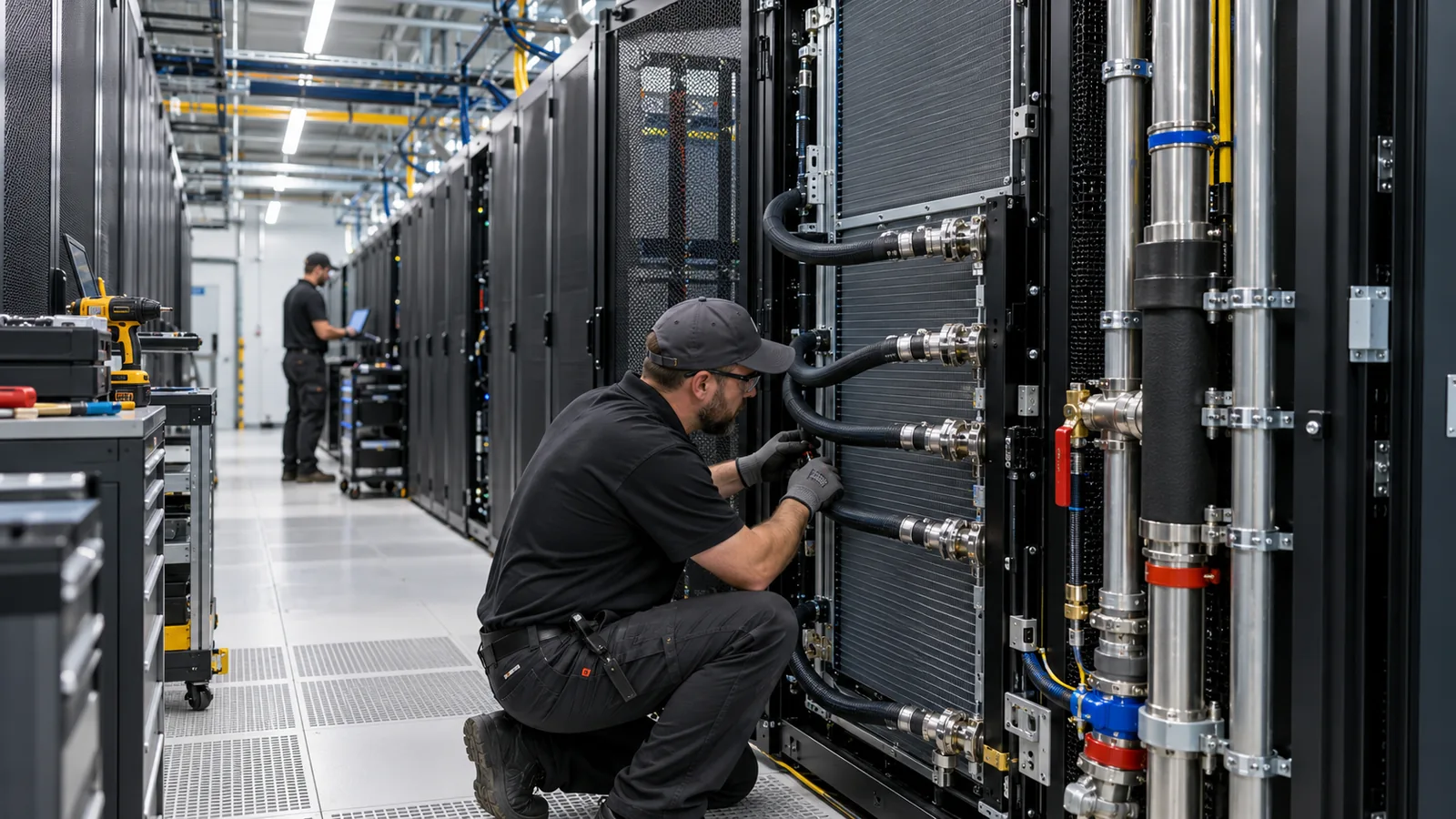
A rear-door exchanger can help an existing data hall handle denser racks. The decisive question is whether air, water and service access all work together.
Sections in this article
Picture a leased data hall where six air-cooled racks are being replaced with much hotter accelerator equipment. There is no appetite for modifying servers to fit cold plates, but room cooling struggles with exhaust recirculation. A rear-door heat exchanger (RDHX) can capture part of the heat at the rack exhaust, before it spreads into the room. Whether that works depends on both the air path and the availability of an approved water loop.
Quick answer: a rear-door exchanger is a retrofit option, not an automatic 40 kW or 80 kW entitlement. The unit's heat capture changes with air volume, entering-air temperature, water supply temperature, water flow and the server fan's ability to push through the added resistance.
Passive or active: choose by air-side resistance
A water-cooled coil replaces the rear door. Server fans must still deliver sufficient airflow after the coil's added pressure drop. Advantages include fewer active door components; risks include fan response and inconsistent performance across server configurations.
Fans help manage exhaust airflow through the coil. They consume electricity and need alarms, controls and maintenance. Ratings may be higher under particular test conditions, but check both normal and fan-failure behavior.
The Open Compute Project's Door Heat Exchanger work addresses heat-extraction metrics, interfaces, compatibility and operational parameters. These are the right dimensions for a request for proposal. A headline “100 kW door” number without its air and water conditions is not useful.
Even with effective rear-door capture, the rack remains an air-cooled server internally. Heat exchanger coils do not magically remove the server's need for inlet air. You still need an appropriate air path and a room cooling strategy for uncaptured heat and other equipment.
Worked sizing screen for a 45 kW rack
Assume a 45 kW rack and propose that the door remove 85% of its heat: 38.25 kW through water, leaving 6.75 kW to be handled elsewhere. This is a design scenario, not a typical guaranteed capture percentage. If the water absorbs that 38.25 kW with a 6°C temperature rise, the approximate flow for water near 1 kg/L and heat capacity 4.18 kJ/(kg·K) is:
About 24.2 US gallons per minute. The 85% capture assumption must first be validated against a vendor's coil curves and the proposed server airflow.
A flow number is not a final specification. It says nothing about the water pressure required to overcome piping and coil resistance. The supplier's pressure-drop curve, hose diameter, isolation-valve selection and pump operating point must establish whether 91.5 L/min can actually be delivered.
Water-side calculations also cannot certify the exhaust temperature. A coil may remove 38 kW in one set of air conditions and much less in another. Get performance data at your expected inlet temperature, server airflow, water supply temperature and allowed water return temperature.
The part of the budget hidden behind the door price
An existing facility may already have suitable water near the rack row. Or it may need new headers, hydraulic separation, pumps, water-treatment provisions, leak detection and building controls. A dedicated CDU is common in many projects, but not categorically mandatory: whether it is needed depends on the specified fluid boundary, water quality, pressures and vendor-approved hydraulic arrangement.
Door, hinge strength, flexible hoses, quick disconnects, condensate strategy, sensors, field labor.
Pipework, valves, supports, insulation, filtration, expansion, flow balancing, controls.
Heat-rejection capacity, supply water temperature, pump head, redundancy, maintenance access.
Do not price the retrofit on the door alone. A quote excluding a water distribution network can look artificially attractive. Conversely, an existing well-controlled hydronic plant can materially reduce the work. The correct comparison is cost per rack successfully cooled in representative conditions, with allowance for maintenance and redundancy.
Five ways a good rear door fails in a bad retrofit
| Potential limit | What to check | Likely consequence |
|---|---|---|
| Airflow restriction | Server fan curve at specified coil pressure drop | Thermal throttling or extra server fan energy |
| Water temperature | Seasonal design case and achievable supply/return | Reduced coil capacity on warm days |
| Dew point | Minimum water/coil-surface temperature versus room dew point | Condensation risk if surface falls below dew point |
| Door movement | Hose bend radius, hinge load and full maintenance opening | Damaged hoses or blocked server replacement |
| Loss of flow | Documented alarms, fallback and response | Heat exits the rack without the intended capture |
Condensation control deserves special care. A fixed rule such as “always keep water 2°C above dew point” may be a reasonable project design margin but is not a universal standard. Local humidity variation, sensor tolerance, insulation, surface temperature and the equipment's approved control strategy determine the actual limit. ASHRAE emphasizes dew point as a practical way to track moisture content in data halls.
Also test service access. A door that performs well when closed but cannot swing open far enough to replace a server has failed an important day-two requirement. Hose routing should accommodate repeated access without overstressing couplings.
What to require before approving a pilot
Ask bidders for a performance map, not just a nominal kW rating: air flow and pressure drop, water temperatures and flow, captured heat, resulting exhaust temperature, wetted materials, maximum pressure and expected energy for any active fans. Require clear drawings showing whether a CDU is part of the offer or part of your existing facility scope.
- Measured IT power and inlet air temperature under representative workload.
- Airflow and fan power before and after installing the door.
- Actual water flow, temperatures and pressure drop with sensor accuracy recorded.
- Coil heat capture and remaining room cooling demand.
- Door-open maintenance, leak alarms and loss-of-flow response witnessed.
Only after this pilot should the team extrapolate to a whole row. Different servers and airflow arrangements make the multiplication unreliable otherwise. The RDHX wins when it solves a real facility constraint without introducing a larger plumbing, airflow or maintenance problem.
Sources and further reading
Primary frameworks and reference materials. Engineering decisions require site-specific validation; legal classifications require assessment of the actual use case.
- Door Heat Exchanger project and workstreamsOpen Compute Project
- Data center moisture and dew-point considerationsASHRAE
- Datacom liquid cooling referencesASHRAE