
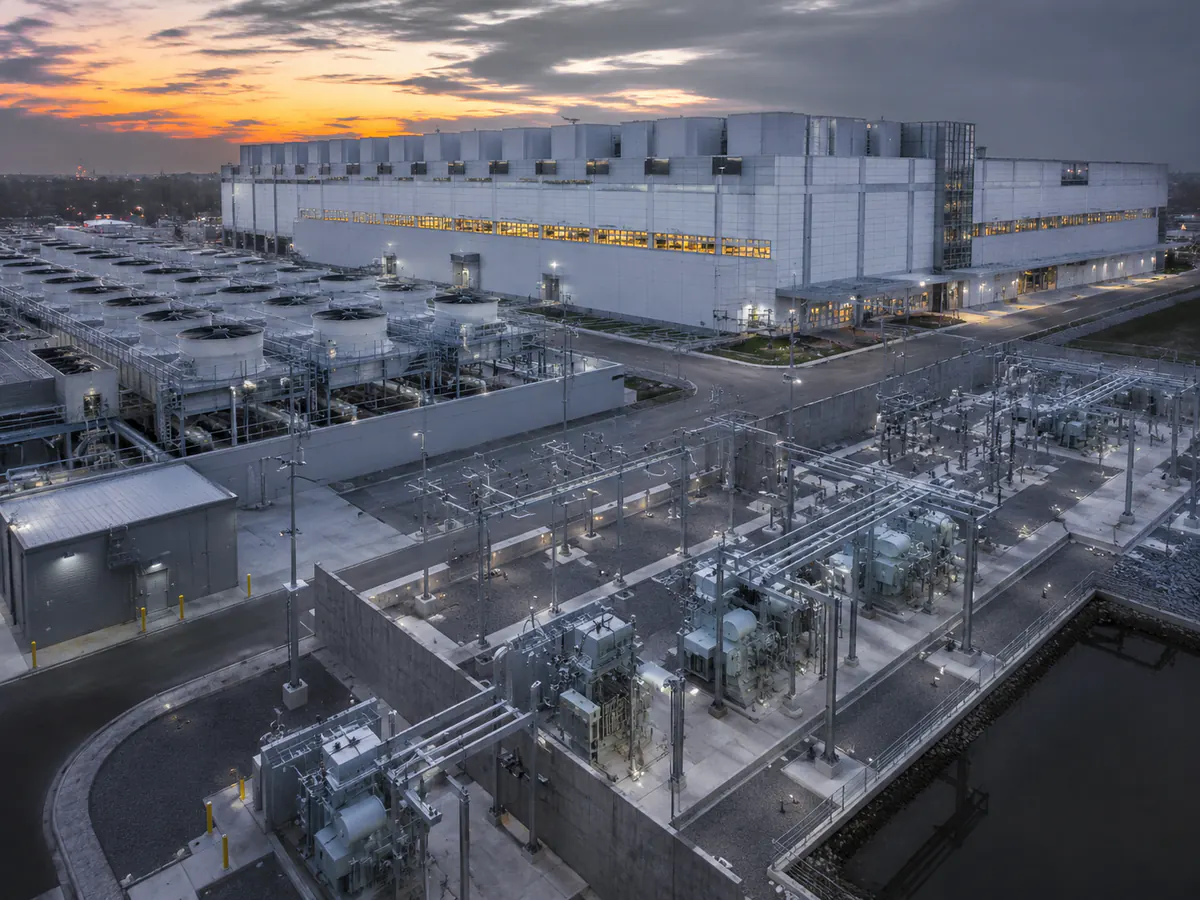
A 100 MW AI data center can plausibly be described as a roughly $1.1 billion construction project or as an infrastructure program costing well above $3.5 billion. Those statements do not necessarily contradict each other.
The difference is scope.
JLL's 2026 U.S. construction benchmarks put a conventional single-tenant, 50 MW air-cooled shell-and-core data center at roughly $10 million to $14 million per MW depending on market. JLL then applies about a 10% premium for liquid-cooled construction. Separately, it says the technology fit-out paid by tenants can cost as much as $25 million per MW for AI infrastructure.
That last number changes the conversation completely. A construction benchmark tells us what it costs to create the powered, cooled building. It does not tell us what it costs to fill that building with accelerators, high-speed networking and the rest of the active technology stack.
Building, electrical and mechanical infrastructure under the benchmark methodology.
$10M–$14M/MW JLL U.S. 2026 market range for its conventional baselineAdditional project cost associated with denser liquid-cooled infrastructure.
about +7% to +10% Turner & Townsend / JLL current benchmark contextAccelerators, servers, networking and other tenant technology.
up to $25M/MW JLL's stated upper-end AI fit-out contextThe three layers above are not a universal price list. JLL's $25M/MW figure is explicitly “as much as,” not an average. Land is excluded from JLL's construction benchmark, and individual project scopes can treat utility and owner costs differently.
Start with the building before adding the AI
JLL's 2026 Global Data Center Outlook is unusually helpful because it states its baseline clearly: a single-tenant, 50 MW, air-cooled facility, with land acquisition and active IT equipment excluded. The U.S. shell-and-core ranges are $10M–$11M/MW in Phoenix, Dallas and Atlanta, $11M–$12M/MW in Northern Virginia and $12M–$14M/MW in Chicago. Those assumptions matter as much as the numbers themselves.
For a first-pass AI estimate, the temptation is to find the nearest market number and call it done. That understates the project if the design is liquid cooled or unusually dense. JLL tells readers to add around 10% for liquid-cooled facilities. Turner & Townsend independently finds a 7%–10% average construction premium in its analysis of similarly sized U.S. liquid-cooled data centers.
CBRE provides another useful cross-check. Its 2026 midyear U.S. outlook says high-density requirements are pushing average construction costs to roughly $14M–$16M per MW for the most demanding builds. I would keep that figure separate rather than average it into JLL's range, because the publications are not necessarily measuring identical project definitions.
Current sources agree that high-density AI facilities cost more, but they do not yet offer one mature, standardized global benchmark for the same scope. Turner & Townsend explicitly says comprehensive AI cost variables are still developing. Combining unlike figures into a precise average would look authoritative and be less accurate.
A 100 MW worked example shows how fast scope compounds
Take a hypothetical 100 MW AI facility in Dallas. JLL's conventional Dallas benchmark is $10M–$11M per MW, so the base shell-and-core construction range is roughly $1.0B–$1.1B.
Apply JLL's 10% liquid-cooling adjustment and the construction range becomes about $1.10B–$1.21B.
Now add the technology layer. If the project were at JLL's stated upper-end AI fit-out figure of $25M/MW, active technology could add as much as another $2.5B. The resulting illustrative subtotal is roughly $3.60B–$3.71B before land and other costs that may sit outside these assumptions.
There is a reason I keep calling that a subtotal rather than “the cost of a 100 MW AI data center.” JLL excludes land from the shell-and-core benchmark. Site-specific utility infrastructure, financing, development costs and the exact boundary between landlord and tenant scope can change the total again.
More importantly, $25M/MW is an upper-end technology-fit-out reference, not something every AI project should insert into a spreadsheet. Different accelerator generations, networking architectures, utilization targets and procurement economics can move the technology budget dramatically.
In an AI project, the computers can cost more than the building around them
This is probably the most important distinction in the entire cost-per-MW discussion.
At a $11M/MW construction benchmark, a 50 MW building represents about $550 million of shell-and-core construction. At JLL's stated upper-end AI technology figure, 50 MW of technology fit-out could reach $1.25 billion. The tenant equipment can therefore be more than twice the cost of the building benchmark in a highly capital-intensive AI deployment.
That helps explain why hyperscaler capital expenditure has become so large. McKinsey estimates that Amazon, Google, Meta and Microsoft together are committing more than $700 billion of capital expenditure in 2026, with a substantial majority directed toward AI infrastructure. That spending spans data center construction, accelerators and networking rather than buildings alone.
It also explains why “AI data center cost” is a dangerous phrase without qualification. An engineer discussing facility construction and an investor discussing the deployed AI compute stack may both use $/MW while talking about budgets that differ by billions of dollars.
The AI construction premium is real, but it is not just “more cooling”
Turner & Townsend's current U.S. data puts the liquid-cooled construction premium at roughly 7%–10%. The cost allocation shifts substantially: mechanical systems rise from around 22% of its air-cooled benchmark to 33% in the liquid-cooled model, while the electrical and shell shares fall proportionally.
Yet Turner & Townsend also warns against assuming every AI facility is simply a conventional cloud data center plus 10%. Some AI training facilities can accept different redundancy strategies from traditional cloud environments. Higher rack density can reduce the building footprint needed for the same IT load. Mega-campuses can gain economies of scale. Their analysis describes both the premium and the potential offsets.
This is a much more useful way to think about an “AI premium.” Several costs rise. Other design requirements can fall. What matters is the complete facility delivering the required compute workload.
Rack density changes what 100 MW physically looks like
One hundred megawatts of IT load does not imply a fixed number of racks. At 20 kW per rack, it represents about 5,000 fully loaded racks. At 50 kW, about 2,000. At 120 kW, roughly 833.
NVIDIA's current DGX GB rack-scale documentation gives the 120 kW example a real hardware anchor: a GB200/GB300 NVL72 rack is approximately 120 kW at full load. The rack integrates compute trays, NVLink switches, power shelves and liquid-cooling manifolds as one rack-scale system.
The arithmetic is intentionally simplistic — actual deployments need support racks, networking, redundancy and design headroom — but it shows why high density can reduce white-space requirements so dramatically.
That reduction is one reason an AI data center can have a more expensive cooling system and still avoid some building cost. The design may spend more per rack while using far fewer racks for the same IT MW.
High density also moves cost upstream into power distribution
A 120 kW rack is not simply a 12 kW rack with ten times as many servers. The electrical path has to be able to deliver that load safely and reliably to a very small footprint.
NVIDIA's DGX GB documentation shows how rack-scale systems now integrate their own high-capacity power shelves and bus bars. At facility level, higher density affects distribution equipment, cable or busway sizing, breaker architecture and how much capacity must be reserved in each hall.
This is one reason CBRE's $14M–$16M/MW figure for the most demanding high-density builds is useful. AI construction premiums are not confined to the cooling plant; the power path itself becomes more technically demanding.
And then there is the power you cannot buy yet
Cost per MW assumes the megawatts can actually be delivered. In the current market, that assumption deserves its own line in the investment case.
JLL's 2026 outlook says speed to power is now the primary site-selection criterion. CBRE similarly says securing large electrical deliveries has overtaken many traditional real-estate considerations for major developments. The practical result is that the cheapest construction market can still be the wrong market if energization arrives years later.
It is difficult to put a universal $/MW figure on delay because the cost depends on the workload, financing structure and value of the compute capacity. But for an AI project with billions of dollars of accelerators waiting for a powered building, schedule has an economic value that belongs beside construction cost.
AI Campus Budget Sandbox
This model is deliberately transparent. It separates building construction from the liquid-cooling adjustment and active technology rather than hiding everything inside one all-in $/MW number. Change the assumptions and watch which layer is actually moving the budget.
Early-stage scope comparison — not a vendor quote or investment forecast.
What the calculator is useful for — and what it is not
It is useful for exposing scope. Set technology fit-out to zero and you have a facility-construction model. Set the liquid premium to zero and you can compare conventional construction against the high-density adjustment. Change the base $/MW number to the relevant market benchmark and the building layer moves independently from the technology layer.
It is not a substitute for a quantity-surveyor estimate, utility study or hardware bill of materials. The model does not know the project's land basis, tax incentives, redundancy, phasing, electrical topology, financing, network architecture or procurement discounts. That is intentional. A simple model is valuable only when it makes its omissions obvious.
Multistory AI facilities can add another large construction adjustment
JLL's benchmark also says to add approximately 20% to construction costs for multistory facilities in the Americas. That is a construction adjustment, not a technology-fit-out adjustment.
Apply 20% to a $1.21B liquid-cooled construction case and the building cost alone can move by another roughly $242 million. The reason is structural rather than “AI”: heavy equipment, vertical logistics and the physical complexity of carrying dense electrical and mechanical infrastructure through multiple floors make vertical data centers more expensive.
A dense urban site may still justify that premium if land, network or customer proximity make the location valuable enough. It is another example of why a single national AI $/MW number has limited meaning without the project form.
AI training and AI inference do not necessarily deserve the same facility
AI is not one workload. Large training clusters can tolerate design choices that would be inappropriate for latency-sensitive inference or conventional cloud services. Turner & Townsend notes that some AI facilities may be able to reduce redundancy compared with traditional cloud environments, depending on the workload's reliability requirements.
That creates a subtle cost effect. A liquid-cooled AI training campus can spend more on cooling and high-density electrical infrastructure while spending less on some layers of redundant power architecture. Another AI facility serving real-time inference may make the opposite choice.
This is why the phrase “AI-ready” is too vague for budgeting. A useful brief describes rack density, cooling interface, uptime expectations, network topology and the expected hardware roadmap.
Do not confuse MW of IT with MW at the utility meter
JLL and Turner & Townsend base their construction comparisons around IT capacity. The grid sees the total facility load, which is higher because cooling and electrical infrastructure consume power too.
A 100 MW IT facility operating at PUE 1.20 would average about 120 MW at the facility level under a simplified steady-load assumption. At PUE 1.30, it would be about 130 MW.
At $0.08/kWh, the 120 MW case represents about $84.1 million of annual electricity if that load were continuous. The 130 MW case is about $91.1 million. This is why capital cost per MW should eventually be paired with an operating model rather than treated as the whole economic picture.
The detailed mechanics are covered separately in our data center electricity-cost guide and PUE cost analysis.
There are three numbers I would keep separate in every AI budget
The first is facility construction $/MW. This is where market, shell, electrical, mechanical, cooling, redundancy and building form live.
The second is active technology $/MW. Accelerators, CPUs, memory, storage, network fabrics and rack-scale systems belong here. This layer can dwarf the building.
The third is delivered and operating $/MW: what it takes to have usable compute online at the required date, including the costs that sit outside a neat shell-and-core or hardware benchmark.
Keeping those numbers separate makes a project easier to compare over time. GPU prices can change without pretending the concrete and switchgear changed. Construction inflation can move without rewriting the hardware assumption. A utility delay can be discussed as a schedule and development problem rather than buried inside a fictitious all-in $/MW average.
So what should you use for a 2026 AI data center?
For early U.S. facility planning, the most defensible public starting point is still the conventional market-specific construction benchmark, adjusted for the actual high-density design. JLL's current U.S. range is roughly $10M–$14M/MW for its air-cooled shell-and-core baseline, while liquid cooling adds about 10% in JLL's model and Turner & Townsend finds a 7%–10% premium in comparable U.S. projects. CBRE says the most demanding high-density builds are already averaging around $14M–$16M/MW.
Then model active AI technology separately. JLL says that layer can reach $25M/MW, which is large enough that it should never be hidden inside the construction number.
The biggest mistake in AI data center costing is not being a few million dollars per MW off. It is comparing two numbers that measure different things. Once the building, high-density premium and technology stack are separated, the extraordinary scale of AI infrastructure becomes easier to understand — and much harder to misrepresent with one headline figure.