
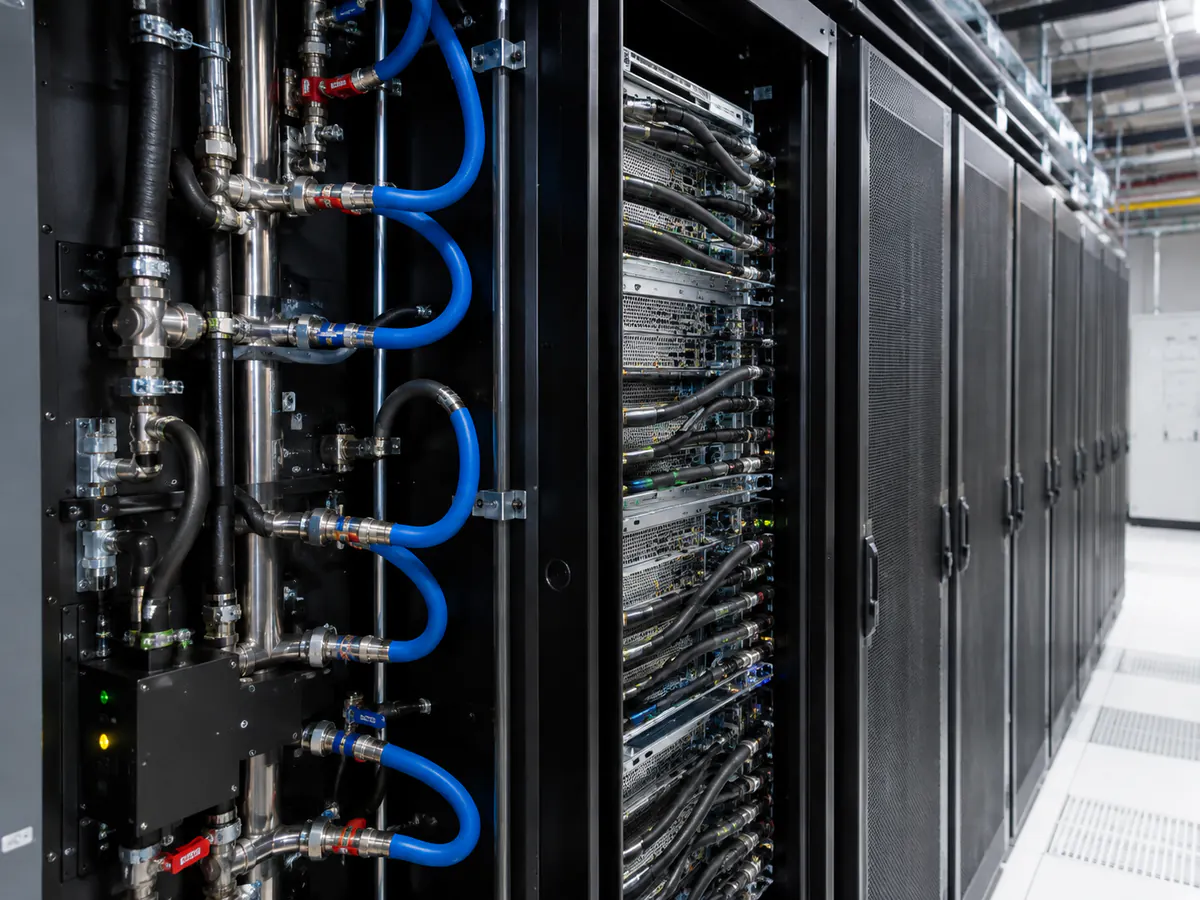
There is a number I would be very cautious about publishing in this article: “liquid cooling costs $X per rack.”
It sounds like exactly the number a buyer wants. It is also increasingly the wrong unit. A 50 kW rack, a 120 kW NVIDIA GB200 NVL72 rack and a future 200+ kW AI rack can all use direct liquid cooling, but they do not create the same facility problem. The coolant distribution unit may serve one rack, a row, or several megawatts of IT. Facility piping may already exist or may require a live retrofit. Heat rejection may be reusable or may need to be rebuilt.
So the useful cost question in 2026 is not “what does liquid cooling cost per rack?” It is what additional infrastructure is required to support this rack density at the scale we intend to deploy?
That distinction matters because the market has moved quickly. NVIDIA's published GB200 NVL72 architecture is roughly 120 kW per rack, with about 85% of the heat handled by liquid and 15% by air. Uptime Institute says hardware roadmaps are already pushing beyond 200 kW per rack. Schneider Electric's Motivair CDU portfolio now spans roughly 105 kW to 2.5 MW per unit, and Uptime reports a broader industry shift toward CDUs in the hundreds of kilowatts or megawatt range rather than one small cooling unit per cabinet.
A high-density rack is really a heat-removal commitment
Electrical power consumed by servers ends up almost entirely as heat. A 120 kW rack is therefore asking the data center to remove roughly 120 kW of heat while the workload is at that level. At 20 racks, that is 2.4 MW. At 250 racks, it is 30 MW.
The cabinet footprint barely changes. The thermal problem changes enormously.
Already above the density many legacy rooms were designed around.
Roughly the rack power published for NVIDIA GB200 NVL72.
The direction current AI hardware roadmaps are pushing toward.
NVIDIA's GB200 NVL platform documentation is a useful real-world anchor because it publishes both the approximate rack power and cooling split. The rack is listed at about 120 kW and roughly 85% liquid / 15% air.
That means the liquid system may remove around 102 kW from a fully loaded 120 kW rack, while roughly 18 kW remains for the air-side system. Eighteen kilowatts of residual air cooling would itself have been considered a dense rack not long ago.
Heat capture percentage becomes a cost variable at 100+ kW
At modest density, leaving a little heat to the room is manageable. At very high density, a small percentage becomes a large absolute cooling load.
CoolIT Systems illustrated the issue at NVIDIA GTC 2026 using a 500 kW rack: at 90% liquid heat capture, 50 kW of heat is still left for air cooling. Even at 95%, 25 kW remains. The presentation argues that future 500 kW and 1 MW racks will make very high liquid heat capture increasingly important because carrying a second air system for the residual load becomes expensive and difficult.
Illustrative residual load using the heat-capture example discussed by CoolIT at NVIDIA GTC 2026.
This is one reason “liquid cooled” is an incomplete specification. A system that captures 70% of rack heat in liquid and one that captures 98% can leave very different air-side infrastructure requirements even if both use cold plates.
What you are actually paying for
At rack level, the visible parts are straightforward: cold plates or another liquid interface, internal tubing, manifolds and connections. The expensive part is making that rack part of a reliable building-scale thermal system.
The coolant distribution unit, or CDU, separates and controls the technology cooling loop and the facility-side cooling system. Then there is distribution piping, pumps, controls, filtration or coolant management, leak detection, heat exchangers, redundancy and the heat-rejection equipment outside the white space.
In a retrofit, there may also be structural work, new pipe routes, changes to plant capacity and staged installation around live IT. This is why Uptime Institute estimates the cost premium for adding DLC support to an existing facility will generally be higher than for a new build.
Schneider Electric's 2026 CDU portfolio is a useful sign of where the architecture is going. Motivair now markets individual units from about 105 kW up to 2.5 MW, with centralized systems scalable beyond 10 MW. The 2.5 MW MCDU-70 announced in January 2026 can theoretically serve the thermal load of more than twenty 120 kW racks before redundancy, design margin and actual operating conditions are considered.
That is why dividing one CDU price by one rack is becoming increasingly meaningless. The infrastructure is being designed as a shared pod- or row-level system.
There is finally enough project data to put a construction range around the problem
The strongest public cost benchmark I would use today comes from Turner & Townsend. Its 2025–2026 Data Centre Construction Cost Index draws on more than 300 live or recent projects across more than 20 countries. For similarly sized U.S. facilities, its latest liquid-cooled project data shows an average 7%–10% construction premium over air-cooled facilities with equivalent IT capacity.
The methodology matters. Turner & Townsend's baseline is a typical 30–50 MW air-cooled build-to-suit hyperscale facility and includes shell/core, architectural fit-out, mechanical and electrical fit-out, contractor costs and M&E equipment. It explicitly warns that other facility types can move the $/W benchmark materially.
Its cost mix also shows what liquid cooling does to the project: mechanical systems rise from roughly 22% of construction cost in the air-cooled model to 33% in the liquid-cooled model. Electrical falls proportionally from 54% to 48%, and shell/architectural from 14% to 9%. The liquid-cooled project still costs more overall.
I would use that 7%–10% as a screening range for the whole project premium, not as a price list for liquid-cooling equipment.
A 30 MW example — and why I would not call the result “cost per rack”
Take 250 racks at 120 kW each. That produces 30 MW of nominal IT load, which conveniently sits at the bottom of Turner & Townsend's 30–50 MW baseline range.
If a comparable air-cooled construction benchmark were $11 million per MW, the underlying project would be about $330 million. A 7%–10% liquid-cooling premium would add roughly $23.1 million–$33 million, taking the illustrative construction envelope to around $353.1 million–$363 million.
You could divide the premium by 250 racks and get roughly $92,000–$132,000 per rack. I would not publish that as “the cost of liquid cooling per rack.”
Why? Because the calculation allocates a whole-building construction premium across the rack count. It can include changes to mechanical plant, piping, controls, commissioning and other facility work. Change the number of racks, density, redundancy architecture or reusable plant and the allocated number changes even if the hardware at the rack barely does.
This is what happens when a 7%–10% whole-project premium is divided across 250 × 120 kW racks in an illustrative $11M/MW project.
Use this instead: a high-density cooling planning calculator
The calculator below is intentionally a planning tool, not an equipment quote. It does four things that are useful early in a project: converts rack count and density into MW, shows how much heat the liquid loop must capture, shows the residual air-side load, and applies an optional whole-project liquid-cooling premium to a base construction benchmark.
Screening model for a rack pod or larger deployment.
Turner & Townsend's 7%–10% benchmark is based on similarly sized U.S. liquid-cooled projects around a 30–50 MW hyperscale baseline. Treat results outside that context as sensitivity analysis, not a market quote.
The calculator exposes something important about heat capture
The default 250-rack example produces 30 MW of IT load. At 85% liquid heat capture, 25.5 MW goes to the liquid loop and 4.5 MW still has to be handled by air.
Four and a half megawatts is not a rounding error. It is an entire conventional data hall's worth of thermal load in some facilities.
Push liquid capture to 98% and the residual falls to 0.6 MW. That can materially change how much room-level air infrastructure has to remain. As rack density rises, this is one of the design choices that can alter both CAPEX and operating complexity.
Cold plate does not mean 100% liquid cooled
Current direct-to-chip systems usually target the components with the highest heat flux — CPUs, GPUs and sometimes other major devices. Memory, storage, network components, power electronics and other hardware may still reject heat to air.
NVIDIA's GB200 example, at roughly 85% liquid and 15% air, is a good illustration of a hybrid rack rather than a theoretical fully liquid-cooled one. By contrast, NVIDIA says its Rubin generation is designed for 100% liquid cooling, including networking components, and can use coolant up to 45°C (113°F). NVIDIA argues that warmer coolant improves the opportunity to reject heat without energy-intensive chilling.
This progression matters for facility cost. The closer the technology gets to capturing all rack heat in liquid, the more the room-level air system can potentially shrink. But the liquid infrastructure also becomes more mission-critical, because there is less air-side capacity available as a fallback.
CDU sizing is not “rack kW equals CDU kW”
A 120 kW rack at 85% liquid capture asks the liquid loop to remove about 102 kW, not the full 120 kW. Ten identical racks ask for about 1.02 MW. Twenty ask for about 2.04 MW.
In theory, Schneider's 2.5 MW CDU could cover that thermal load. In practice, designers account for redundancy, operating margin, flow conditions, supply temperatures, maintenance and the consequences of a CDU failure. The number of CDUs is therefore an engineering and resiliency decision, not just a division exercise.
Uptime's June 2026 maintenance research is useful here because it describes a real market trend: operators are increasingly favoring larger CDUs — hundreds of kilowatts or megawatt scale — often in redundant arrangements serving rows of racks, with facility teams taking responsibility for them. That is a different operating model from treating every rack as a self-contained cooling appliance.
The cost curve is not linear from 50 kW to 200 kW
Doubling rack power does not necessarily double cooling cost. Some shared infrastructure scales efficiently: larger CDUs, common piping and central heat rejection can spread fixed costs across more IT capacity.
Other costs can jump when a threshold is crossed. A room designed for 50 kW racks may need a different power distribution architecture at 120 kW. A retrofit may run out of pipe capacity. Higher coolant flow can change pumping requirements. A residual air load that was manageable at one density can become impractical at another.
This is why the economic curve tends to have steps rather than a smooth $/kW line. The expensive moment is often when the next increment of rack density forces a facility-level redesign.
Retrofit cost is mostly a question of what the building already gives you
An existing facility with chilled-water infrastructure near the white space, spare plant capacity and accessible pipe routes starts from a very different position than a direct-expansion air-cooled site with no facility water loop.
Schneider Electric's 2026 reference design for a 3.818 MW Tier III facility explicitly models both situations. One liquid-cooled retrofit scenario uses liquid-to-air CDUs where facility water is unavailable; another uses liquid-to-liquid CDUs where a facility water system exists. The distinction is useful because it shows that “retrofit liquid cooling” is not one architecture.
Liquid-to-air can avoid a major facility-water retrofit, but it leaves the ultimate heat rejection with the existing air system. Liquid-to-liquid can make better use of a suitable water loop, but only if that loop has the capacity and temperatures the new IT requires.
I would therefore treat any generic retrofit price per rack with skepticism until the existing heat-rejection system is known. The rack hardware is often the easy part.
Resilience can add more cost than the cooling hardware suggests
High-density liquid-cooled racks have less thermal inertia than a low-density room. If coolant circulation stops, the temperature at the chip can rise quickly. Uptime has repeatedly highlighted shorter ride-through times as density rises.
That can justify redundant pumps or CDUs, backup power for the cooling loop, thermal storage or other measures depending on the workload's availability requirement. A training cluster that can checkpoint and restart may make a different economic choice from a mission-critical inference platform with strict service commitments.
This is one reason two liquid-cooled deployments at the same rack density can have materially different costs. The thermal load is the same; the required failure behavior is not.
Maintenance is becoming more standardized, but it is not fully standardized yet
Uptime's 2026 maintenance research describes an industry that is starting to converge around water-based cooling loops, including PG25 mixtures, larger CDUs and clearer responsibility between facilities and IT teams. But coolant chemistry, connector standards, maintenance procedures and ownership boundaries still vary.
That matters financially because every design choice creates a support model. Who samples and treats coolant? Who owns leaks inside the server? Which team maintains the CDU? Which spare parts have to be kept on site? Can one vendor's rack connect to another vendor's facility loop without an intermediate system?
These questions rarely appear in the initial “cooling cost” headline, but they influence the operating cost for years after construction is finished.
There is a point where the building can get simpler again
Today's liquid-cooled data centers often cost more partly because they still have to support both air and liquid. That does not mean the same premium will exist forever.
Uptime's view is that direct liquid cooling could eventually reduce infrastructure cost once IT hardware and facility interfaces standardize enough for buildings to be designed around it rather than adapted to it. If nearly all rack heat leaves through liquid, room-level airflow, fan capacity and some conventional cooling equipment can shrink substantially.
NVIDIA's move toward fully liquid-cooled Rubin systems is interesting for exactly this reason. A 100% liquid design changes the facility conversation from “add liquid cooling to an air-cooled room” toward “how much air cooling does this room need at all?”
We are not fully in that world yet. In 2026, the transition itself is part of the cost.
What I would ask before accepting a liquid-cooling quote
Not “how much is the CDU?” first. I would start with the deployment: how many racks, what sustained kW per rack, and what percentage of heat actually goes to liquid under the expected workload.
Then I would ask where the CDU sits and what it serves. One rack? A row? A pod? Is N+1 capacity included? Is the quoted cooling capacity nominal or usable after redundancy and design margin?
After that comes the building. Is there already a suitable facility-water loop? What supply temperature can it deliver? Does existing heat rejection have spare capacity? What remains on air? Does the electrical infrastructure support the same density that the cooling system supports?
Finally, I would ask who owns the operational boundary between facility and IT equipment. A technically elegant system can become an expensive operating model if every maintenance event falls into a contractual gap between vendors.
The sensible 2026 cost range is project-level, not rack-level
For a new U.S. high-density facility in the 30–50 MW class, the strongest current public evidence supports using roughly 7%–10% above an equivalent air-cooled construction benchmark as an early screening assumption. Uptime's separate work suggests roughly 5%–10% additional CAPEX for DLC support in new builds depending on requirements, with retrofit premiums likely higher.
Those two ranges come from different methodologies, but they tell a broadly consistent story: liquid cooling is currently a material project premium, not a trivial rack accessory.
The mistake would be turning either benchmark into an equipment quote. At 50 kW, 120 kW or 200+ kW per rack, the real cost is determined by how the racks share cooling infrastructure, how much air cooling remains, whether the building is new or existing and what level of resilience the workload demands.
If a liquid-cooling proposal can be summarized only as “$X per rack,” it is probably not detailed enough to compare yet. The number worth pricing is the complete thermal path from silicon to outdoor heat rejection, at the actual deployment scale. That is where the cost lives — and where most of the expensive surprises can be found before construction rather than after it.