
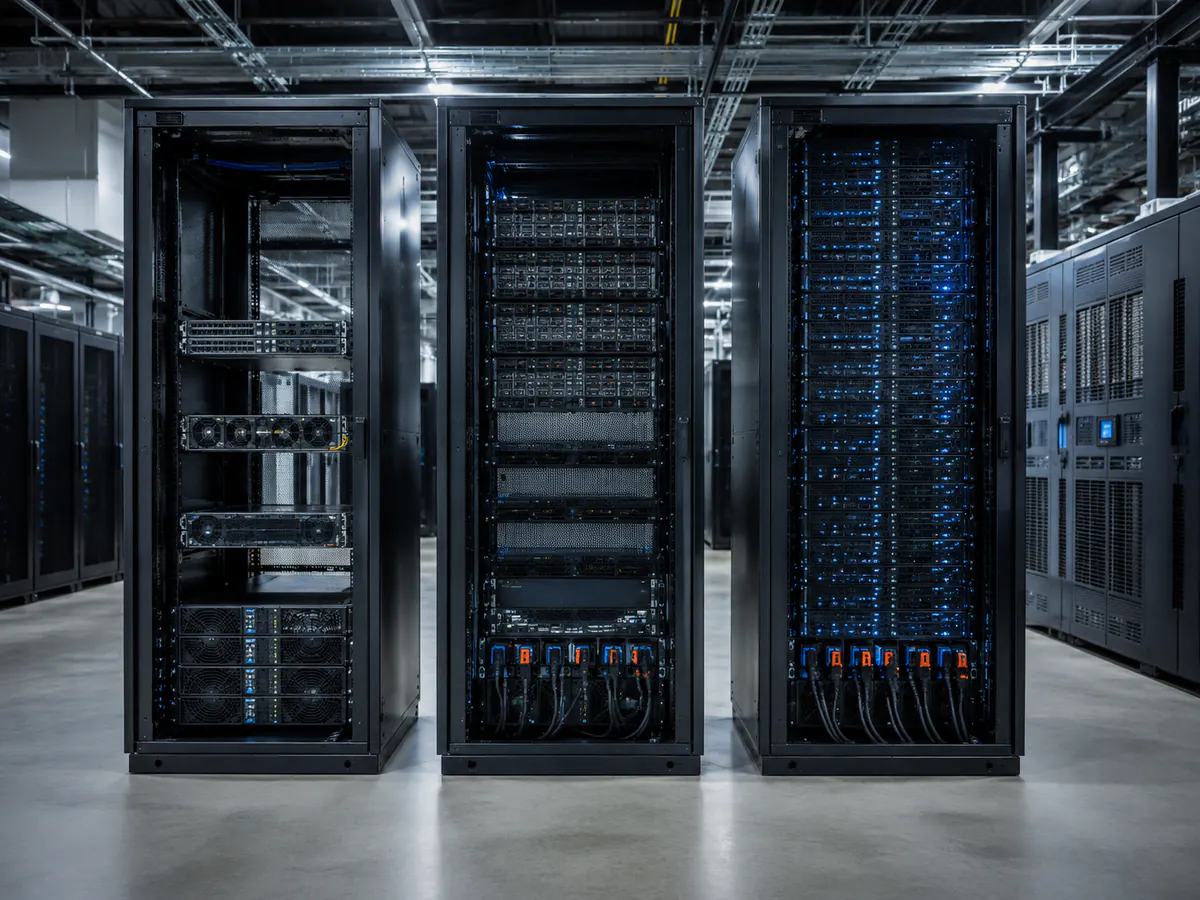
One megawatt of IT can occupy 50 racks at 20 kW, 20 racks at 50 kW or just 10 racks at 100 kW. The servers still add up to the same 1 MW. Almost everything around them changes.
That is the useful way to compare rack density. Higher density does not magically reduce the amount of IT power a workload needs. It compresses that power into fewer cabinets and a smaller piece of floor, which can save space and distribution hardware while making each individual rack much harder to power and cool.
The trade-off becomes particularly important around the three densities in this article. At 20 kW, air cooling is still a familiar and economically viable design point. At 50 kW, the answer is workload- and facility-specific: modern reference designs show that air cooling can still work, while other systems move to liquid. Around 100 kW and above, direct liquid cooling becomes increasingly difficult to avoid for rack-scale AI hardware.
This is a rack-count illustration, not a floor-plan estimate. Real white-space requirements include aisles, support equipment, distribution, access and redundancy.
At 20 kW, density is high — but not exotic anymore
Twenty kilowatts per rack still deserves the label “high density” in many enterprise environments, but it no longer sits at the edge of what mainstream air-cooled infrastructure can support.
Uptime Institute's July 2026 analysis says typical rack densities are only now shifting toward about 10 kW, with more than a quarter of operators reporting densities above that threshold. It also says the economic gains from densification begin to thin out at around 20–25 kW per rack. That is an important dividing line: 20 kW is high enough to gain much of the space benefit of densification without necessarily requiring the infrastructure associated with extreme AI racks.
Vertiv's current AI reference designs reinforce that point from the equipment side. Its published 20 kW H100 design uses air cooling. Vertiv also publishes 30 kW and 40 kW air-cooled designs for H100, H200 and B200 configurations. The current portfolio shows that air cooling remains a serious design option well above traditional enterprise density.
At 20 kW, one MW of IT requires 50 racks. That is enough cabinets that rack count, floor area and cabling still matter materially, but each cabinet is relatively forgiving compared with the 100 kW case. Losing one rack removes 2% of the hypothetical 1 MW pod rather than 10%.
The most interesting case is 50 kW
Fifty kilowatts per rack sits in an awkward and useful middle ground. It is high enough that many older data centers cannot support it everywhere. It is also low enough that saying “50 kW requires liquid cooling” is demonstrably too broad.
Vertiv's 2026 reference-design library includes a 58 kW B200 design and a 60 kW B300 design using air cooling. That does not mean every 60 kW rack can or should be air cooled. It proves that rack density by itself does not determine the cooling technology.
The chassis, fan design, allowable inlet temperatures, airflow volume, containment strategy, climate and room infrastructure all affect whether air remains practical. So does the commercial value of density. A design team with abundant white space may choose more racks at lower density instead of paying to push an existing room toward its thermal limit.
Uptime's broader view is that the industry consensus for when direct liquid cooling becomes economically attractive sits roughly in the 20–30 kW/rack range, while explicitly treating that as an economic tendency rather than a hard thermal boundary. Some systems can stay on air well above it; some dense hardware requires liquid for product-level reasons.
This is where rules of thumb become dangerous. “Liquid above 30 kW” is useful as a planning prompt. It is not a design standard.
At 100 kW, the rack stops behaving like an ordinary cabinet
Compress one MW into ten 100 kW racks and each cabinet now represents a tenth of the entire pod. The electrical and thermal infrastructure has to concentrate correspondingly.
Modern rack-scale AI systems give us a real reference point. NVIDIA documents approximately 120 kW rack power for DGX GB200, while current Vertiv infrastructure designs use about 130 kW rack density for GB200 and 142 kW for GB300. Those Vertiv designs use liquid + air cooling. That is where the market is already operating, not a theoretical future case.
Uptime Institute says rack densities above 50 kW are becoming increasingly common in AI deployments and expects major AI hardware roadmaps to move beyond 200 kW per rack. By 2026, its planning question has shifted from whether liquid cooling will be needed to how much liquid-cooled capacity organizations should prepare for.
One hundred kilowatts is therefore no longer an extreme laboratory number. But it is still far from a normal fleet-wide rack density.
Densification saves racks much faster than it saves infrastructure cost
Going from 20 kW to 50 kW cuts the rack count required for 1 MW from 50 to 20 — a 60% reduction. Going from 50 kW to 100 kW halves it again to 10.
The natural conclusion would be that cost keeps falling as aggressively as rack count. Uptime's research says otherwise.
The largest capital benefits of densification occur at lower densities because the project needs fewer cabinets, less white space, shorter conductor runs and fewer distribution components. From roughly 20–25 kW per rack onward, those gains start diminishing. High-density power distribution and thermal-management equipment begin adding their own premiums.
This creates a slightly counterintuitive result: moving from 5 kW to 20 kW can transform the economics of the floor plan, while moving from 50 kW to 100 kW may produce a much smaller infrastructure saving even though rack count is halved.
The power path becomes much more concentrated
One MW at 20 kW per rack spreads the load across 50 branch positions. One MW at 100 kW spreads it across ten. The total is unchanged, but each electrical path carries five times as much power.
That affects busway or PDU sizing, breakers, conductors, rack power shelves and the consequences of a local failure. A distribution segment that comfortably served ten 20 kW racks may not have the physical or electrical capacity to serve ten 100 kW racks even though the floor footprint looks identical.
It also means spare capacity has to exist in the right place. A data center can have several unused megawatts at campus level and still be unable to install one more 100 kW rack in a particular row because the local electrical path is full.
Cooling has the same localization problem
One MW of IT ultimately becomes roughly one MW of heat regardless of whether it is spread across 50 racks or ten. The difference is where that heat appears.
At 20 kW/rack, the heat is distributed across a larger room area. At 100 kW/rack, each cabinet has to reject five times as much heat. Airflow that was adequate at the lower density may become physically awkward or energy-intensive at the higher one.
Direct liquid cooling changes the geometry because it removes a large share of heat at the chip or server and transports it through fluid rather than pushing all of it through the room air. That is why extreme rack density and liquid cooling have become so closely linked.
But “liquid cooled” does not mean air disappears. Current GB200/GB300 infrastructure designs commonly remain liquid + air because some components and residual heat still rely on the air side. Our liquid cooling cost analysis goes deeper into why heat-capture percentage matters economically.
The same 10 MW hall can look radically different
Scale the one-MW example by ten. A fully loaded 10 MW IT hall would require about 500 racks at 20 kW, 200 racks at 50 kW or 100 racks at 100 kW.
That change is large enough to affect more than white space. Fewer racks can mean fewer top-of-rack switches, fewer rack PDUs, fewer physical cabinets and potentially shorter cable paths. But the remaining racks may demand much larger power feeds, liquid distribution, stronger floors and more specialized maintenance.
A design team should therefore compare the complete 10 MW hall, not just rack count. Otherwise, densification savings are counted while high-density infrastructure premiums are ignored.
Density can save expensive white space — or create white space you cannot use
Colocation makes this trade-off particularly visible. A tenant paying for cabinets or cages has an obvious reason to compress compute into fewer racks. But the provider has to be able to deliver the power density to those exact positions.
If a provider can offer 500 kW only by spreading it across 25 racks at 20 kW, a customer designed around five 100 kW racks cannot simply declare the deployments equivalent. The customer's hardware, networking and cooling topology may require the density itself.
Conversely, a customer that does not need dense rack-scale systems can sometimes lower cost and operational risk by accepting more cabinets. The value of high-density capacity depends on whether the workload actually benefits from compression.
AI training has a stronger reason to densify than ordinary enterprise IT
Large training systems need enormous amounts of accelerator-to-accelerator communication. NVIDIA's rack-scale Blackwell architecture uses copper NVLink connections inside the rack to create a 72-GPU domain. That tight integration is one reason the system is physically dense.
Uptime's analysis of AI training density makes the trade-off explicit. Lower-density alternatives can reduce rack power and weight, but may require more racks to deliver comparable training performance because they give up some of the communication advantages of the tightly integrated rack-scale architecture. Uptime estimates that one lower-density approach can require roughly 50% more racks for comparable training performance.
This is an important reason not to evaluate density only as a facilities metric. For AI training, the workload itself can place an economic value on keeping GPUs physically and electrically close together.
At 100 kW, failure domains deserve more attention
In the one-MW example, losing one 20 kW rack removes 2% of the pod. Losing one 100 kW rack removes 10%. Real AI clusters are more complicated than that arithmetic because workload topology matters, but the concentration effect is real.
Cooling failures also accelerate at higher thermal densities. Uptime notes that cold-plate-cooled high-density IT may tolerate loss of coolant circulation for only seconds, compared with the much longer thermal ride-through available in traditional low-density rooms. That can justify UPS-backed pumps, thermal storage or additional cooling redundancy.
Higher density can therefore reduce the number of physical failure points while increasing the amount of compute affected by each one.
Floor loading can become a design constraint before floor area does
High-density AI racks are not just electrically heavier; they are physically heavier. Uptime has documented Blackwell rack systems around 1.4 metric tons per rack in its density analysis. That can matter in existing facilities, especially raised-floor environments or upper floors never intended for modern rack-scale systems.
Compressing 1 MW from 50 cabinets into ten does not necessarily reduce structural requirements in proportion to rack count. It concentrates weight into fewer points, alongside concentrated power and coolant distribution.
For a retrofit, floor loading is therefore one of the checks that can turn a theoretically available 100 kW rack position into an unusable one.
20, 50 and 100 kW are really three different operating models
At 20 kW, the design can still look recognizably like a conventional high-density data hall. Air cooling is viable, the rack count remains substantial and operators can often use familiar electrical and mechanical practices.
At 50 kW, the facility is in transition territory. Air can still be viable with the right hardware and room design — Vertiv's 58–60 kW air-cooled references prove that — but liquid cooling becomes economically and operationally credible. Existing sites may need local upgrades rather than a complete architectural change.
At 100 kW, density itself becomes one of the defining properties of the facility. Liquid cooling, concentrated electrical distribution, stronger local capacity planning and closer coordination between IT and facilities move from specialist topics into the core design.
Those descriptions are deliberately not thresholds. The actual system matters more than the round number.
What I would ask before choosing a target rack density
First: does the workload gain anything from being denser? If the answer is no, density is a facilities optimization rather than a compute requirement, and the project should prove that the saved floor space is worth the added infrastructure complexity.
Second: can the cooling technology support the target under normal and failure conditions? A marketing claim about maximum rack density is less useful than knowing the sustainable design load with the promised redundancy.
Third: can the electrical path deliver the load at every intended rack position? Site-wide MW is not enough.
Fourth: what does the next hardware generation do to the plan? A 50 kW design can be perfectly rational today and an expensive retrofit if the actual roadmap moves to 120–150 kW racks two years later.
Finally: what is the economic value of the space being saved? In a constrained colocation hall or urban site, density can be extremely valuable. On a large greenfield campus with inexpensive land, spreading the same load across more cabinets may be the more robust answer.
The highest rack density is not automatically the best one
The industry spent years assuming that ever-higher rack density would continuously improve data center economics. The current AI cycle has made that assumption easier to test because 100+ kW racks are no longer hypothetical.
What the latest evidence suggests is more nuanced. Densification is extremely valuable at lower levels. Its capital benefits begin to flatten around 20–25 kW/rack. Air cooling can stretch further than simple rules of thumb imply. And at the extreme end, high density can be worth the premium because the AI architecture itself needs it.
So the difference between 20, 50 and 100 kW is not simply “low, medium and high.” It is a shift in what the rack means to the building. At 20 kW, the rack is still mostly a unit of IT. At 50 kW, it starts becoming a facilities design decision. At 100 kW, the rack is effectively a small piece of power-and-cooling infrastructure in its own right.