
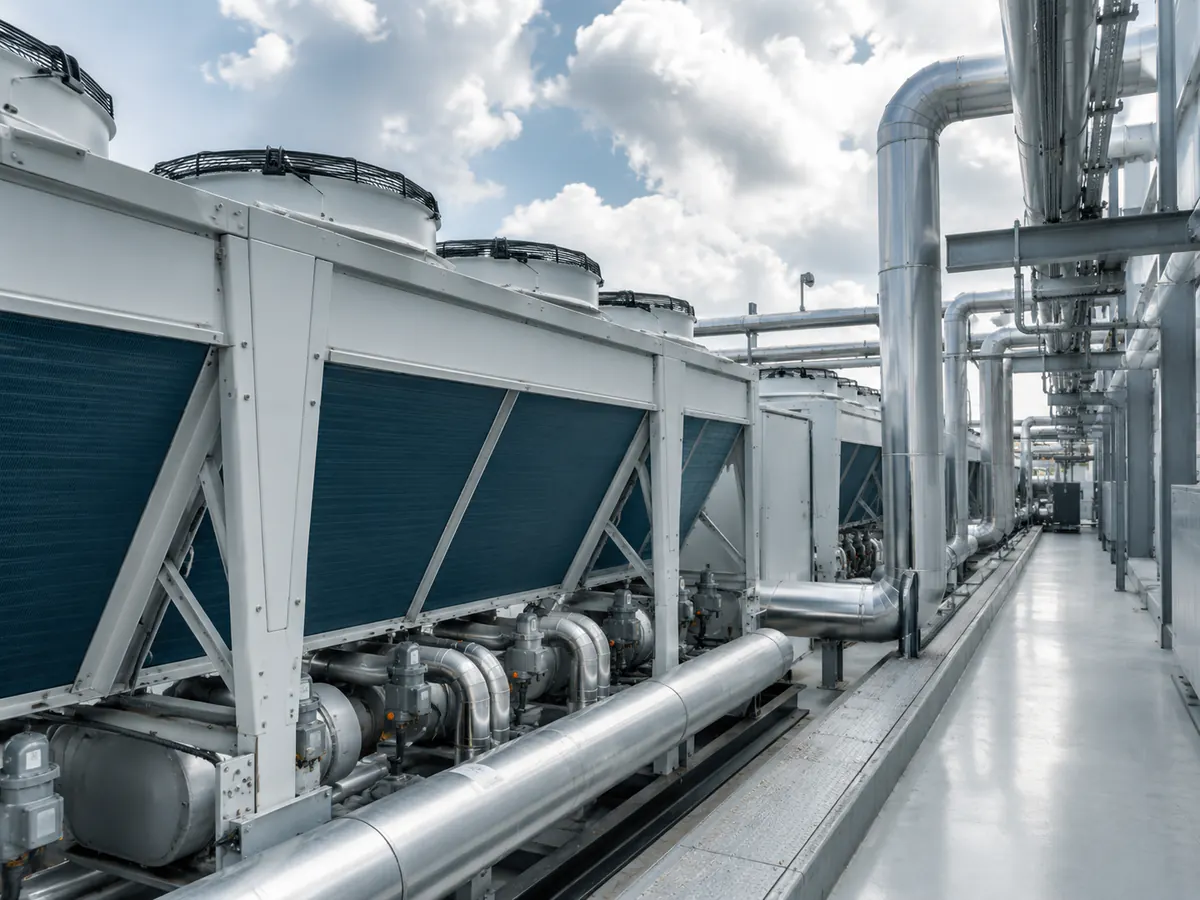
Cooling is one of the few data center costs that can become more expensive in two directions at once. Higher rack density can force more sophisticated cooling infrastructure into the building, and the same thermal load can also keep affecting the operating budget every hour the facility runs.
That is why a useful cooling-cost estimate needs to separate construction cost from operating cost. A liquid-cooled AI hall can cost more to build than an equivalent air-cooled facility, yet it may also handle densities that would otherwise require much more floor area or would simply be impractical with conventional air cooling.
Current U.S. benchmark data makes the capital side unusually clear. Turner & Townsend's 2025–2026 construction index estimates that similarly sized liquid-cooled data centers in the United States carry an average construction premium of roughly 7% to 10% over comparable air-cooled facilities. JLL's 2026 outlook uses a similar rule of thumb, applying about a 10% premium to liquid-cooled construction. Those are whole-project premiums, not claims that “cooling costs 10% more.” The underlying shift inside the budget is much more interesting.
Mechanical systems rise from about 22% to 33% of the indexed construction cost mix, while shell/architectural and electrical shares fall proportionally. That does not mean those categories become cheap; it means cooling consumes a larger share of a larger technical build.
Turner & Townsend derives those figures from live and recent project data and notes that its baseline is a typical 30–50 MW air-cooled hyperscale facility. Its current cost-trend analysis is one of the more useful public references because it shows both the liquid-cooling premium and how the cost allocation changes.
Cooling can represent a third of the construction mix in a liquid-cooled project
The jump from 22% mechanical in the air-cooled benchmark to 33% in the liquid-cooled benchmark is not just the price of swapping fans for pipes. Direct liquid cooling introduces equipment that does not exist in the same form in a conventional air-cooled hall: coolant distribution units, fluid networks, manifolds, heat exchangers and controls all have to be designed, installed, commissioned and maintained.
Uptime Institute's July 2026 analysis reaches a similar conclusion from a different angle. It estimates that support for direct liquid cooling can add roughly 5% to 10% to capital expenditure for a new build, depending on assumptions and requirements, and says retrofitting an existing facility is likely to cost more. Uptime also points to a cost that is easy to miss: many facilities will need to oversize both air and liquid cooling capacity during the transition.
That last point matters because the industry is not moving from one cooling architecture to another overnight. A new hall might support dense liquid-cooled AI racks while other halls in the same campus remain air cooled. The facility then carries two cooling systems, two operational skill sets and potentially two sets of spare parts and maintenance procedures.
Existing servers and lower-density racks remain on conventional cooling.
CDUs, piping and liquid-side infrastructure support dense compute.
Capital, controls, commissioning and maintenance can overlap for years.
The 7%–10% premium becomes very large at data center scale
Take a conventional 50 MW U.S. data center with a shell-and-core construction benchmark of $11 million per MW. That is a $550 million project before land and active IT equipment. Applying an illustrative 7%–10% liquid-cooling premium moves the construction envelope to roughly $588.5 million–$605 million.
In other words, a seemingly modest percentage can translate into roughly $38.5 million–$55 million on a project of that size.
The example deliberately uses a simple baseline. A real AI facility can move further because the cooling architecture is only one part of the high-density premium. JLL's 2026 Global Data Center Outlook forecasts an average global shell-and-core construction cost of $11.3 million per MW and notes that active AI technology fit-out can reach as much as $25 million per MW. JLL explicitly separates shell-and-core construction from tenant technology fit-out, which is an important distinction whenever cooling costs are discussed.
But liquid cooling can reduce the amount of building needed for the same IT capacity
The construction premium is only one side of the economics. Higher density means more computing capacity can fit into less white space. Turner & Townsend notes that denser AI deployments can reduce the building footprint needed to deliver the same or greater IT load, and very large campuses can gain economies of scale that offset part of the technical premium.
This is where a simple “liquid cooling costs 10% more” statement becomes misleading. If the liquid-cooled design lets a developer support 50 MW of IT in a materially smaller building, the project may save on shell, land intensity or other infrastructure even while the mechanical systems become more expensive.
The correct comparison is therefore not air cooling versus liquid cooling in isolation. It is two complete designs delivering the same required IT capacity, density, resilience and future expansion capability.
Density is what forces the cooling conversation
Conventional air cooling remains entirely viable for a large part of the installed base. Uptime Institute said in April 2026 that direct liquid cooling is still concentrated mainly in applications where air cooling is no longer a practical alternative, rather than becoming a universal replacement for conventional cooling. Its analysis expects liquid cooling to remain tied closely to high-density use cases over the next several years.
At the same time, the density frontier is moving quickly. Uptime's July 2026 work says typical rack densities are shifting toward 10 kW and notes that future AI systems are pushing the industry toward much higher figures. In a separate July analysis, Uptime says major AI hardware roadmaps are approaching rack power levels above 200 kW. That is the kind of load at which liquid cooling stops looking like an optional efficiency project and starts becoming part of the basic facility design.
The key point is not that every rack is heading to 200 kW. Most are not. The point is that cooling architecture now has to be selected against the workload roadmap, not just today's average rack.
The operating bill is driven by heat, not by the cooling label
Almost all of the electrical energy consumed by IT equipment eventually becomes heat inside the data center. A 10 MW IT load therefore creates a thermal problem of roughly the same order: around 10 MW of heat has to be moved from the equipment to the environment.
Cooling electricity is one contributor to PUE, alongside power conversion losses and other facility loads. If a 10 MW IT facility operates at PUE 1.50, total facility load is 15 MW. If improvements to cooling and other infrastructure bring annual PUE to 1.30, total facility load falls to 13 MW.
The difference is 2 MW continuously, or 17.52 GWh per year. At $0.08/kWh that is about $1.40 million per year. It would be wrong to attribute all of that saving to cooling unless cooling alone caused the PUE change, but it shows the scale of the operating-cost opportunity around facility overhead.
This is why our PUE energy-cost analysis treats PUE as a whole-facility multiplier rather than casually describing it as “cooling efficiency.” Cooling is often the largest variable facility load, but PUE includes more than cooling.
Cooling cost changes with climate, but not in a simple north-versus-south way
Outdoor temperature and humidity affect how often a facility can use economization and how efficiently heat can be rejected. A cooler climate can reduce mechanical cooling hours, but site economics do not stop there. Electricity price, water availability, utility capacity, land cost and permitting can easily outweigh a climate advantage.
This is another area where I would avoid over-optimizing one metric. A site with excellent annual cooling conditions is not automatically the lower-cost data center if power is expensive or difficult to secure. Likewise, a hot market can remain economically attractive if power, land, taxes and network access are favorable enough.
Water changes the cost conversation
Evaporative cooling can reduce electrical energy use in suitable conditions, but it introduces water consumption and local water risk into the operating model. Air-cooled chillers may use less water while consuming more electricity. Direct liquid cooling can move heat more efficiently from the chip, but the facility still needs a way to reject that heat outside the building.
That means “liquid cooled” does not automatically tell us whether a site will use more or less water. The answer depends on the complete heat-rejection design. Cold plates, immersion, CDUs, dry coolers, cooling towers and hybrid systems can be combined in different ways.
For a cost model, water therefore deserves its own operating assumption rather than being hidden inside a generic cooling percentage. In water-constrained regions it may also become a site-selection or permitting issue rather than merely a utility expense.
Retrofit economics are much less forgiving than greenfield economics
Designing liquid cooling into a new data center is one problem. Introducing it into a live facility built around air cooling is another.
Uptime Institute's 2026 analysis says the capital premium for existing facilities is likely to be higher than the 5%–10% range it estimates for new builds. That is intuitive: piping routes, floor loading, heat rejection, leak management, CDU locations, maintenance access and electrical capacity may all be constrained by a building that was never designed for dense liquid-cooled racks.
There is also a sequencing problem. A retrofit may need to happen around live IT, which can turn otherwise ordinary construction work into a more expensive operational project. Downtime windows, temporary capacity and commissioning plans can matter as much as equipment cost.
What is the most economical way to design cooling for the expected workload?
Retrofit questionWhat can be changed safely inside the physical and operational constraints of the existing facility?
Maintenance cost is still developing as liquid cooling matures
Direct liquid cooling is moving from specialist HPC deployments into much larger commercial environments, and the operating model is still settling. Uptime's June 2026 work on liquid-cooling maintenance describes an industry converging around larger coolant distribution units and clearer division of responsibilities between facilities teams and IT teams, while standards and practices continue to mature. The report highlights the operational complexity created by different coolant chemistries, system designs and maintenance boundaries.
For budgeting, that means maintenance should not be treated as if liquid cooling were simply another mature mechanical line item with universally predictable costs. Spare components, coolant management, technician skills, warranty boundaries and the responsibility split between facility operator and IT vendor can all affect long-run OPEX.
A cooling budget should follow the heat path
The cleanest way to review cooling cost is to follow heat from the chip to the outside environment. Every handoff can carry capital cost, energy cost and maintenance cost.
Fans, cold plates or immersion interface.
Airflow management, manifolds or local CDUs.
Pumps, heat exchangers and central distribution.
Dry coolers, chillers, towers or hybrid plant.
A proposal that is cheap at one stage can simply push cost into the next. Warmer liquid temperatures, for example, can improve opportunities for efficient heat rejection, while a design requiring colder water can increase chiller dependence. The full thermal chain is what matters.
What a realistic first-pass cooling budget should contain
At concept stage, I would separate the cooling economics into four buckets rather than forcing everything into one percentage of construction cost.
First, the mechanical construction scope: heat-rejection equipment, cooling plant, pumps, piping, controls and the equipment needed to deliver cooling to the IT space. Second, any density premium: CDUs, liquid distribution, containment or specialized equipment that exists because of the workload. Third, annual operating cost: electricity, water, treatment and maintenance. Fourth, transition and expansion cost: the cost of supporting tomorrow's rack densities without rebuilding the facility every time the IT roadmap changes.
Keeping those buckets separate also prevents one of the most common errors in cooling discussions: using a lower PUE to justify a higher CAPEX without checking whether the lifetime saving actually pays for the added infrastructure.
The useful number is not “cooling costs X%”
For a conventional air-cooled hyperscale project, Turner & Townsend's current U.S. benchmark puts mechanical systems at roughly 22% of the indexed construction cost mix. For a comparable liquid-cooled facility, that share rises to about 33%, and the whole project carries an estimated 7%–10% premium. Those figures are valuable because they establish scale.
They are not a universal cooling budget. A 5 kW enterprise rack, a 50 kW GPU rack and a future 200 kW AI rack create different thermal problems. So do Dallas and a cooler northern market. So do a new campus and a retrofit.
The more useful way to think about cooling cost in 2026 is this: price the heat path, then price the transition. The first tells you what it costs to remove today's heat. The second tells you what it will cost when the workload no longer looks like today's.