
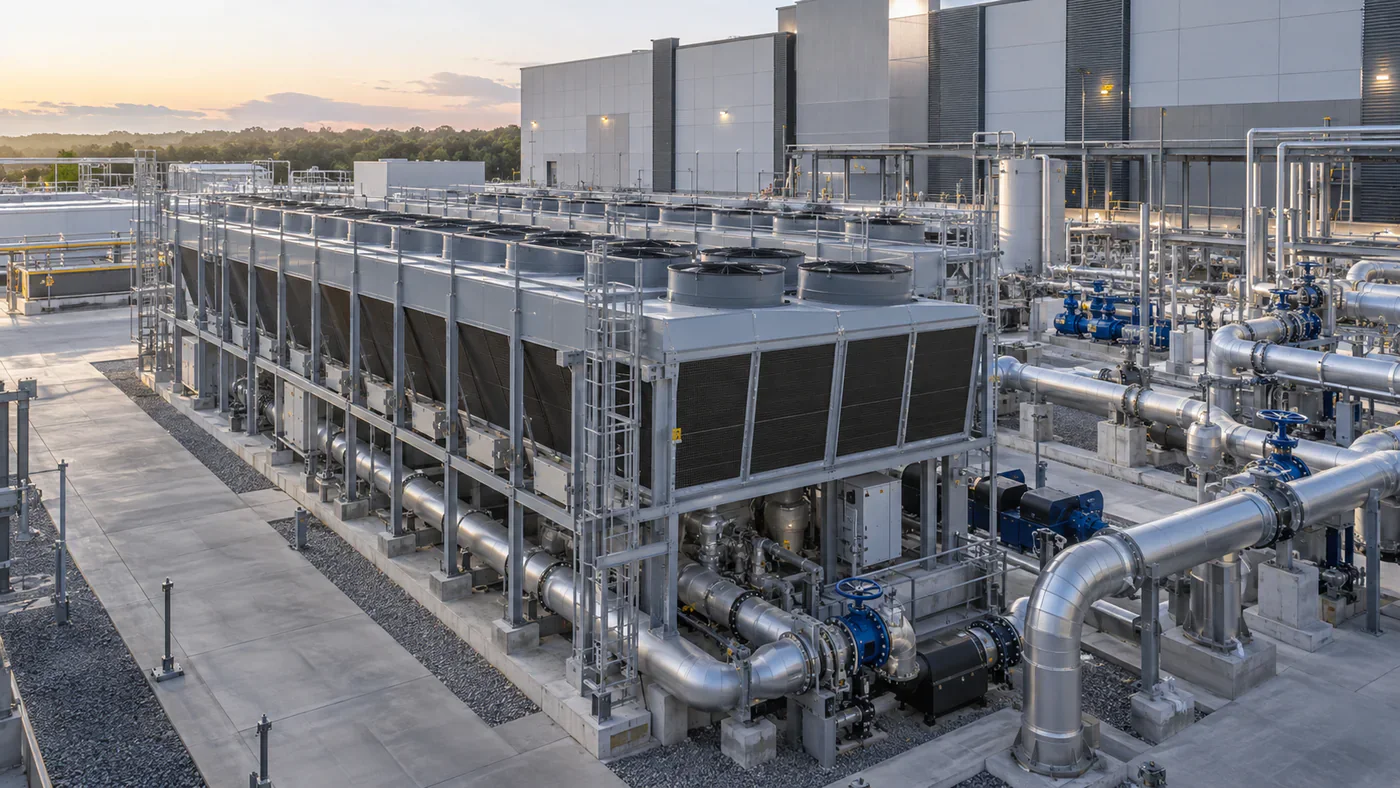
A chiller is not the cooling system. It is one machine inside a larger thermal chain, and confusing those two scopes is one of the fastest ways to understate data center cooling cost.
The chiller itself removes heat from a chilled-water loop. The project still has to move that water, reject the heat to ambient, control the plant, provide electrical power, build the piping, commission the sequence and keep enough redundant capacity available when one machine is offline.
In 2026, procurement adds another layer. Chillers remain among the longest-lead mechanical components in large data center projects, and the difference between an air-cooled and water-cooled plant can change both schedule and site infrastructure.
Capacity, compressor type, refrigerant, efficiency, controls and factory options shape the equipment price.
Pumps, towers or dry coolers, piping, electrical service, controls and commissioning can rival the importance of the chiller itself.
Submittals, manufacturing, shipping, installation, flushing, testing and controls integration sit between purchase and operation.
Start with the thermal load, not the chiller tonnage
Chillers are often discussed in refrigeration tons. Data centers are usually discussed in megawatts. The conversion is straightforward:
A 10 MW thermal load is approximately 2,843 refrigeration tons before redundancy and design margin.
But IT load and chiller load are not automatically the same number.
Almost all electrical energy consumed by IT equipment eventually becomes heat, but the chiller plant may not carry every watt of facility heat. Some heat can be rejected through economization, dry coolers, direct liquid loops or other paths. Pump and fan heat can also add load to the thermal system.
The useful starting point is therefore the actual heat balance and cooling architecture, not a rule such as "one ton per X square feet."
Air-cooled and water-cooled chillers create different cost boundaries
Air-cooled chillers reject heat directly to outdoor air through condenser coils and fans. Water-cooled chillers reject heat into a condenser-water loop, which then needs another heat-rejection device such as a cooling tower or dry cooler.
Simpler plant boundary and no cooling tower, but larger outdoor footprint and different peak-efficiency behavior.
Can deliver strong efficiency at scale, but adds pumps, piping and separate heat-rejection infrastructure.
Carrier currently markets both approaches specifically for data centers: the AquaForce 30XF air-cooled platform and AquaEdge water-cooled centrifugal chillers. Johnson Controls likewise offers air- and water-cooled data center architectures, including 2026 reference designs for gigawatt-scale AI facilities.
That matters for cost because a water-cooled chiller quote is not a complete water-cooled plant quote.
There is no useful universal 2026 price per ton
Chiller cost is often reduced to dollars per ton. That can be useful inside a narrow project class, but it is a poor universal benchmark for data centers.
Two 1,500-ton chillers can be very different machines.
The condenser architecture changes both the machine and the surrounding plant scope.
Screw, centrifugal, magnetic-bearing and other compressor designs have different efficiency, capacity and service characteristics.
Warmer chilled-water loops can improve efficiency and change the number of machines required.
Extreme outdoor temperatures affect air-cooled capacity, condenser performance and equipment selection.
Refrigerant choice affects machine design, regulatory exposure and lifecycle planning.
N+1 or greater redundancy can materially increase installed nameplate capacity above the required thermal load.
Drives, harmonic mitigation, dual feeds and controls can move package cost.
Integrated economizer options can increase equipment scope while reducing annual compressor energy.
The U.S. Bureau of Labor Statistics reported continued price pressure in the broader air-conditioning and refrigeration equipment category in 2026. That is useful market context, but it still does not justify applying one published chiller price to every data center.
Chiller sizing should include redundancy explicitly
Consider a simplified 30 MW thermal design load.
At 3.517 kW per refrigeration ton, that load is approximately 8,530 tons.
Suppose the design uses 1,800-ton machines.
This is not a recommended plant design. It is a capacity example.
Real sizing has to consider part-load operation, ambient conditions, fouling, approach temperatures, pump configuration, failure modes and whether redundant capacity can actually serve the remaining system after a component is isolated.
The economic lesson is simpler: a budget based only on required load can understate the installed machine count.
The plant around the chiller can be as important as the chiller
A chiller plant budget should be built as a system ledger.
Compressors, evaporators, condensers, drives, controls and factory accessories.
Chilled-water and condenser-water circulation depending on plant topology.
Cooling towers, dry coolers or integrated air-cooled condensers.
Large-bore distribution, isolation valves, balancing, strainers, expansion and specialty components.
Chemical treatment, filtration, makeup and blowdown systems where applicable.
Feeders, starters or drives, switchgear, transformers and emergency power strategy.
Plant sequencing, BMS integration, sensors, optimization logic and failure response.
Flushing, functional testing, load validation, failure scenarios and final balancing.
This is why our data center cooling cost guide covers a broader scope. The present article isolates the chiller decision and the immediate plant required to make it useful.
Water-cooled chillers can move cost into towers and condenser water
Water-cooled centrifugal chillers can be highly efficient at large scale, especially at part load. But the condenser side does not disappear.
A conventional water-cooled plant may need cooling towers, condenser pumps, chemical treatment, makeup water, blowdown, freeze protection and additional controls.
That means a lower chiller kW/ton does not automatically produce the lowest total plant cost.
Comparing only compressor power can make one plant look more efficient while ignoring the equipment required to reject that heat outdoors.
Air-cooled chillers trade water infrastructure for electrical and footprint constraints
Air-cooled chillers reject heat directly to ambient air, avoiding a conventional cooling-tower loop.
That can reduce water consumption and simplify the plant. It can also increase outdoor equipment footprint and make peak performance more sensitive to ambient temperature and recirculated hot air.
Johnson Controls' 2026 air-cooled AI factory reference design is useful because it demonstrates how serious that architecture has become at very large scale. The company designed the reference around air-cooled centrifugal chillers for a 1 GW AI facility and specifically addresses heat-island effects, elevated water temperatures and zero-water operation.
The lesson is not that air-cooled chillers are universally better. It is that water availability, electrical power and site geometry can now outweigh traditional assumptions about central-plant efficiency.
Heat island effects can reduce air-cooled chiller capacity
A large array of air-cooled chillers rejects enormous amounts of heat. If that hot discharge air is drawn back into neighboring condenser coils, the effective entering-air temperature rises.
That can reduce available capacity and increase power consumption.
Johnson Controls' 2026 reference work explicitly models heat-island effects at AI-factory scale and reports meaningful peak-power savings from mitigating them.
Equipment spacing, wind, walls, roof geometry and discharge-air recirculation can change the usable capacity of the installed plant.
Warmer water can reduce the number of chillers required
Data center cooling loops have historically operated at colder supply temperatures than many current liquid-cooled AI systems require.
Raising the chilled-water or technology-cooling loop temperature can reduce compressor lift and improve chiller capacity and efficiency, depending on the machine and plant.
Johnson Controls reported in its 2026 air-cooled reference design that raising chilled-water temperature for warm-water technology loops improved coefficient of performance and reduced the required number of chillers in its modeled architecture.
That is an important procurement point: chiller count is not fixed until the design temperatures are fixed.
A buyer who requests quotes before the thermal architecture is mature may be pricing more machines than the final design requires — or the wrong machines entirely.
AI liquid cooling does not eliminate chillers
Direct-to-chip cooling moves heat capture closer to the processor, but that heat still has to go somewhere.
The CDU transfers heat from the technology cooling loop into the facility water system. Depending on climate and operating temperature, the facility can reject that heat through dry coolers, chillers or a hybrid arrangement.
Johnson Controls describes the modern thermal chain as chip → CDU / air handler → facility loop → chiller or other heat rejection.
Carrier similarly positions CDUs alongside both air- and water-cooled chiller systems for high-density data centers.
Our liquid cooling cost guide covers the rack and CDU side of that architecture. This article focuses on the facility-level refrigeration plant.
2026 chiller lead times remain highly variable
JLL's 2026 Global Data Center Outlook places the average U.S. chiller lead time at approximately 35 weeks.
SourceBlue's Q2 2026 cost index shows a much wider range: 3–49 weeks for air-cooled chillers and 12–60 weeks for water-cooled chillers.
Those ranges are more useful than pretending one lead time exists.
A small standard air-cooled unit and a multi-thousand-ton project-specific centrifugal chiller are not competing for the same manufacturing slot or component set.
SourceBlue also notes that chiller lead time remains sensitive to sizing, manufacturer and project-specific requirements even as broader equipment lead times have stabilized.
Lead time starts after more than a purchase order
Procurement schedules often oversimplify chiller delivery into one line: "PO + 35 weeks."
Real schedules can contain several clocks.
The project may not release the unit until capacity, voltage, refrigerant, design temperatures, piping connections and controls requirements are sufficiently stable.
After delivery, the chiller still needs piping, power, controls, water treatment where applicable, startup and functional testing.
The useful schedule milestone is not "chiller delivered." It is cooling capacity available for commissioning.
Factory testing can protect the schedule later
Large mission-critical chillers may receive factory performance testing before shipment.
That adds cost and can consume manufacturing time, but discovering a performance problem in the factory is usually less disruptive than discovering it after the machine is rigged into a live data center plant.
The project should define early whether it requires witness testing, certified performance data, controls simulation or other factory acceptance activities.
Those requirements belong in the procurement schedule from the beginning rather than being added after the production slot is booked.
Rigging can become a design constraint
Chillers are large, heavy pieces of equipment.
Outdoor air-cooled units may be crane-set directly into final position. Indoor water-cooled machines can require rigging paths, removable walls, knock-out panels or phased assembly.
The lowest equipment quote can lose value if the selected machine creates unusual structural reinforcement, crane reach or building-access work.
Procurement and building design need to agree on the same machine, not just the same cooling capacity.
Electrical demand belongs in the chiller comparison
Cooling equipment competes with IT equipment for the site's available electrical capacity.
A less efficient plant may be affordable as mechanical equipment but expensive in a power-constrained market because it consumes megawatts that could otherwise support revenue-generating compute.
This becomes especially important for AI campuses where grid capacity is the gating resource.
If a thermal design reduces peak cooling power, the released electrical capacity may support additional IT load, reduce upstream infrastructure or preserve expansion headroom.
That is one reason Johnson Controls' 2026 AI reference designs quantify electrical capacity returned to the compute plant rather than discussing chiller efficiency only as an operating expense.
Part-load efficiency matters because plants rarely sit at one load
Chillers spend much of their operating life below design peak.
Redundant machines, seasonal weather and phased IT deployment can all create part-load operation.
DOE's current Federal Energy Management Program guidance therefore evaluates electric chillers using both full-load and integrated part-load performance, referencing AHRI 550/590 test procedures and ASHRAE 90.1 efficiency paths.
That is the right way to think about data center procurement as well. The best full-load number does not necessarily produce the lowest annual plant energy if the machine spends most of its life at 40–70% load.
Redundant chillers can improve efficiency if the controls use them intelligently
Redundancy is usually described as an availability cost: install an extra machine so one can fail.
Variable-speed chillers complicate that picture.
Depending on the performance curve, running multiple machines at an efficient part-load point can consume less power than forcing fewer machines closer to peak.
Johnson Controls' 2026 air-cooled reference architecture explicitly uses intelligent utilization of redundant chillers as part of its energy strategy.
That means redundancy should be included in controls design, not treated only as idle emergency capacity.
Free cooling can change annual cost more than machine efficiency
In suitable climates, the plant can reject heat without running compressors for every hour of the year.
Air-side and water-side economization use different mechanisms, but the economic idea is the same: use favorable outdoor conditions to reduce mechanical refrigeration.
Carrier's current AquaForce 30XF data center platform, for example, integrates a free-cooling option into the air-cooled chiller package.
Economizer value depends on climate, supply-water temperature, load profile and system controls. A high-temperature liquid loop can increase the number of hours in which ambient conditions can reject heat without full compressor operation.
That can make design temperature one of the most economically important choices in the chiller plant.
Water cost is not just the utility bill
In evaporative systems, water economics include more than gallons purchased.
Treatment chemicals, filtration, blowdown, sewer charges, basin maintenance, plume, drought restrictions and local permitting can all affect lifecycle cost.
Water availability can also become a site-selection issue rather than an operating-cost issue.
Our data center water use guide covers WUE and water-system boundaries in more detail.
For a chiller comparison, I would model water-cooled and air-cooled alternatives with both annual energy and annual water consumption rather than optimize one resource in isolation.
Noise can become a real design cost for air-cooled plants
Large air-cooled chiller arrays contain many condenser fans and can operate continuously.
On a remote industrial campus, that may be straightforward. Near residential areas or strict property-line noise limits, acoustic treatment can affect equipment selection, fan speed, barriers and site layout.
Johnson Controls identifies noise impact as one of the issues addressed in its 2026 air-cooled reference design.
The cost comparison should therefore include any acoustic mitigation required to obtain or maintain the site's permits.
Refrigerant strategy has become a lifecycle procurement issue
Chillers are long-lived assets, so refrigerant choice should be evaluated against the expected operating life rather than only current availability.
Manufacturers are moving toward lower-global-warming-potential refrigerants across new chiller platforms. Carrier's current 30XF and Johnson Controls' YVAM/YDAM platforms, for example, are marketed with lower-GWP refrigerant options.
A data center owner should understand future service availability, safety classification, technician requirements and regulatory exposure before standardizing a campus around one refrigerant platform.
A cheap chiller can create an expensive plant
Consider two machines with the same nominal cooling capacity.
This is an original scenario, not market pricing.
The point is that procurement can rationally select the more expensive chiller if the machine reduces electrical infrastructure, operating energy, plant footprint or future capacity risk. It can also rationally select the less efficient machine if schedule is the dominant commercial constraint.
How I would build a 2026 chiller budget
- Establish the design thermal load in MWth and refrigeration tons.
- Define chilled-water and technology-cooling temperatures before requesting final equipment pricing.
- Compare air-cooled and water-cooled architectures at the full plant boundary.
- Select machine size and quantity around both capacity and redundancy.
- Model part-load performance rather than only full-load efficiency.
- Include pumps, towers or dry coolers, piping, treatment and controls.
- Add electrical distribution, harmonics and standby-power requirements.
- Price rigging, foundations, structural work and site access.
- Obtain current manufacturer lead times and define what the quoted clock actually starts from.
- Include factory testing, startup and commissioning.
- Compare annual energy and water cost under the actual climate and load profile.
- Model schedule exposure separately from mechanical CAPEX.
So what does a data center chiller cost in 2026?
There is no single defensible data center chiller price per ton that applies across air-cooled, water-cooled, centrifugal, screw and high-temperature AI cooling plants.
What can be stated confidently in 2026 is that chillers remain schedule-sensitive equipment. JLL reports an average U.S. lead time of about 35 weeks, while SourceBlue shows ranges extending from a few weeks for some air-cooled equipment to as much as 60 weeks for water-cooled machines.
The correct project budget therefore separates: chiller equipment cost, installed plant cost, annual resource cost and schedule exposure.
That separation becomes even more important as AI increases thermal density. Warmer loops, liquid cooling, water constraints and power-constrained campuses can change the value of a chiller far more than a small difference in factory purchase price.
The machine is only one line item. The economic decision is the cooling plant it enables.
Sources and research notes
- JLL — 2026 Global Data Center Outlook . Used for current U.S. data center chiller lead-time context.
- SourceBlue — Q2 2026 Cost Index Report . Used for 2026 air-cooled and water-cooled chiller lead-time ranges.
- Johnson Controls — 2026 AI Factory Reference Design Guides . Used for water-cooled, air-cooled and high-temperature AI cooling architecture context.
- Johnson Controls — Air-Cooled Reference Design Guide for Gigawatt-Scale AI Factories . Used for heat-island, elevated-water-temperature, energy and zero-water design context.
- Carrier — Data Center Thermal Management . Used for current air-cooled and water-cooled chiller architecture, rapid restart and CDU integration context.
- U.S. Department of Energy — Purchasing Energy-Efficient Electric Chillers . Used for full-load and integrated part-load efficiency methodology, including AHRI 550/590 and ASHRAE 90.1 references.
- U.S. Bureau of Labor Statistics — Producer Price Index, August 2026 . Used for broad air-conditioning and refrigeration equipment price context. The index is not treated as a chiller-specific quote.
- Cushman & Wakefield — 2026 Data Center Development Cost Guide . Used for broader critical-equipment, labor and development-cost context.