
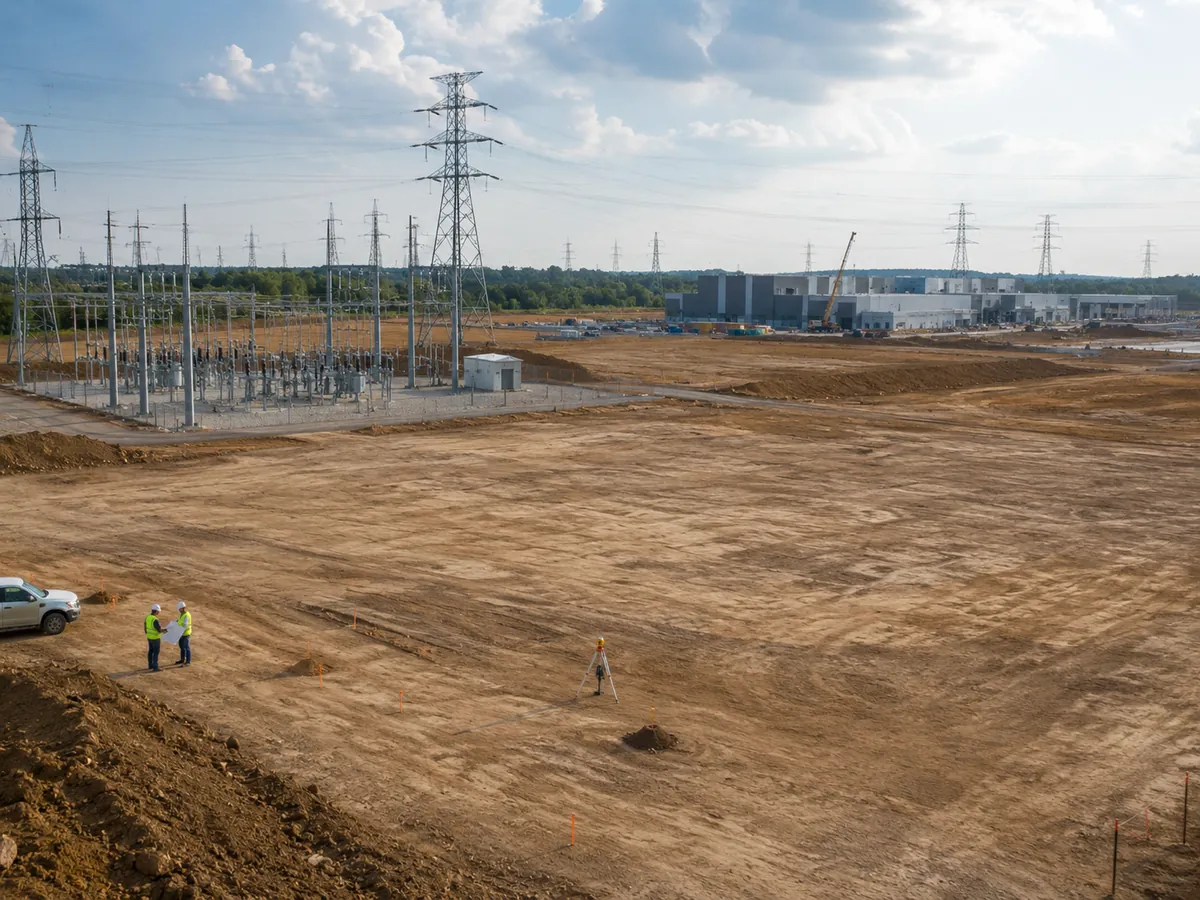
Two 100-acre parcels can have the same asking price and completely different value for a data center developer.
One may already have a credible path to large-scale utility power. The other may have inexpensive land but no firm delivery date for the electrical capacity the project actually needs.
That distinction is why I would not evaluate data center land using only dollars per acre. The land price matters, but so do power certainty, delivery timing, infrastructure requirements and the cost of waiting.
More expensive acreage, but with a credible power-delivery path and fewer major infrastructure unknowns.
Higher visible land costCheaper acreage, but with uncertain utility capacity, longer development timing and greater execution risk.
Lower visible land costThe cheaper parcel is not automatically the cheaper data center site. The rest of this article will separate raw land price from the economic cost of making that land usable.
The market is no longer pricing acreage alone
Current data center research is unusually consistent on this point: electrical deliverability is changing what land is worth.
Cushman & Wakefield's 2026 U.S. Data Center Development Cost Guide says grid-connected power has become increasingly scarce and that land values are diverging sharply between powered and non-powered sites. Its central point is not that every powered parcel deserves the same premium. It is that a site with credible near-term power removes a development risk that an otherwise similar parcel still carries. Cushman & Wakefield's 2026 guide describes power as the gating factor for many U.S. developments.
JLL reaches the same conclusion from a global site-selection perspective. Its 2026 Global Data Center Outlook ranks speed to power as the primary site-selection criterion, ahead of community support, latency and proximity to customers. JLL's 2026 outlook shows why a land-only comparison is increasingly incomplete.
The 2026 U.S. guide says values are diverging sharply between powered and non-powered sites.
Its 2026 global outlook identifies speed to power as the primary criterion driving site selection.
Its 2026 U.S. marketplace report says availability, timing and contractual certainty of power now drive feasibility and value.
A powered-site premium is really a certainty premium
The word powered needs care. A parcel beside a transmission line is not necessarily the same thing as a site with a utility commitment, an agreed delivery schedule and enough capacity for the intended campus.
Colliers' 2026 U.S. Data Center Marketplace report describes power availability, delivery timing and contractual certainty as the primary determinants of project feasibility, valuation and absorption. It also says near-term deliverability is attracting a disproportionate share of demand. Colliers' 2026 report .
I would therefore avoid putting a single binary field called “powered: yes/no” in a land comparison. The more useful question is: how much capacity is actually deliverable, under what commitment, and by what date?
The price dispersion can be enormous
Historical and current transaction evidence also shows why a national dollars-per-acre average should be treated carefully.
Cushman & Wakefield reported a weighted average U.S. data center land cost of about $244,000 per acre in 2024. In the same research, prices for parcels of 50 acres or more had increased 23% from the prior year. That figure is useful as historical context, not as a 2026 quote.
At the other end of the market, CBRE's North America Data Center Trends report says recent and pending site transactions in Northern Virginia and the Northeast exceeded $8 million per acre. CBRE specifically connects that pressure to the shortage of powered land and says greenfield sites capable of receiving power within 18 to 36 months are highly sought after. CBRE's market report .
$244,000 per acre and $8 million-plus per acre describe different periods, markets, parcels and levels of site readiness. I would not average them, and I would not present the two endpoints as a normal 2026 U.S. pricing range.
Their value is in showing how little acreage alone explains.Time-to-power can be part of the land economics
CBRE's 2026 U.S. outlook says securing very large power deliveries in less than 36 months can now outweigh pure connectivity considerations. Where new transmission, substations or generation are required, interconnection can extend to 24, 36 or even 48-plus months. CBRE's 2026 outlook .
That delay does not automatically become part of the accounting purchase price of land. Economically, however, it can affect carrying cost, financing, development sequencing, customer delivery dates and the value of capital tied up before the site produces revenue.
This is the distinction the rest of the article will model: raw land cost is what is paid for the parcel; effective site cost is what the project may have to absorb before that parcel can support the intended data center.
What are you really paying for when powered land costs more?
A powered-site premium is easiest to understand by asking what uncertainty has already been removed from the development program.
I would separate that value into four components: electrical capacity, delivery timing, infrastructure already resolved and execution certainty. The exact commercial value of each component is project-specific, but the framework helps explain why two parcels with the same acreage can support very different valuations.
A parcel is more useful when the required MW can be delivered rather than merely discussed as a future possibility.
A credible delivery date can materially change the development schedule and the period during which capital remains unproductive.
Transmission upgrades, substations, utility work and on-site electrical infrastructure can shift cost outside the land purchase.
A site with a stronger utility commitment can reduce the probability that the project is delayed, resized or redesigned after acquisition.
The land price can be higher while the development problem is smaller
This is the counterintuitive part of powered-site economics. Paying more for the parcel can be rational if the higher price buys a shorter or more reliable path to operation.
Imagine two sites that can both physically accommodate the planned campus. Site A costs more per acre but has a credible utility delivery path. Site B costs less but requires significant power work with a less certain schedule.
The land acquisition comparison favors Site B. The development comparison may not.
Not every dollar of power infrastructure belongs in the land price
It is important not to blur accounting categories. A substation, utility upgrade or transmission contribution may be required because of the data center project, but that does not automatically make it part of the purchase price of the land.
For decision-making, however, those costs still belong in the site comparison. A cheap parcel that requires substantial additional infrastructure can have a higher effective development cost than its acquisition price suggests.
Purchase price, transaction costs and other direct costs of acquiring the parcel.
Incremental utility, electrical, civil and infrastructure work needed before the site can support the intended development.
Carrying and financing effects created by the period between acquiring the site and reaching a usable development state.
Time-to-power creates an option value
A site that can support development sooner can create strategic value beyond a simple construction-cost calculation.
Earlier power can allow the developer to sequence phases sooner, commit capacity to customers earlier or avoid holding a site through an extended period of uncertain utility development.
I would not assign a universal dollar value to that advantage. The value depends on financing, customer commitments, expected lease-up, campus scale and the probability that the alternative site actually experiences the modeled delay.
Paying more per acre is not automatically expensive. Paying less per acre is not automatically cheap.
A 100-acre example: cheaper land can produce a higher effective site cost
The easiest way to test the powered-land premium is to put two sites through the same planning model.
The example below is entirely illustrative. Every dollar amount is a Data Center Scope editorial assumption, not a market quote, transaction comp or claimed 2026 average.
Site B saves $80 million on the land purchase. That advantage is visible immediately.
But the same illustrative site requires $70 million more in enabling infrastructure and absorbs another $36 million of modeled timing burden. The effective comparison therefore becomes:
Nothing in this example proves that powered land is always cheaper. It demonstrates the opposite of a universal rule: the correct answer depends on how much additional cost and delay the lower-priced site actually introduces.
The break-even point can be surprisingly early
Before timing is considered, Site B costs $140 million: $40 million for the parcel plus $100 million of site-enabling work. Site A costs $150 million.
That means Site B has only a $10 million remaining advantage after infrastructure is included.
Under the illustrative $1.5 million monthly timing assumption, that advantage disappears after roughly 6.7 months of additional delay.
This is not a market rule. Change the infrastructure assumptions, financing structure or value of time and the break-even point changes.
Delay sensitivity changes the answer without changing the acreage
Holding every other assumption constant, the effect of additional time-to-power looks like this:
This sensitivity is useful because the acreage, land purchase price and intended campus have not changed. Only one variable changed: how long the lower-certainty site takes to become usable.
“Effective site cost” is a decision model, not an accounting label
I am using the phrase effective site cost here as an editorial planning concept. It should not be confused with a formal accounting definition.
A real investment model may also include taxes, financing structure, permitting, water, fiber, incentives, civil work, environmental remediation and many other variables. The simplified equation isolates the effect we are examining here: land price versus power readiness.
The assumptions should disappear as diligence improves
At an early screening stage, a model like this can expose which site variables deserve investigation. It should not remain assumption-driven once utility studies, engineering estimates and transaction terms become available.
Gross acreage can be as misleading as price per acre
A 100-acre parcel does not necessarily provide 100 acres of usable data center development area.
Setbacks, stormwater systems, access roads, utility corridors, substations, transmission infrastructure, environmental constraints, grading and buffers can all reduce the portion of a parcel that can actually support buildings and supporting infrastructure.
That means a useful land comparison needs at least two acreage figures: gross acreage and realistically developable acreage.
I would rather pay more per gross acre for a site with a clean, efficient development envelope than compare two parcels as though every acre produces the same amount of usable capacity.
Power does not rescue a fundamentally weak site
Power readiness can dominate site selection without making every other variable irrelevant.
A site can have an attractive electrical position and still be a poor development candidate because of zoning, access, environmental constraints, fiber, water strategy, civil requirements or community restrictions.
Due diligence should turn “powered” into evidence
The word powered is useful shorthand in market commentary. It is not enough for an investment decision.
Before assigning a premium, I would want the underlying evidence to answer a much more precise set of questions.
Compare the planned campus load with the capacity covered by the utility process.
Separate desired capacity from capacity supported by current utility evidence.
A capacity number without a credible schedule can be difficult to use in a development model.
Identify substations, transmission work, utility upgrades and on-site electrical scope that remain outside the land price.
Deposits, milestones, construction responsibilities and other conditions can materially change the value of the apparent power position.
Power diligence should sit beside entitlement, environmental, civil, fiber, water and access diligence.
“Powered” should be supported by documents, not adjectives
I would be cautious with a listing that describes a site as powered without explaining what that means.
Nearby transmission, an active utility study, an executed agreement and capacity available by a defined date are not equivalent stages of readiness.
MW deliverable · utility status · delivery date · required upgrades · deposits · conditions · expansion path
When would I pay a premium for powered land?
I would not pay a powered-land premium simply because the market is willing to attach one.
The premium becomes economically interesting when the additional land price is smaller than the cost, delay or risk that the stronger site position removes.
- Utility capacity has credible documentary support.
- Delivery timing materially improves the project schedule.
- Major enabling infrastructure is already resolved.
- Customer commitments make earlier delivery valuable.
- The alternative site carries meaningful execution risk.
- The capacity claim remains speculative.
- The delivery date is still highly uncertain.
- The site has major non-power development constraints.
- The premium exceeds the costs it is expected to avoid.
- The project can tolerate a slower development schedule.
Normalize site offers before comparing dollars per acre
Two site proposals can use the same phrase — powered land — while transferring very different infrastructure obligations to the buyer.
I would normalize the offers into a common site-selection record before comparing acquisition prices.
Only after those fields are normalized does a clean price-per-acre comparison become useful.
So what does data center land cost in 2026?
There is no national number that I would use as a reliable answer.
The evidence shows substantial dispersion. Historical transaction data can sit in the hundreds of thousands of dollars per acre, while specific highly constrained powered-site transactions can reach several million dollars per acre.
That does not mean data center land normally costs somewhere between those two endpoints. It means that land readiness matters enormously.
For a real development decision, I would start with the parcel price, then ask how many acres are actually usable, how much power is credibly deliverable, when it arrives, what infrastructure remains and what the project absorbs while waiting.
The cheapest acre is not necessarily the cheapest capacity. A powered-site premium can be rational when it buys real delivery certainty. It becomes dangerous when “powered” is only a label and the unresolved development work remains hidden outside the asking price.
Sources and research notes
This article combines current market research with a Data Center Scope planning framework. Market figures are kept separate from the illustrative assumptions used in the 100-acre comparison.
Used for the distinction between powered and non-powered land and the observation that truly powered sites are attracting a premium as grid-connected capacity becomes harder to secure.
Used for the finding that speed to power has become the primary site-selection criterion in the current development environment.
Used for the role of power availability, delivery timing and contractual certainty in project feasibility and valuation.
Used for the observation that sites offering power access within 18 to 36 months are highly sought after and that selected recent and pending transactions in Northern Virginia and the Northeast exceeded $8 million per acre.
Used for current power-delivery constraints, including the growing importance of securing very large power deliveries within 36 months and the possibility of 24-, 36- or 48-plus-month interconnection timelines for large projects.
The approximately $244,000-per-acre weighted average cited above refers to 2024 transaction research. It is retained only as historical context and is not presented as a 2026 national average.
The $244,000-per-acre historical benchmark, the $8-million-plus transactions and the current power-delivery observations come from external research. The 100-acre Site A versus Site B example, including the $1.5 million monthly timing assumption, is an original Data Center Scope scenario created to demonstrate the decision framework. It is not market data.