
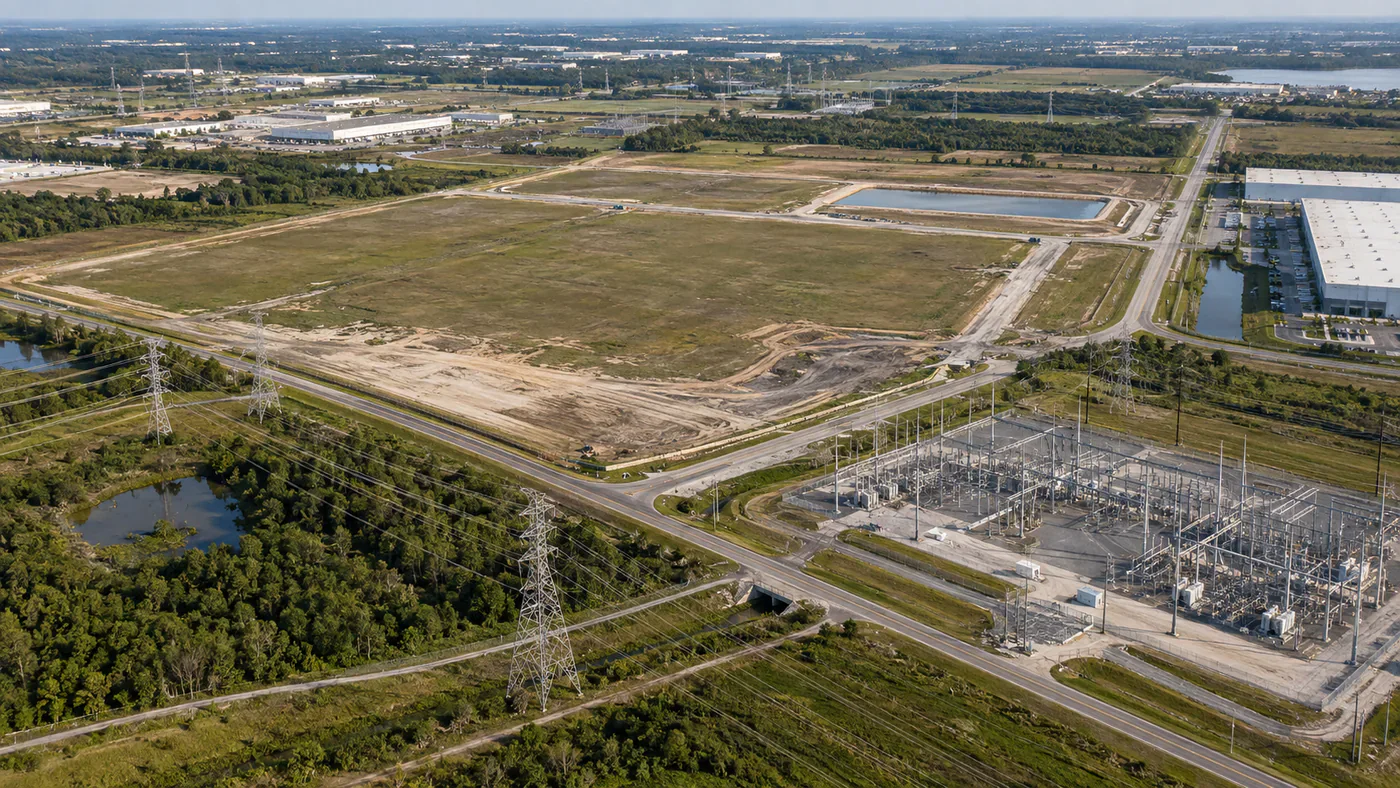
The cheapest parcel is rarely the cheapest data center site.
A site can look attractive on a land-price map and become uneconomic once the project discovers a five-year power path, a difficult substation upgrade, limited fiber diversity, water constraints, flood exposure, permitting risk or an expansion plan that does not fit the property.
That is why I would not treat data center site selection as a real-estate exercise. In 2026, it is closer to a deliverability exercise: can this location actually support the required megawatts, schedule, network architecture and operating model at an acceptable level of risk?
Power delivery now sets the order of site selection
The old site-selection sequence often started with market, land and connectivity, then moved into utilities. That order is increasingly backwards for large projects.
CBRE's H1 2026 North America data center research says power availability and infrastructure delivery timelines remain the most decisive factors influencing site selection, leasing and pricing. JLL's 2026 outlook makes the same point more directly: speed to power is now the primary site selection criterion, followed by community support, latency and proximity to customers.
Cushman & Wakefield's 2026 development cost guide adds an economic consequence. In primary U.S. markets, powered land averaged roughly $584,000 per MW in 2026 year-to-date, 51% higher than a year earlier. The premium is not simply for dirt. It is a premium for reduced execution risk.
The important distinction is not "near a substation" versus "far from a substation." It is whether capacity, interconnection scope, ownership, upgrades and delivery dates are sufficiently defined to support the project.
A data center site is a bundle of constraints
I would screen a site in eight layers. The first four can kill a project. The remaining four usually determine whether a viable project is also an attractive one.
Capacity, delivery date, voltage, interconnection work and expansion.
Zoning, permitting path, local support, environmental review and schedule.
Usable acreage, geotechnical conditions, drainage, floodplain and access.
Carrier access, route diversity, latency and scalable fiber architecture.
Cooling strategy, water availability, discharge, drought exposure and permits.
Land, power tariff, taxes, incentives, labor, civil works and financing carry.
Flood, wildfire, wind, seismic, utility, fuel and access risks.
Future megawatts, adjacent land, utility headroom and repeatable infrastructure.
Do not accept "power available" as an answer
Power due diligence needs to move from a marketing statement to a deliverable scope.
A broker may describe a property as having access to 100 MW because a transmission line or substation is nearby. That does not establish that 100 MW can be delivered to the site, at the required voltage, on the required date, without major system upgrades.
At minimum, I would want the power workstream to answer:
- How many megawatts are available for the first phase?
- How much additional capacity can be delivered later?
- What is the utility's current target energization date?
- What studies, deposits or agreements are still outstanding?
- What transmission, substation or feeder upgrades are required?
- Who owns and pays for each portion of the interconnection?
- What service voltage will be delivered?
- Is the quoted capacity firm, interruptible or subject to curtailment?
- What assumptions could move the delivery date?
Those questions connect directly to the economics discussed in our utility interconnection cost guide and transformer procurement guide. Site selection should use the same system boundary as the later project budget, otherwise costs migrate invisibly between "land," "utility" and "electrical infrastructure."
Time to power can outweigh land price
Consider two hypothetical sites for an 80 MW first phase.
This example does not prove that Site A is the better investment. A three-year timing advantage has to be valued against the land premium, financing structure, customer commitments and probability that the utility dates actually hold.
The point is narrower: comparing the two sites only on dollars per acre would ignore the variable most likely to control revenue timing.
Gross acreage is not usable acreage
Large campuses can require enormous sites. CBRE's 2026 midyear outlook notes continued site-selector preference for projects in new markets seeking 250+ MW with 125+ acres.
But acreage alone is a poor capacity metric.
Wetlands, floodplain, stormwater retention, setbacks, transmission easements, slopes, rock, poor soils, protected areas, utility corridors and road geometry can reduce the portion of a parcel that can actually support buildings and infrastructure.
The infrastructure reserve matters. A campus needs room not only for data halls, but also for substations, generators, cooling equipment, fuel systems, water infrastructure, security, roads, laydown areas and future construction.
That is why our data center land cost guide separates nominal land price from infrastructure value. A cheaper parcel can become more expensive after grading, retaining walls, deep foundations, utility extensions and off-site road work are included.
Zoning and community support have become schedule variables
Entitlement risk used to be treated as a legal workstream that followed technical site selection. It deserves to sit much earlier in the process.
CBRE reported in H1 2026 that local opposition and zoning delays are stalling projects across North America, making local approval as critical to site selection as power and fiber availability in some markets.
That does not mean a site should be rejected because a public hearing is required. It means the approval path should be mapped before the project assumes the land is developable on its target schedule.
Noise, generator testing, water consumption, visual impact, transmission lines, tax treatment and perceived pressure on the local grid can all become public issues. The commercial model should not assume that technical feasibility automatically becomes political feasibility.
Fiber availability is not the same as network resilience
A map showing fiber near the parcel is useful for screening. It is not enough for final selection.
For a large facility, I would separate four questions:
The FCC National Broadband Map can help identify reported fixed-service availability in the United States, including providers and technology. But the FCC itself notes that the map describes availability rather than actual network performance. For data center due diligence, it should be a starting point, not proof of route diversity, dark-fiber capacity or carrier-grade service.
Two carriers entering the property through the same conduit or following the same bridge crossing are not the same thing as two genuinely diverse network paths.
Water should be evaluated against the cooling design, not in isolation
"How much water is available?" is incomplete without "what cooling architecture are we planning?"
A facility using evaporative heat rejection has a different site profile from one designed around dry cooling or a hybrid strategy. AI and high-density deployments can also change heat-rejection requirements, making the relationship between rack density, climate and cooling design more important.
I would evaluate:
- source capacity and seasonal constraints;
- water quality and treatment requirements;
- municipal or utility connection capacity;
- drought exposure and future allocation risk;
- discharge or blowdown requirements;
- cooling-system water intensity;
- the cost and energy penalty of reducing water consumption.
USGS provides current and historical streamflow, groundwater and drought information through its national water-data systems. Those datasets can support regional screening, but project due diligence still needs the actual utility, rights and permit conditions that apply to the site.
For the engineering side of this tradeoff, see our data center water use guide and air vs. liquid cooling comparison.
The lowest electricity rate may not produce the lowest power cost
State-level industrial electricity prices are useful for market screening, but a hyperscale or wholesale data center is not an average industrial customer.
The real economic model can include:
- energy charges;
- demand charges;
- transmission and capacity charges;
- utility riders;
- minimum bills or contract demand;
- taxes and franchise fees;
- renewable or clean-energy products;
- interconnection contributions;
- backup or standby service terms.
EIA's monthly state data are useful for comparing broad industrial-price environments. Our electricity cost by state guide uses the same principle: treat public averages as a first-pass screening input, then replace them with the actual utility tariff and negotiated commercial terms.
Tax incentives should improve a viable site, not rescue a weak one
Sales-tax exemptions, property-tax abatements and investment incentives can materially change lifecycle economics. They can also distract a site team from more fundamental execution risks.
I would evaluate incentives after the site has passed the major deliverability gates.
An incentive package does not compensate for a site that cannot secure power until after the customer needs capacity.
Once a site is viable, incentives matter. Our state tax-incentive guide tracks how those programs affect the development case.
Natural-hazard risk belongs in the financial model
Data center resilience is often discussed as an engineering problem: redundant power paths, generators, UPS systems and cooling redundancy. Site geography sits underneath all of those systems.
Flooding, wildfire, extreme heat, wind, hail, earthquake, drought and winter weather can influence design, insurance, utility reliability, construction sequencing and operating procedures.
FEMA's National Risk Index evaluates 18 natural hazards and combines exposure, hazard frequency and historic loss information into expected annual loss metrics. FEMA's Flood Map Service Center remains the official source for National Flood Insurance Program flood-hazard information.
Those tools are useful screening inputs. They do not replace site-specific civil, structural, geotechnical, drainage or insurance analysis.
No large site is risk-free. The useful comparison is the cost and operational consequence of the risks that remain after mitigation.
Labor and logistics can separate a buildable site from a deliverable one
A site can pass power, land and fiber screening and still struggle to deliver at scale.
Cushman & Wakefield's 2026 development guide points to skilled-labor shortages and long equipment lead times as major cost pressures. It estimates average greenfield development cost for the most modern facilities in the United States and Canada at about $17.6 million per MW, excluding chips and GPUs, with power infrastructure the largest average cost category.
For site selection, I would therefore look beyond wage rates. The questions include whether the market has enough qualified electrical and mechanical labor, whether major equipment can reach the site, and whether local roads, bridges, laydown areas and crane access support the intended construction sequence.
A remote location with cheap land and power can still carry a logistics premium if the contractor ecosystem is thin or every specialized trade has to travel.
AI changes the value of expansion headroom
AI does not create a separate site-selection discipline, but it can make old assumptions fail faster.
Higher rack densities can increase electrical block size, cooling intensity and the importance of liquid-cooling infrastructure. A campus originally screened for conventional cloud density may still work, but the same acreage and utility capacity can support a different amount of IT load once the mechanical and electrical architecture changes.
That makes future headroom valuable.
I would distinguish:
- land headroom — can another building physically fit?
- power headroom — can the utility deliver another phase?
- substation headroom — can the electrical architecture scale?
- cooling headroom — can heat rejection scale with density?
- network headroom — can additional capacity be added on diverse routes?
Our capacity planning guide and rack density guide cover the downstream design consequences in more detail.
Use gates before weighted scoring
Site-selection matrices often create a false sense of precision. A location can score well on seven categories and still be unusable because the eighth category is a hard constraint.
I would use a two-stage process.
Remove sites that cannot meet required power, schedule, entitlement, physical or connectivity thresholds.
Compare cost, resilience, tax, sustainability, labor, scalability and commercial flexibility only after basic deliverability is proven.
This prevents a low land price or attractive tax package from mathematically compensating for a fatal power constraint.
A practical 2026 data center site-selection checklist
Power
- Initial MW and ultimate MW confirmed
- Target energization date documented
- Interconnection studies and upgrade scope understood
- Service voltage and ownership boundaries defined
- Tariff and large-load commercial terms reviewed
Land & civil
- Usable acreage calculated
- Geotechnical and topographic risks screened
- Floodplain, wetlands and drainage reviewed
- Road, heavy-haul and construction access checked
- Expansion area protected
Permitting
- Zoning path confirmed
- Environmental approvals mapped
- Generator and air permits assessed
- Local political and community risk reviewed
- Approval durations included in the schedule
Connectivity
- Carrier presence verified
- Physical route diversity verified
- Latency matched to workload
- Capacity and expansion options reviewed
- Single points of failure identified
Cooling & water
- Cooling concept aligned with climate
- Water source and capacity understood
- Drought and restriction exposure reviewed
- Discharge and treatment requirements identified
- Future high-density loads considered
Commercial & risk
- All-in land and sitework cost modeled
- Tax incentives separated from base feasibility
- Natural hazards quantified
- Insurance implications reviewed
- Labor, logistics and contractor depth assessed
How I would compare final candidate sites
Once the hard gates are passed, a weighted model becomes useful. The weighting should reflect the project rather than use one universal template.
These ranges are illustrative, not an industry standard. A latency-sensitive edge facility might increase the network weighting. A 500 MW AI campus might place even more weight on power, land scale and cooling resources.
So what makes a good data center site in 2026?
The strongest site is not necessarily the one with the cheapest land, lowest published electricity rate or largest incentive package.
It is the site where the project can convert land into operating IT capacity with the fewest unresolved constraints.
In 2026 that usually means proving power first, then proving schedule, physical feasibility, entitlement, connectivity and expansion. Cost optimization comes after those gates because a cheap site that misses the delivery window can be economically worse than an expensive site that reaches revenue sooner.
I would therefore summarize site selection with one question: what has to be true for this parcel to become a functioning data center, and how much uncertainty remains around each of those conditions?
The best due diligence does not eliminate uncertainty. It makes the uncertainty visible early enough to price it, mitigate it or walk away.
Sources and research notes
- CBRE — North America Data Center Trends H1 2026 . Used for current power-delivery, permitting and site-selection context.
- CBRE — U.S. Real Estate Market Outlook Midyear Review 2026: Data Centers . Used for large-campus site and power-procurement context.
- JLL — 2026 Market Outlook for Global Data Centers . Used for the current hierarchy of site-selection priorities.
- Cushman & Wakefield — 2026 Data Center Development Cost Guide . Used for powered-land, construction-cost and labor context.
- U.S. Energy Information Administration — Electric Power Monthly . Used for state-level industrial electricity-price context.
- Federal Communications Commission — National Broadband Map guidance . Used for broadband-availability screening limitations.
- FEMA — Flood Maps, National Risk Index and hazard tools . Used for natural-hazard screening context.
- U.S. Geological Survey — National Water Dashboard . Used for water-availability and drought-screening context.