
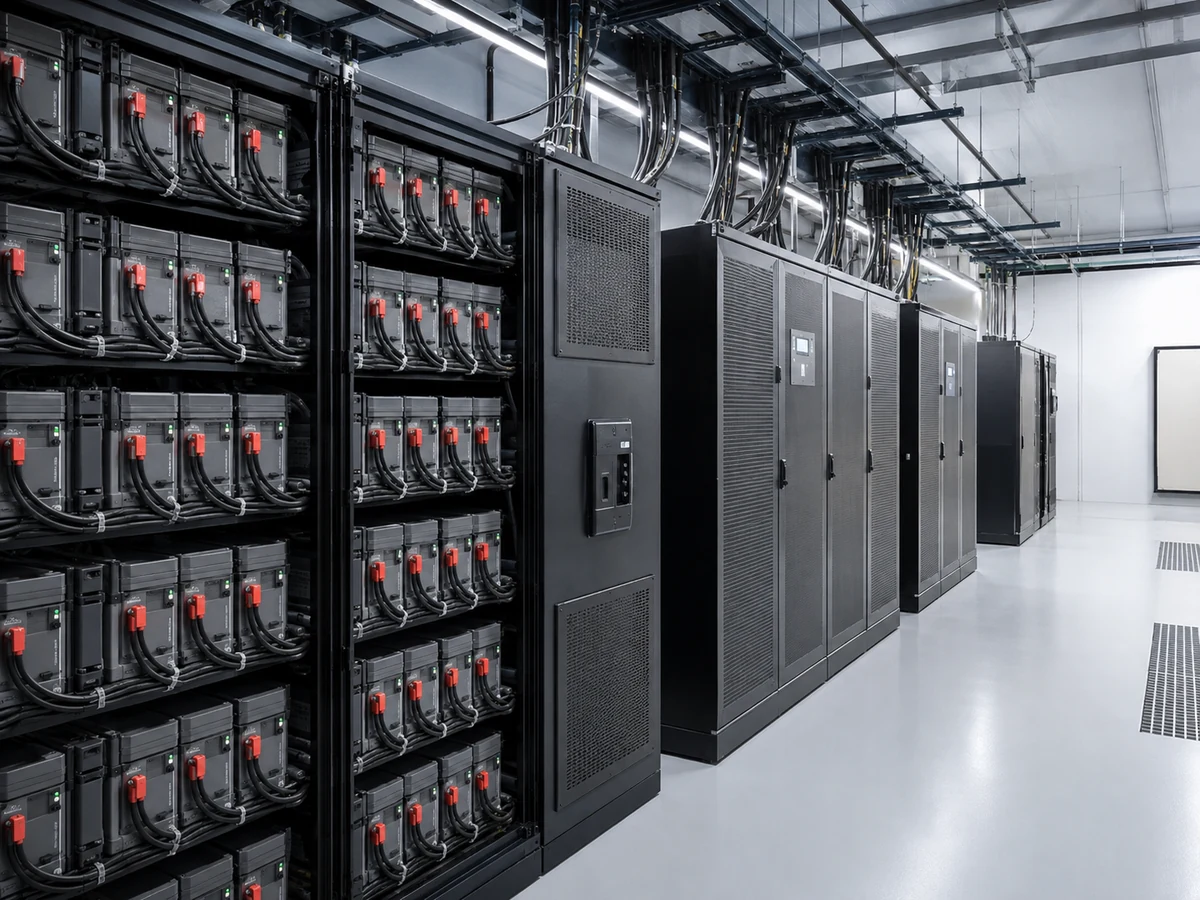
A 10 MW data center does not have a single 10 MW UPS price.
The cost depends on how much load actually needs uninterrupted power, how the UPS blocks are arranged, whether the architecture is N+1 or 2N, how much battery runtime is required and whether the battery system uses VRLA or lithium-ion technology.
The UPS itself is therefore only one layer of the budget. Batteries, bypass equipment, switchgear, cabling, controls, commissioning, replacement cycles and electrical losses can all change the economics.
Size from the critical load rather than automatically copying the facility's headline MW.
N+1 and duplicated power paths can push installed UPS capacity well above the load being protected.
Efficiency losses, maintenance and battery replacements belong in the economic comparison.
There is no defensible universal 2026 UPS price per kW
Public market data is much weaker for large UPS systems than it is for complete data center construction.
A May 2026 UPS purchasing guide from SecondWatt reached a useful conclusion: the available public source set does not support a universal price range for three-phase data center UPS deployments.
That matches how I would approach the problem. A $/kW figure without a redundancy topology, battery package, runtime and installation boundary is not a comparable benchmark.
Older infrastructure benchmarks have placed UPS equipment at roughly $0.8 million per MW. That can still be useful as a historical screening reference, but I would not relabel it as a current turnkey 2026 quote.
Cushman & Wakefield's September 2026 development guide gives the more important current context. Power infrastructure now represents an average 21% of modern greenfield development cost, the largest category in its dataset.
Batteries, bypass paths, electrical distribution, controls, installation and commissioning can sit outside the UPS cabinet price.
UPS sizing should begin with critical load rather than building MW
Assume a project is described as a 20 MW data center. That does not tell us how many UPS megawatts to buy.
The 20 MW could mean IT design capacity. It could refer to delivered utility capacity. It might even describe a future campus phase rather than the first operating building.
UPS capacity should instead follow the load that requires continuous conditioned power through an upstream disturbance and during the transition to longer-duration backup power.
Redundancy can make installed UPS MW very different from protected MW
Imagine a 6 MW critical load divided into three 2 MW blocks.
In an N configuration, three 2 MW blocks could theoretically support the full requirement. Add one equivalent redundant block and installed capacity becomes 8 MW.
This is only an arithmetic example. Real UPS blocks, bypass arrangements and redundancy architectures are more nuanced.
The important point is that cost should be divided by both installed UPS kW and protected critical kW. Those are not necessarily the same denominator.
Large UPS blocks are getting larger as AI infrastructure scales
UPS equipment itself is changing with data center density.
In August 2026 Vertiv expanded its PowerUPS 9000 family with a 1.8 MW model designed for large-scale data centers and high-density AI infrastructure.
Vertiv specifically highlights control capabilities intended to handle the rapid power changes associated with AI workloads.
Eaton's current data center portfolio includes the 9395X platform in the 1 MW to 1.7 MW range.
This does not mean every AI data center should simply buy larger UPS blocks. Larger blocks can reduce equipment count, while smaller modular blocks can improve phasing and granular redundancy.
Modularity changes both CAPEX and stranded capacity
A monolithic design can appear cheaper when the full final load is installed immediately.
But many data centers do not reach final design load on day one. Installing UPS capacity in phases can defer capital and reduce the amount of power infrastructure sitting unused during early occupancy.
- Fewer initial units
- Potentially simpler large-block design
- More capital committed before load arrives
- Better alignment with deployment phases
- Less early stranded UPS capacity
- More modules, interfaces and expansion planning
The batteries deserve their own lifecycle model
UPS battery cost is not just a first-year procurement question.
Eaton's current three-phase UPS battery handbook gives a standard service-life reference of approximately three to five years for VRLA batteries and around 10 years for lithium-ion batteries, while noting that actual life depends heavily on operating conditions, discharge cycles and maintenance.
Eaton's lithium-ion guidance elsewhere places lithium-ion life at approximately 10 to 15 years compared with 3 to 5 years for lead-acid systems.
That means a 10-year TCO comparison can produce very different battery replacement schedules even when both systems protect exactly the same load.
I would not convert those lifecycle references directly into guaranteed replacement dates. Temperature, battery management, cycling and site conditions can materially change actual service life.
More batteries increase runtime, not UPS power capacity
This distinction is easy to miss in concept budgets.
Eaton explicitly notes that adding more batteries can increase runtime, but it does not increase the power capacity of the UPS.
A project therefore has two independent sizing questions:
- How many kW or MW must the UPS support?
- How long must the battery system support that load?
Ten minutes of runtime and five minutes of runtime can require different battery systems while using the same UPS power block.
Efficiency creates an operating cost that belongs beside CAPEX
Current large UPS systems can operate around the high-90% efficiency range.
Eaton lists up to 97.5% efficiency for its 9395X platform, while the 93PM G2 and Vertiv Liebert EXL S1 publish figures around 97% in double-conversion operation.
A few tenths of one percentage point look insignificant until the UPS operates continuously at megawatt scale.
This is not a product comparison or expected operating result. Real efficiency varies with load and operating mode.
It simply shows why UPS losses deserve a place in a multi-year financial model rather than disappearing inside the facility PUE.
Economizer modes can improve efficiency but change the engineering question
Several current UPS platforms advertise efficiency approaching 99% in energy-saving or economization modes.
I would not treat that as a free TCO improvement.
The operating mode affects the power path and therefore needs to be evaluated against the facility's power-quality requirements, transfer behavior and resilience philosophy.
A cost model should use the efficiency of the operating mode the data center actually expects to run, not simply the highest percentage on the product page.
A UPS budget should have at least seven separate lines
Rectifier, inverter and power electronics.
Battery cabinets or racks, monitoring and battery management.
Static and maintenance bypass equipment and associated paths.
Equipment needed to connect the UPS into the wider power train.
Cabling, busway, labor, rigging, terminations and integration.
Functional testing, load testing and integrated system testing.
Battery replacement, service and eventual power-electronics renewal.
The cheapest UPS quote can simply contain the smallest scope
Quote normalization matters here for the same reason it matters with generators.
Before comparing dollars per kW I would verify:
- UPS output rating and power factor;
- number of modules and redundancy;
- battery chemistry and runtime;
- battery cabinets and monitoring;
- bypass equipment;
- input and output switchgear;
- freight and rigging;
- installation labor;
- startup and commissioning;
- service agreement and warranty.
A quote that excludes batteries should obviously not be normalized against one that includes a complete battery plant.
How I would build a concept-stage UPS budget in 2026
- Define the critical load requiring UPS protection.
- Add credible near-term growth rather than the theoretical maximum campus load.
- Choose the redundancy architecture before calculating $/kW.
- Select an initial module or block size and calculate installed UPS capacity.
- Define battery runtime and chemistry separately.
- Add bypass, switchgear, installation and commissioning explicitly.
- Model electrical losses using expected load and operating mode.
- Add battery replacements and major maintenance to the lifecycle case.
- Replace benchmarks with vendor quotations as design maturity improves.
So what does a data center UPS cost in 2026?
The public evidence does not support one reliable turnkey number per kW across large three-phase data center UPS deployments.
That is not a reason to abandon cost benchmarking. It is a reason to benchmark the system properly.
I would keep four numbers visible: protected kW, installed UPS kW, initial CAPEX and 10-year lifecycle cost.
Once those boundaries are fixed, vendor quotes become comparable. Before that, a single $/kW figure can create more false precision than useful information.
Sources and research notes
- Vertiv — PowerUPS 9000 1.8 MW expansion, August 2026 . Used for current high-density UPS scale and AI-load context.
- Eaton — Data Center UPS Systems . Used for current capacity, efficiency and battery-technology context.
- Eaton — Three-Phase UPS Battery Handbook . Used for battery lifecycle and runtime-sizing context.
- SecondWatt — 2026 Data Center UPS Pricing Guide . Used for procurement and public-benchmark limitations.
- Cushman & Wakefield — 2026 Data Center Development Cost Guide . Used for current overall power-infrastructure cost context.