
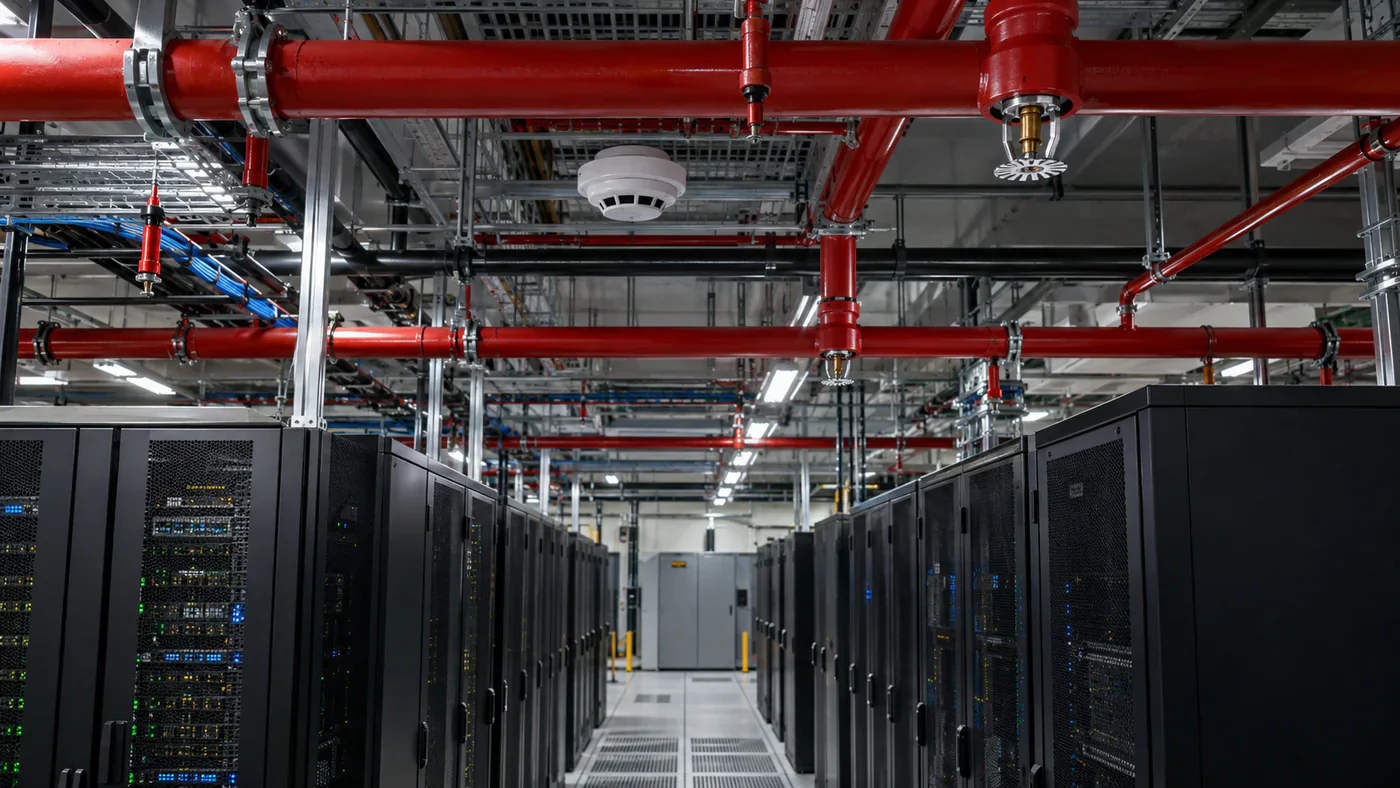
Data center fire protection is not a choice between water and gas. It is a layered system that has to detect a problem early, control or extinguish it, protect people, limit collateral damage and return the space to service without creating a second failure.
That makes fire suppression a reliability decision as much as a life-safety decision.
A data hall protected only by a conventional sprinkler system may satisfy one part of the risk picture but still expose sensitive electronics to water and extended cleanup. A clean-agent system may suppress an early fire without residue, but it depends on detection, enclosure integrity, pressure management and the ability to retain the design concentration long enough to work.
The best design is therefore not the system with the most expensive agent. It is the system whose detection, suppression and recovery strategy match the facility's actual hazards and acceptable downtime.
Aspirating and multi-criteria detection can identify smoke before conventional ceiling detectors would react in high-airflow spaces.
Pre-action water, clean agent, water mist and other systems solve different fire and collateral-damage problems.
Cleanup, recharge, room access, agent replacement and equipment inspection determine how quickly the data hall can return to service.
Start with the fire scenario, not the suppression technology
A data center contains several very different hazards inside one building.
A data hall, UPS room, battery room, generator enclosure, office area and electrical switchroom should not automatically receive the same fire protection strategy.
Johnson Controls' 2026 data center fire protection guidance makes the same point: start with risk rather than technology. High airflow, criticality, equipment value, acceptable extent of damage and recovery objectives all affect the protection architecture.
Early smoke movement, sensitive equipment and continuity requirements.
Battery chemistry can introduce thermal runaway, gas release and re-ignition concerns.
Switchgear, transformers and cabling create different ignition and access conditions.
Combustible liquids and mechanical equipment create a different fire profile from the white space.
Detection is often the highest-value part of the system
Fire suppression gets most of the attention because it is the dramatic part of the system. In a data center, early detection may be more valuable.
High-volume cooling airflow can dilute and transport smoke before a conventional spot detector reaches its alarm threshold.
Aspirating smoke detection changes the detection method. A network of sampling pipes continuously draws air back to a highly sensitive detector, allowing staged alarms at very low smoke concentrations.
Johnson Controls identifies aspirating detection as particularly useful in high-airflow environments, and VESDA describes the same advantage for data centers: incipient detection, multiple alarm thresholds and remote diagnostics.
Staged detection can also reduce the chance that a single nuisance signal initiates an unnecessary discharge.
Pre-action sprinklers remain the foundational water-based option
Pre-action systems are widely used in data halls because the sprinkler piping is normally dry until the detection system confirms a fire event.
That creates an extra barrier between a damaged sprinkler head and an accidental water release.
Johnson Controls describes pre-action systems as particularly suitable for data halls for exactly that reason: they reduce the risk of unintended discharge while retaining broad water-based fire protection.
The exact sequence depends on whether the system is single-interlock, double-interlock or another approved configuration.
The important economic point is that a pre-action system costs more than conventional wet pipe because it adds detection logic, valves, controls and more complex commissioning.
Clean agent systems solve the collateral-damage problem
Gaseous clean-agent systems are attractive in electronic spaces because the extinguishing medium is electrically nonconductive and leaves little or no residue.
NFPA 2001 is the principal U.S. standard for clean agent extinguishing systems. Current NFPA documentation lists the 2025 edition, and clean agent guidance specifically recognizes electrical and electronic hazards as typical applications for total-flooding systems.
Data center clean-agent systems generally fall into two broad families: inert gases and halocarbon agents.
Extinguish primarily by reducing the oxygen concentration. They typically require large storage volume but use naturally occurring gases.
Achieve design concentration with lower storage volume, but environmental profile, future availability and agent policy should be evaluated carefully.
Johnson Controls' current data center guidance emphasizes both inert and halocarbon systems for critical electronic spaces.
The room is part of the clean-agent system
A total-flooding agent works only if the enclosure can hold the required concentration.
Cable penetrations, raised-floor openings, doors, dampers, wall joints and other leakage paths can let agent escape faster than the design assumes.
That is why room-integrity testing matters.
A door-fan test measures enclosure leakage and predicts whether the room can retain the required concentration without discharging the actual cylinders.
If walls, doors and penetrations cannot retain agent, adding more agent is not necessarily the right fix.
Room integrity also changes over time. New cable penetrations, raised-floor modifications and construction work can alter leakage after the original commissioning test.
Pressure relief can be as important as room sealing
Total-flooding systems rapidly introduce a large volume of gas into an enclosed room.
That can create positive or negative pressure transients depending on the agent and discharge sequence.
Pressure-relief vents may therefore be required to protect walls, doors and ceiling systems while still maintaining enough enclosure integrity for the agent to remain effective.
This is one of the hidden costs that makes a clean-agent budget larger than "cylinders + pipe."
Water mist sits between sprinklers and gaseous suppression
Water mist uses very small droplets to cool the fire, attenuate heat and locally displace oxygen as droplets vaporize.
NFPA 750 is the U.S. standard governing water mist systems. Current NFPA material describes water mist as a water-based suppression technology using very fine sprays, with applications designed around tested and listed system configurations.
Siemens states that its high-pressure water mist systems can use up to 80% less water than conventional sprinklers in applicable designs, while Johnson Controls describes low-pressure water mist as an option validated through full-scale tests for data center areas including hot aisles, raised floors and concealed spaces.
Can reduce collateral water damage and stored-water infrastructure compared with conventional sprinkler discharge.
Nozzle spacing, pressure, obstructions and listed design conditions matter. The system cannot be designed as a generic low-water sprinkler.
Clean agent and pre-action are often layered rather than mutually exclusive
One of the most common mistakes in fire-protection discussions is to frame clean agent and sprinklers as competing systems.
Many facilities use both.
Johnson Controls' 2026 data center guidance describes a pragmatic layered pattern: very early warning detection, pre-action sprinklers as foundational building protection, and gaseous total-flooding systems in mission-critical spaces.
The clean-agent system can attack the fire early without residue. The sprinkler system remains available if the event develops beyond the gaseous system's design case.
Suppression cost is mostly about system boundary
There is no credible universal fire suppression cost per square foot for data centers.
A small enterprise room with pre-action sprinklers and aspirating detection has a fundamentally different cost structure from a hyperscale hall with clean-agent flooding, reserve cylinders, pressure relief, multiple detection zones and redundant control infrastructure.
I would build the cost model by system layer.
Aspirating detectors, sampling pipe, spot detectors, interfaces, alarm panels and network integration.
Pre-action valves, piping, sprinklers or mist nozzles, pumps, tanks and nitrogen systems where applicable.
Agent cylinders, manifolds, piping, nozzles, release controls and reserve agent strategy.
Penetration sealing, doors, dampers, pressure relief and enclosure testing.
Shutdown logic, HVAC interfaces, BMS signals, alarms, abort functions and remote monitoring.
Cause-and-effect testing, detector verification, room-integrity tests, flow tests and integrated failure scenarios.
Cylinder checks, detector service, valve testing, water system inspection and periodic functional tests.
Reserve cylinders, replacement components and spare detectors can reduce post-discharge downtime.
Reserve agent can be a business-continuity investment
A clean-agent system can perform exactly as intended and still leave the data hall exposed after discharge if replacement agent is not immediately available.
Johnson Controls highlights reserve containers as one way to accelerate post-event reinstatement.
That creates a simple business question: how long can the facility operate without the primary gaseous protection system restored?
The value depends on refill lead time, site criticality, available alternate protection and whether a discharged zone can remain occupied.
False discharge risk deserves its own cost line
A suppression event does not need a real fire to be expensive.
An accidental clean-agent discharge can trigger evacuation, shutdown sequences, cylinder replacement, investigation and downtime. An accidental water discharge can add equipment damage and cleanup.
That is why release logic, detector zoning, abort functions, maintenance controls and impairment procedures deserve the same attention as the suppression medium itself.
The financial model should consider both fire loss and false-operation loss.
Airflow can determine whether detection and suppression behave as expected
Modern data halls move extraordinary volumes of air.
Containment, CRAH fans, rear-door heat exchangers and liquid-cooled architectures can all change air movement inside the room.
That affects smoke transport, detector location and the distribution of gaseous agents.
A design that worked in an open 8 kW/rack room should not automatically be copied into a contained 80 kW/rack AI hall without reviewing airflow and compartment geometry.
This is one reason fire-protection design should be coordinated with the thermal design rather than completed in isolation.
Hot-aisle containment can create hidden detection zones
Containment improves cooling performance by controlling air paths. It can also create semi-enclosed spaces in which smoke behaves differently from the room outside.
Detectors and suppression nozzles need to account for those spaces.
Water mist listings, sprinkler obstruction rules and gaseous-agent discharge patterns can all be affected by physical barriers.
A late containment redesign can therefore become a fire-protection change order rather than a purely mechanical change.
Lithium-ion UPS systems change the suppression problem
Lithium-ion batteries introduce a different failure mechanism from conventional electronic equipment.
Thermal runaway can release heat and flammable gases, propagate between cells or modules and create re-ignition risk.
Johnson Controls' March 2026 data center guidance is explicit that lithium-ion battery risk requires a prevention-first approach including off-gas monitoring, compartmentation and system-specific protection rather than reliance on one suppression technology.
UL 9540A is the U.S. and Canadian test method used to evaluate thermal runaway propagation behavior in energy storage systems. UL Solutions notes that the 2026 edition of NFPA 855 places increased emphasis on large-scale fire testing, and UL 9540A evaluates fire spread, gas release, deflagration and suppression performance at multiple levels.
Battery chemistry, rack configuration, ventilation, gas detection, separation and tested propagation behavior should drive the strategy.
Clean agent does not stop every battery failure mechanism
A gaseous agent can extinguish flame, but thermal runaway is an electrochemical process that can continue generating heat inside a cell.
That distinction matters.
The suppression strategy needs to be based on the tested behavior of the actual battery system, not on the assumption that an agent suitable for electronic cabinets is automatically sufficient for a large lithium-ion installation.
UL 9540A large-scale testing exists precisely because propagation behavior can vary between battery products and installation arrangements.
Passive fire protection is part of the system
Detection and suppression receive most of the engineering attention, but compartmentation controls how far a fire can spread before active systems or the fire service contain it.
UL Solutions' data center fire-safety guidance emphasizes early coordination of passive and active fire protection, especially because data centers contain large numbers of cable, duct and pipe penetrations through fire-resisting assemblies.
Firestopping is therefore not a cosmetic closeout item.
The AHJ can change the design economics
Fire-protection designs do not exist in a vacuum.
The authority having jurisdiction, insurer, fire marshal and owner standards can all affect acceptable system architecture.
A design that is technically feasible may need additional testing, redundant water supply, different battery separation or a different suppression method to satisfy local requirements.
The cost implication is straightforward: engage the AHJ early enough that compliance is not discovered after procurement.
Water supply can become a site-level issue
A large pre-action or water mist system still depends on an adequate water supply.
Depending on the site, that may involve municipal pressure, fire pumps, dedicated tanks, underground mains or redundant water infrastructure.
Water mist can reduce required flow in approved applications, but it may add specialized pumps, stainless piping or proprietary components.
The right comparison therefore includes both the distribution network and the source infrastructure.
Data hall size changes clean-agent economics quickly
Total-flooding gaseous systems are strongly influenced by protected room volume.
A larger room means more agent, more cylinder storage, larger piping and potentially more pressure relief.
That can make a very large undivided hall expensive to protect with gas.
Compartmentation can reduce the size of each protected zone, but it also adds walls, doors, controls and operational boundaries.
Simpler zoning, but larger agent quantity and potentially larger discharge event.
Lower agent quantity per discharge, but more walls, controls, valves, penetrations and testing.
A 20,000-square-foot example shows why scope matters more than area
Consider two hypothetical 20,000-square-foot data halls.
This is an original scenario, not a market-price benchmark.
It illustrates why a simple dollars-per-square-foot number is not enough to price fire protection.
Commissioning should prove the sequence, not just the components
Fire systems are highly integrated.
A detector signal may need to trigger alarms, shut down airflow, close dampers, release a pre-action valve, start a timer, sound pre-discharge notification, release agent, report to the BMS and signal the fire alarm network.
Testing each device individually does not prove the full sequence works.
Integrated testing should therefore be part of the commissioning plan, not a late fire-alarm closeout activity.
Maintenance cost depends on how specialized the system becomes
A conventional sprinkler system has a broad service ecosystem.
Specialized clean-agent or water mist systems can rely more heavily on manufacturer-specific cylinders, valves, nozzles, control modules and trained technicians.
That does not make specialized systems a poor choice. It means lifecycle serviceability belongs in procurement.
I would ask:
- How many qualified service providers operate in the market?
- Are replacement cylinders or valves locally stocked?
- How long does recharge take after discharge?
- Are proprietary tools or software required?
- Can one spare component support multiple zones?
- What testing interrupts normal data hall operation?
Environmental policy can change agent selection
Halocarbon clean agents differ in global warming potential and regulatory profile.
Johnson Controls' 2026 guidance recommends favoring lower-GWP agents such as FK-5-1-12 or naturally occurring inert gases when environmental objectives are part of the design.
Agent availability and future policy should therefore be reviewed over the expected service life rather than treated as a one-time procurement question.
Inert gases avoid some fluorinated-agent concerns but can require much larger storage volume, which creates its own building and cost impact.
Recovery time should be designed before the fire occurs
Fire protection often stops at successful extinguishment.
Operations teams need a second plan: how does the room return to service?
Little residue, but the system may remain impaired until cylinders are replaced.
Water exposure and cleanup can extend the recovery window.
Lower water volume can reduce collateral cleanup, but components still need inspection and reset.
The recovery plan should identify spare inventory, specialist contractors, temporary protection measures and the conditions required before the space can be reoccupied.
How I would build a data center fire-protection budget
- Define the fire scenarios by room rather than applying one building-wide suppression technology.
- Set the acceptable extent of damage and maximum tolerable downtime.
- Design detection before choosing the suppression medium.
- Establish code, insurer and AHJ requirements early.
- Price water-based protection as a complete system including supply, pumps, valves, piping and testing.
- Price gaseous systems including agent, cylinders, piping, pressure relief, room sealing and integrity testing.
- Evaluate water mist only against a listed and tested application for the actual room geometry.
- Treat lithium-ion battery areas as a separate hazard and use system-specific test evidence.
- Include BMS, HVAC and fire-alarm integration.
- Include integrated commissioning and cause-and-effect testing.
- Add inspection, maintenance and post-discharge recovery costs.
- Decide whether reserve agent or spare components are justified by the recovery objective.
So which fire suppression system is best for a data center?
There is no single best suppression technology for every data center.
Pre-action sprinklers remain a strong foundational protection layer. Clean agents can extinguish early fires without residue in high-value electronic spaces. Water mist can reduce water demand and collateral damage where the tested application fits. Lithium-ion battery spaces may need a different strategy again, based on tested propagation behavior and gas-management requirements.
The most defensible design is layered: detect early, suppress with the medium appropriate to the hazard, limit fire spread physically and plan the recovery before an incident occurs.
From a cost perspective, the biggest mistake is to compare only the suppression hardware.
The real project cost includes detection, enclosure work, water supply, controls, testing, maintenance, reserve inventory and the downtime associated with both a real fire and an accidental discharge.
A system that costs more to install can still be cheaper if it reduces the probability of a large outage or returns the protected room to service faster after an event.
Sources and research notes
- Johnson Controls — Fire Protection of Data Centers: Balancing Economics, Environment and Uptime . March 2026 guidance used for layered protection, early detection, clean agent, water mist, lithium-ion and recovery context.
- Johnson Controls — Data Center Fire Protection . Used for current aspirating detection, pre-action, water mist and gaseous suppression application context.
- UL Solutions — Fire Safety in Data Centers . Used for early fire-engineering coordination, passive protection and battery-risk context.
- UL Solutions — UL 9540A Test Method . Used for lithium-ion thermal runaway and large-scale battery fire testing context.
- NFPA — NFPA 2001, Standard on Clean Agent Fire Extinguishing Systems . Used for clean-agent system and electrical/electronic hazard context.
- NFPA — NFPA 750, Standard on Water Mist Fire Protection Systems . Used for water mist system design and testing context.
- Siemens — Sinorix Water Mist Fire Suppression . Used for current water-mist operating principles and water-use context.
- VESDA — Aspirating Smoke Detection for Data Centers . Used for early-warning detection and staged alarm context.