
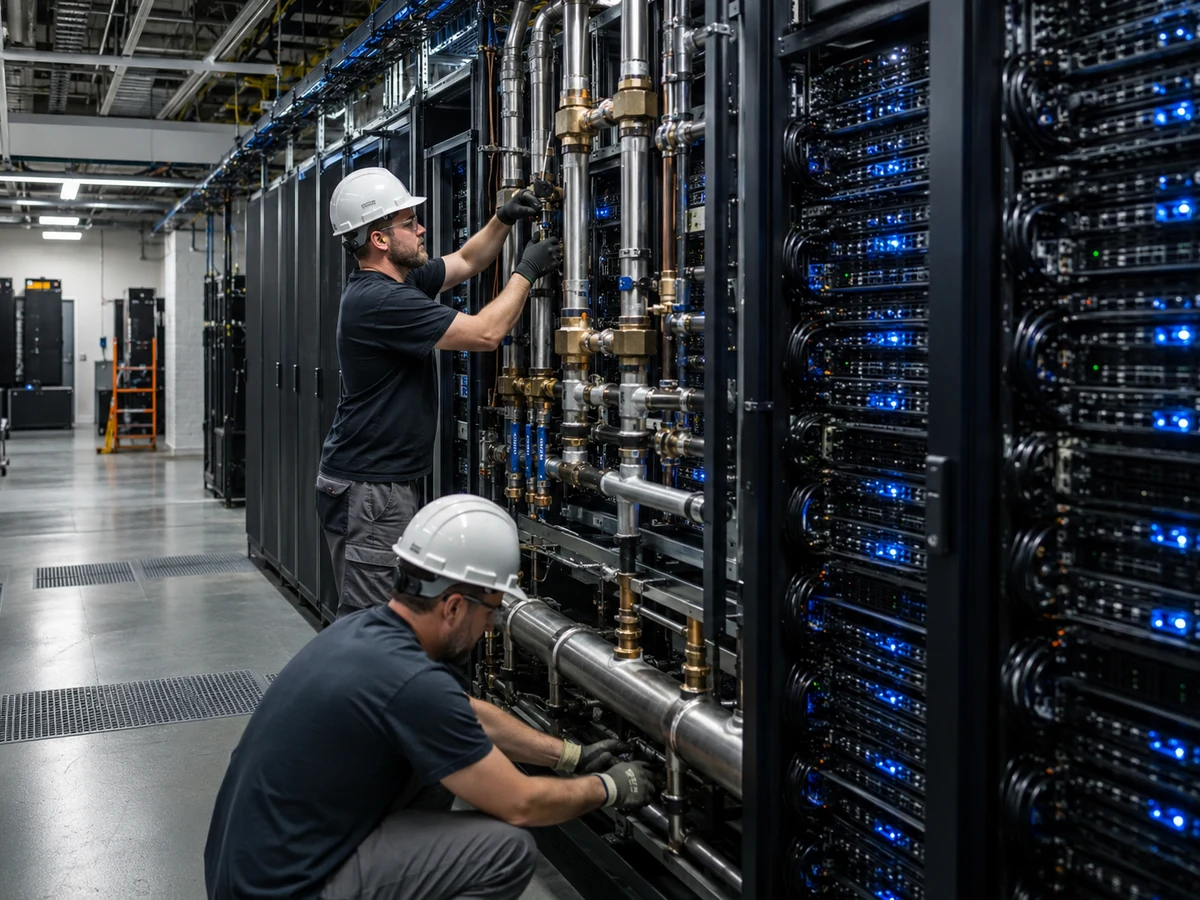
Retrofitting an existing data center for AI is not simply a matter of replacing air cooling with liquid cooling.
High-density GPU infrastructure can change the power path, rack layout, cooling distribution, structural loads, controls, operating procedures and the amount of useful capacity that remains elsewhere in the hall.
That is why the right economic question is not “What does a CDU cost?” It is: “What does it cost to turn an existing MW into usable AI-ready MW without destroying the value of the facility around it?”
CDUs, secondary loops, piping, heat rejection and residual air cooling all have to work together.
Legacy busway, PDUs and branch circuits may have been designed for a fraction of modern AI rack density.
Migration, phasing, maintenance windows and tenant disruption can materially change the investment case.
The strongest 2026 public benchmark is about $2 million per MW
STL Partners published one of the clearest current cost references in May 2026.
Its research estimates that converting existing data center capacity for liquid cooling requires approximately $2 million per MW of retrofit CAPEX, compared with more than $11 million per MW for new greenfield liquid-cooled capacity.
On headline CAPEX alone, that makes retrofit dramatically cheaper than building a new AI-ready facility from scratch.
I would still treat the $2 million figure as a planning benchmark, not a universal turnkey price.
STL's research was commissioned with support from Airedale and is based on interviews across the data center ecosystem plus the firm's broader advisory work. The report also explicitly warns that headline retrofit CAPEX can exclude commercial consequences such as workload migration, downtime risk, lost tenancy revenue and legacy-site constraints.
The retrofit can be a power project disguised as a cooling project
Schneider Electric's 2026 EcoStruxure Reference Design 99 is useful because it shows what an actual mixed-density retrofit can look like.
One retrofit scenario starts with 80 conventional 12 kW air-cooled racks and adds an AI cluster containing eight 73 kW liquid-cooled AI racks plus eight 40 kW networking racks.
Total modeled IT load is 1.864 MW.
The interesting part is not only the liquid loop. The electrical distribution changes with density.
Schneider's design uses 250 A busway for groups of 12 kW racks and 800 A busway for the liquid-cooled AI cluster. The 73 kW AI racks use multiple high-current feeds with redundant A- and B-side distribution.
That is why I would never price an AI retrofit from cooling hardware alone.
There are several retrofit paths between “air cooled” and “new building”
An existing facility does not have to become fully liquid cooled in one project.
Rear-door heat exchangers or other localized approaches can raise density while retaining much of the room-level cooling architecture.
A technology cooling loop serves liquid-cooled racks while the CDU rejects the heat back into the existing room air system.
CDUs connect the technology loop to facility water, requiring more piping and closer integration with the mechanical plant.
Power, cooling plant, heat rejection and room architecture are redesigned around sustained high-density AI deployment.
Schneider's reference design demonstrates why liquid-to-air can be attractive in a brownfield facility: it allows direct-to-chip racks to be deployed where a dedicated facility-water connection is not available at the rack.
The tradeoff is that the heat still has to be rejected into the room, so the existing air-cooling system remains part of the capacity limit.
The hidden retrofit ledger is wider than cooling
Existing utility capacity, UPS blocks, transformers, switchgear, busway and branch distribution.
New busway, rack PDUs, protection, monitoring and redundant feeds.
CDU capacity, redundancy, pumps, controls, manifolds, hoses and quick disconnects.
Chilled-water connections, fan walls, heat exchangers, heat rejection and hydraulic changes.
Rack weight, piping routes, ceiling or floor congestion and maintenance clearances.
Monitoring, alarms, valve control, automatic shutdown logic and integration into BMS/DCIM.
Moving workloads or creating swing capacity while sections of the live hall are modified.
Pressure testing, flushing, controls validation, failure scenarios, staff training and handover.
A technically possible retrofit can still be economically weak
CBRE's H1 2026 North American market report says liquid-cooled retrofits for GPU densities continue to increase in popularity.
It alsolder air-cooled facilities can become concentrated into a smaller number of very high-density racks. That can leave parts of the available floor area underutilized.
This is the stranded-capacity problem.
Power and cooling were distributed relatively evenly across a larger amount of white space.
Electrical capacity can be consumed before the physical rack positions are full.
A retrofit can therefore create premium AI capacity while simultaneously making some legacy white space less useful.
The lost value of that stranded area belongs in the commercial model, even though it may never appear on an engineering invoice.
Live-site disruption may matter more than the equipment premium
CBRE reports that ready-for-service fit-out periods for existing air-cooled data centers converting to liquid cooling can extend beyond six months.
That does not mean every retrofit takes six months. It does show that conversion is no longer necessarily a minor tenant fit-out.
Existing workloads may need to remain online while contractors install new piping, busway and cooling equipment around them.
The commercial cost can include maintenance windows, phased rack migration, temporarily unavailable capacity, lost rent and additional contractor premiums for working in a live mission-critical environment.
A retrofit with lower construction CAPEX can still lose against greenfield if disruption destroys too much operating value.
Power availability is the strongest argument for reusing an existing site
The economics change radically when the existing facility already holds a scarce and usable grid connection.
STL Partners specifically identifies power-constrained markets as places where retrofit becomes strategically attractive because existing energized capacity can be more valuable than the building itself.
Schneider makes the same point from the infrastructure-planning side: existing facilities have viable retrofit options precisely because new grid capacity and greenfield delivery can be much slower.
A technically imperfect building with secured power can therefore be a better AI candidate than a perfect parcel that cannot be energized for several years.
The $2M/MW benchmark needs a viability test before it enters the budget
I would use STL's figure as an initial benchmark and then test whether the specific asset deserves to stay near it.
If several of those answers are weak, the headline retrofit benchmark becomes less relevant because the enabling work starts to dominate.
A phased retrofit can protect both capital and uptime
Brownfield modernization does not have to begin with the entire campus.
Schneider and Vertiv both emphasize modular approaches that can add liquid-cooled capacity at rack, row or pod level while retaining conventional infrastructure elsewhere.
That can be economically useful when AI demand is still developing. The operator can convert one zone, observe real operating behavior and expand only when customer demand justifies the next phase.
The tradeoff is that repeated phases can create more interfaces and mobilizations than one large conversion.
When would I retrofit instead of build new?
Retrofit has the strongest economic argument when the existing asset has something that is difficult to recreate: power, location, connectivity, customer proximity or a meaningful time-to-market advantage.
I would be more cautious when the building already has constrained electrical distribution, limited heat rejection, structural problems and a full hall of customers who cannot be moved.
- Existing grid capacity is valuable
- AI demand is already committed
- Conversion can be phased
- Cooling plant has usable headroom
- Downtime exposure is manageable
- Deep electrical replacement is required
- Heat rejection is fundamentally undersized
- Live-site disruption is unacceptable
- Structural constraints are extensive
- Long-term density needs justify a purpose-built facility
So what does an AI data center retrofit cost in 2026?
The most useful current public benchmark is approximately $2 million per MW for a liquid-cooling retrofit, according to STL Partners, versus more than $11 million per MW for new liquid-cooled greenfield capacity.
I would not interpret that as $2 million multiplied by every MW in an existing building.
The correct denominator is the capacity actually being converted, and the economic model should add power upgrades, migration, stranded space, lost revenue, commissioning and live-site risk where those costs sit outside the headline retrofit scope.
The better screening equation is: AI retrofit value = cost of converted MW + disruption cost versus cost and delivery time of equivalent new capacity.
In power-constrained markets, that comparison can strongly favor retrofit. In a fundamentally unsuitable legacy building, the same calculation can point in exactly the opposite direction.
Sources and research notes
- STL Partners — Liquid cooling retrofits can cost roughly 80% less, May 2026 . Used for the ~$2M/MW retrofit and $11M+/MW greenfield comparison.
- STL Partners — The Retrofitting Roadmap . Used for methodology, hidden-cost and retrofit-viability context.
- Schneider Electric — EcoStruxure Reference Design 99 . Used for the 1.864 MW mixed-density retrofit example and power/cooling architecture.
- CBRE — North America Data Center Trends H1 2026 . Used for retrofit adoption, stranded white-space and fit-out timing.
- Vertiv — Implementing Liquid Cooling at Existing Data Centers . Used for retrofit power, rack, mechanical and technical-space considerations.