
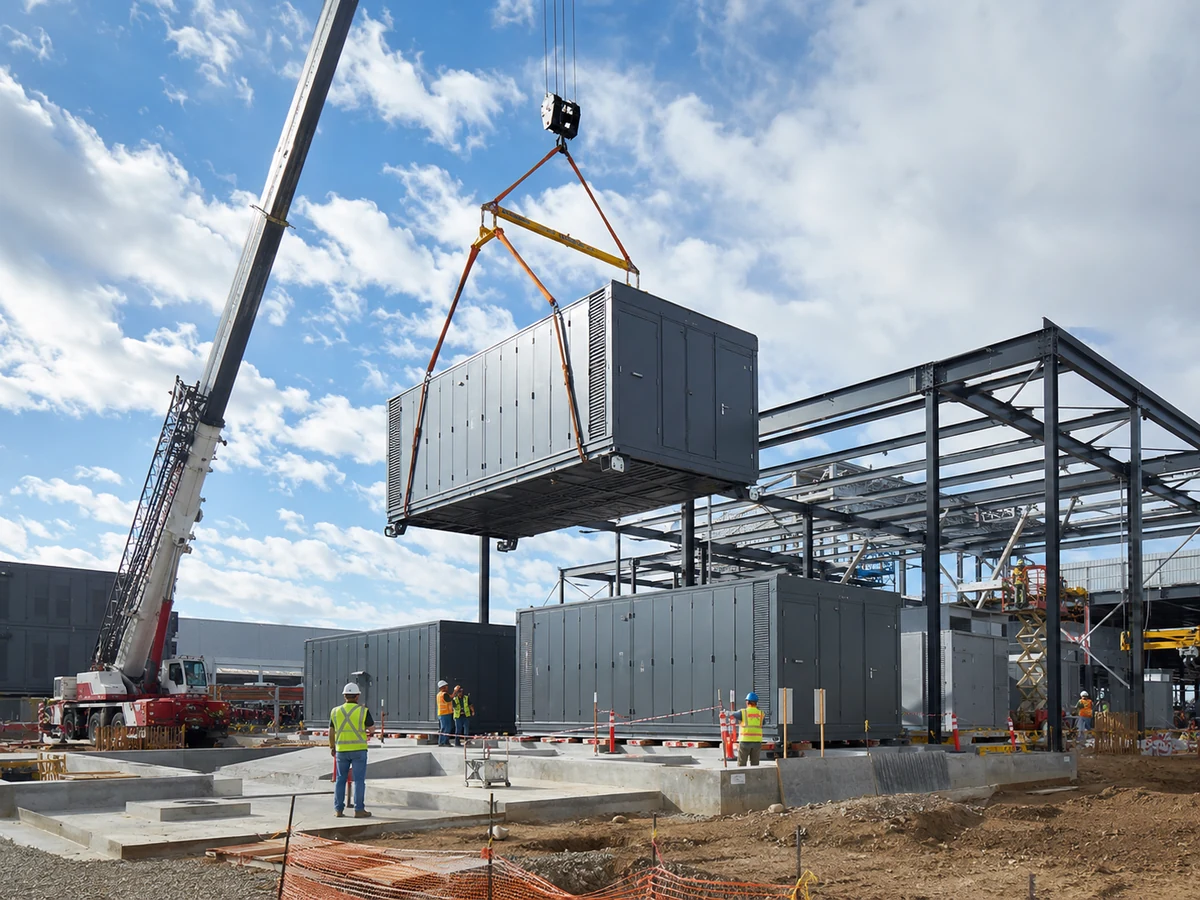
Prefabrication does not make a data center cheap by magic.
What it can do is move expensive work away from a constrained construction site, standardize repeatable systems and allow factory manufacturing to happen while foundations, utilities and the building are progressing in parallel.
That changes the economics in a way a simple cost-per-MW comparison can miss.
Maximum site-specific flexibility, but greater exposure to local labor, weather and late-stage coordination.
More integration happens before delivery, shifting site work toward assembly and connection.
Traditional shell with factory-built power, cooling or white-space modules.
Modular does not automatically mean lower construction CAPEX
Schneider Electric's February 2026 white paper on prefabricated data center modules makes this point unusually clearly.
Its conclusion is not that modular data centers are universally cheaper to buy. Schneider says prefabricated modules can be faster to deploy, more predictable and delivered at a cost similar to traditional stick-built facilities.
That distinction matters.
A developer who expects a 30% reduction in initial construction CAPEX simply because equipment arrives on skids can build the wrong business case.
The wider 2026 cost environment makes schedule more valuable
JLL forecasts average global shell-and-core data center construction cost of approximately $11.3 million per MW in 2026.
That is up from $10.7 million per MW in 2025 and $7.7 million per MW in 2020.
JLL attributes the pressure to a combination of rising demand, extended lead times and limited skilled-trade availability.
Its July 2026 U.S. construction update also found contractors exposed to data center work carrying an average 12.2 months of backlog, compared with 8.3 months for contractors without data center exposure.
In that environment, avoiding a few months of site congestion can have an economic value even if the manufactured equipment itself costs roughly the same.
Prefabrication changes where the work happens
A traditional data center brings a large number of trades and vendors together at the final site.
Electrical equipment arrives. Mechanical systems arrive. Controls are installed. Cabling, piping and integration occur progressively while the rest of the building is still being completed.
A prefabricated strategy tries to move some of those interfaces into a controlled manufacturing environment.
Schneider describes this as moving from a customized construction mentality toward a standardized site-integration mentality.
Power modules are one of the clearest modular use cases
A prefabricated data center does not have to mean putting servers inside a shipping container.
One of the most common approaches is to keep the main building conventional while moving repeatable power systems into factory-built modules or skids.
Vertiv's current OneCore platform takes this approach at much larger scale. The company positions it as a hybrid prefabricated design for projects from roughly 10 MW to 250 MW and beyond.
That scale is important because modular construction is no longer only an edge-data-center strategy.
Parallel work is the main schedule advantage
The strongest modular schedule argument is not that factory workers necessarily assemble every component faster.
It is that factory manufacturing and site construction can happen at the same time.
In a conventional sequence, some of that equipment integration may have to wait until the building is sufficiently complete.
The modular strategy therefore compresses calendar duration by overlapping workstreams rather than simply making every individual task shorter.
Factory integration can reduce some site commissioning work
Prefabrication also changes commissioning.
Equipment can be assembled, wired and tested before shipment. Controls integration can be validated in a controlled environment rather than for the first time at the construction site.
Vertiv described this approach in 2026 when discussing digitally validated OneCore infrastructure for AI deployments.
The final installed facility still requires site testing and Integrated Systems Testing.
Factory validation does not eliminate commissioning; it can move some defects and integration work earlier in the schedule.
Modular construction can reduce exposure to local labor constraints
A large conventional data center can require a major temporary workforce of electricians, mechanical trades, controls specialists and general construction labor.
That becomes more difficult when several campuses are being built in the same market.
Factory manufacturing centralizes part of that workload into dedicated facilities.
It does not remove labor from the project. It changes where the labor is consumed.
More assembly, wiring and integration can happen before delivery.
Factory capacity, transport engineering and module handling become more important.
The logistics bill is one of modular construction's hidden costs
A factory-integrated skid still has to reach the data center.
Module dimensions, weight, bridge restrictions, turning radii, permits, escorts, cranes and staging space can all affect delivery cost.
A design optimized for factory efficiency but impossible to move economically to the site is not an optimized design.
Standardization saves money only when the project can stay standardized
Repeatability is one of prefabrication's largest potential advantages.
Design one power block, manufacture it repeatedly and apply the lessons from the first units to later units.
The problem appears when every site, utility or customer requires a different version.
Excessive customization can remove much of the manufacturing advantage while preserving the transport and integration complexity.
Strongest modular economics.
Often the practical hybrid model.
Factory efficiency begins to erode.
Late design changes are more expensive once manufacturing begins
Traditional construction can sometimes absorb evolving design decisions relatively late because installation has not yet happened.
A factory-built module requires earlier design freeze.
Once manufacturing starts, changing breaker arrangements, pipe connections, dimensions or controls can create rework inside an already integrated assembly.
This moves project risk earlier.
Phased deployment can reduce stranded capital
One of the more compelling modular economic arguments is not construction cost at all.
It is the ability to add infrastructure in repeatable increments as demand grows.
Schneider's earlier TCO research found substantial lifecycle savings where scalable prefabricated infrastructure avoided building all final capacity on day one.
That research estimated a 30% TCO improvement in its modeled scenario, but I would not treat that as a universal 2026 modular discount.
The underlying principle remains useful: capacity that is not yet needed does not necessarily need to be installed yet.
A 40 MW project should compare calendar cost, not just construction cost
Consider two hypothetical 40 MW developments with identical operating value once complete.
Project A has lower direct construction CAPEX but opens five months later. Project B uses more prefabrication, costs slightly more to procure, but reaches customer-ready operation earlier.
More on-site integration and a longer delivery schedule.
Parallel factory/site work and earlier potential revenue.
The correct comparison would add financing carry, extended site overhead and delayed revenue to the slower scenario before deciding which project is actually cheaper.
The assumptions above are illustrative. They are not a claim that modular always costs more upfront or always saves five months.
The modular budget needs its own scope ledger
Equipment, structural enclosure or skid, wiring, piping, controls and factory labor.
FAT, controls validation and pre-delivery documentation.
Freight, route studies, permits, escorts and insurance.
Pads, structural supports, penetrations and utility connections.
Cranes, module positioning and physical assembly.
Electrical, mechanical, controls and communications interfaces.
Final functional testing and integrated-system verification.
Financing, project overhead and revenue impact associated with the actual delivery date.
When would I choose modular over traditional construction?
- Speed to capacity has high economic value
- Design can be repeated across many MW
- Local skilled labor is constrained
- Deployment is phased
- Factory capacity is secured early
- Transport routes are practical
- The site requires heavy customization
- Design remains fluid late in the project
- Local labor and contractors are readily available
- Transporting large modules is difficult
- Architecture will not repeat across phases
- Schedule compression has little financial value
So what does a modular data center cost in 2026?
There is no credible universal modular discount per MW.
Schneider's current guidance is more useful than a headline percentage: prefabricated modules can provide faster deployment and greater predictability at a cost comparable with traditional construction.
The financial advantage can then emerge through parallel work, reduced site congestion, factory integration, phased deployment and earlier usable capacity.
The disadvantages also deserve explicit pricing: transport, factory capacity, early design freeze, customization and final site integration.
I would therefore compare modular and traditional construction using: direct CAPEX + logistics + commissioning + schedule cost + stranded capacity + design-change risk.
That pthan asking which construction method has the lowest theoretical $/MW before the project is defined.
Sources and research notes
- Schneider Electric — Benefits and Drawbacks of Prefabricated Modules for Data Centers, February 2026 . Used for current modular-versus-traditional cost, deployment and standardization context.
- Vertiv — OneCore Prefabricated Hybrid-Built Data Center . Used for current 10 MW to 250 MW+ deployment scale and on-site labor context.
- Vertiv — OneCore AI Deployment, March 2026 . Used for factory integration and digitally validated infrastructure context.
- JLL — 2026 Global Data Center Outlook . Used for current construction-cost and delivery-pressure context.
- JLL — U.S. Construction Perspective Mid-Year 2026 . Used for current contractor-backlog and skilled-labor context.
- Schneider Electric — TCO Analysis of Traditional vs Scalable Prefabricated Infrastructure . The older modeled 30% TCO result is used only as historical scenario evidence for phased-capacity economics, not as a universal 2026 savings claim.