
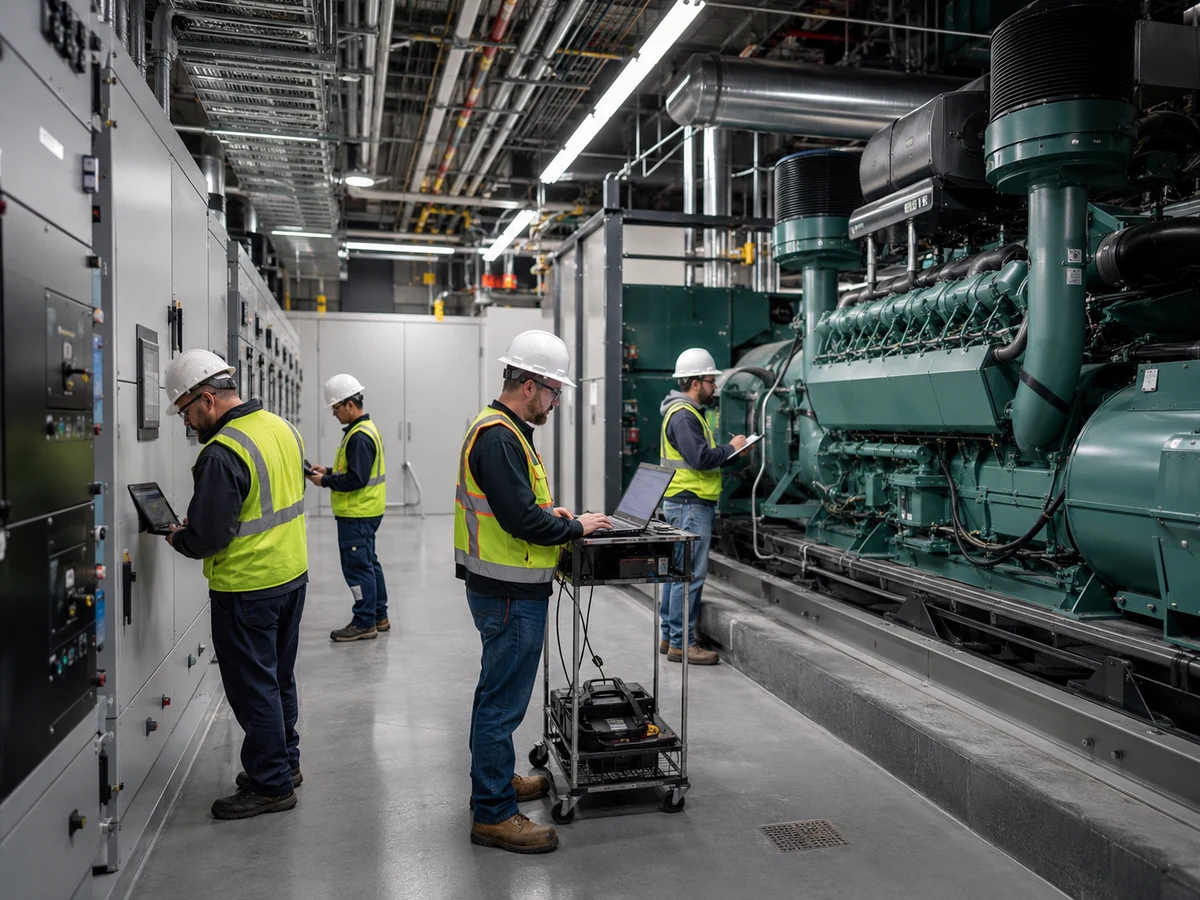
Commissioning is one of the few parts of a data center project where intentionally creating failures can reduce operational risk.
Generators are started. Utility power is interrupted. UPS systems transfer. Cooling equipment is removed from service. Controls are forced through abnormal conditions. The objective is to discover how the facility behaves before customer workloads depend on it.
That makes commissioning difficult to price with one percentage of construction CAPEX. The cost depends on what is tested, how deeply it is tested, how much temporary equipment is required and how many defects must be corrected and retested.
Factory tests, site acceptance, startup and pre-functional checks.
Functional and integrated testing under realistic load and failure conditions.
Procedures, training, documentation, issue closure and handover.
There is no defensible universal commissioning percentage in 2026
Current construction benchmarks give useful context for the size of the underlying project, but not a universal commissioning allowance.
Cushman & Wakefield's September 2026 development guide places average greenfield cost for the most modern U.S. and Canadian facilities at about $17.6 million per MW, excluding chips and GPUs.
JLL's 2026 outlook uses a narrower shell-and-core boundary and forecasts an average global construction cost of about $11.3 million per MW.
Those two figures are not contradictory; they have different scope boundaries. They also illustrate why saying “commissioning costs X% of the data center” can be misleading unless both the numerator and denominator are defined.
Commissioning begins before the facility is physically complete
JLL's current data center commissioning framework describes seven stages, starting at programming and design rather than at final startup.
These labels should not be treated as one universal global standard. Uptime Institute material commonly refers to Level 4 functional testing and Level 5 integrated systems testing, while other commissioning organizations use somewhat different phase structures.
The useful principle is more stable than the numbering: commissioning should move from individual equipment toward complete systems and finally toward the behavior of the facility as one interconnected environment.
Factory acceptance testing can move risk away from the construction site
Long-lead electrical and mechanical equipment is too expensive to discover major defects only after installation.
Factory acceptance testing can include witnessed testing of generators, UPS systems, switchgear, cooling equipment, controls and other critical infrastructure before shipment.
That creates direct cost: commissioning-agent time, engineering support, travel, manufacturer testing and sometimes specialist instrumentation.
But it can also prevent a much more expensive site problem if an issue is found before transport and installation.
Easier access to the manufacturer, controlled conditions and less impact on the construction schedule.
Confirms transport, installation, connections, controls and interfaces have not introduced new problems.
Integrated systems testing is where the building has to behave like a data center
Individual equipment can pass every startup check while the integrated facility still fails.
That is why Integrated Systems Testing, or IST, is economically important. Uptime describes Level 5 testing as an opportunity to exercise the complete data center ecosystem under maintenance and failure scenarios before live IT load is at risk.
A typical scenario might interrupt utility power and verify that the UPS supports the critical load while generators start, transfer occurs and the cooling system maintains acceptable conditions.
Load banks are not optional accounting noise
Commissioning often happens before enough production IT equipment exists to create the design electrical and thermal load.
Temporary load banks can therefore be required to simulate servers and produce both electrical demand and heat.
Their economic boundary can include rental, transport, temporary distribution, cabling, setup, technicians, fuel where generators are loaded and the electricity consumed during testing.
The $16,000 is arithmetic, not a commissioning-price benchmark. It simply shows that the energy consumed during a large test is itself a visible cost before temporary equipment or labor is added.
Liquid cooling is adding new commissioning interfaces
Uptime Institute highlighted this issue specifically in January 2026.
Its research says coolant distribution units can complicate commissioning because direct liquid cooling physically couples facility infrastructure and IT technology more tightly than conventional air cooling.
CDU controls, pumps, secondary loops, heat exchangers, water quality, leak detection and technology-side flow requirements all create additional interfaces that may need verification.
Uptime also notes that best practices for liquid-cooled mission-critical environments are still maturing.
This is one reason I would not automatically apply the commissioning allowance from an air-cooled 2022 project to a high-density AI facility in 2026.
The commissioning budget should separate direct testing from defect correction
Finding issues is evidence that commissioning is doing its job. Correcting those issues is not necessarily part of the commissioning agent's original fee.
Planning, test scripts, meetings, coordination, reporting and issue tracking.
FAT preparation, witnessing, specialist support and travel.
Startup verification, instrumentation and system-level tests.
Load banks, temporary cables, distribution and measurement tools.
Multi-system failure scenarios involving power, cooling, controls and operations.
Contractor corrections and repeat tests after deficiencies are discovered.
Training, procedures, systems manuals, records and final issue closure.
Rework is where commissioning cost can become unpredictable
A clean commissioning program largely spends money according to plan. A problematic one can create repeated testing cycles.
Imagine that a generator-transfer sequence fails during IST because a controls dependency was configured incorrectly.
Correcting the issue may require the controls contractor, electrical contractor, generator vendor, commissioning authority and operations team to return for another coordinated test.
The additional cost is not just technician hours. The project may need another load-bank window, more temporary power arrangements and additional schedule contingency.
A cheaper commissioning scope can simply test less
Two commissioning proposals should not be compared only by total fee.
One may include extensive FAT witnessing, complete functional testing, full IST, documentation review and operational-readiness support. Another may cover only selected systems and final witness testing.
I would normalize at least:
- number of facilities or phases;
- MW commissioned;
- systems included;
- factory tests included;
- percentage of equipment tested versus sampled;
- number of IST scenarios;
- load-bank responsibility;
- travel and witness costs;
- retesting allowance;
- documentation and training scope;
- seasonal or post-occupancy testing.
Prefabrication can move commissioning cost from site to factory
Modular power trains and prefabricated infrastructure do not eliminate commissioning. They can change where it happens.
Vertiv described a 2026 deployment where integration logic was developed and validated during manufacturing using digital-twin and mimic applications.
Because much of the integration work happened before the equipment reached site, on-site commissioning could focus more heavily on connectivity and point validation.
Multiple vendors converge late in construction and system behavior is proven after installation.
Factory integration can reduce some site activity, but the final installed system still needs verification.
Commissioning has a schedule value as well as a testing cost
A failed test may delay turnover. Skipping the test may move the same failure into live operations.
That creates an unusual economic tradeoff.
Those benefits are difficult to convert into one universal dollar figure, but they are the reason commissioning should not be treated as administrative closeout.
How I would build a commissioning budget in 2026
- Define the Owner's Project Requirements and commissioning scope during design.
- Identify critical equipment requiring factory acceptance testing.
- Build the testing program by system rather than applying one percentage to total CAPEX.
- Define functional and integrated-system scenarios.
- Estimate temporary load-bank capacity and test duration.
- Assign responsibility for fuel, electricity, temporary cabling and specialist technicians.
- Create a separate rework and retesting allowance.
- Include operations training and turnover documentation.
- Add liquid-cooling and AI-specific interfaces where relevant.
- Protect schedule between final IST, issue closure and customer-ready turnover.
So what does data center commissioning cost in 2026?
There is no defensible universal commissioning cost per MW or percentage of CAPEX that I would apply across every project.
A better model separates the commissioning authority's professional services from factory testing, temporary test equipment, energy and fuel, vendor support, rework, retesting and operational turnover.
The scope also needs to reflect the facility itself. A conventional air-cooled deployment and a high-density liquid-cooled AI project may require materially different integration work.
The number I would want to see in a project budget is therefore not simply “commissioning: 1%”.
I would want a commissioning ledger that explains what will be tested, how it will be tested, who pays for the test infrastructure and what happens when something fails.
Sources and research notes
- JLL — Seven Stages of Data Center Commissioning . Used for the Level 0–6 commissioning framework.
- Uptime Institute — Mission Critical Commissioning . Used for functional and integrated-systems-testing principles.
- Uptime Intelligence — Coolant Distribution Units Can Complicate Commissioning, January 2026 . Used for current liquid-cooling commissioning context.
- Vertiv — 2026 Integrated Power Train Deployment . Used for factory pre-integration and reduced on-site commissioning context.
- Cushman & Wakefield — 2026 Data Center Development Cost Guide . Used for current development-cost context.