
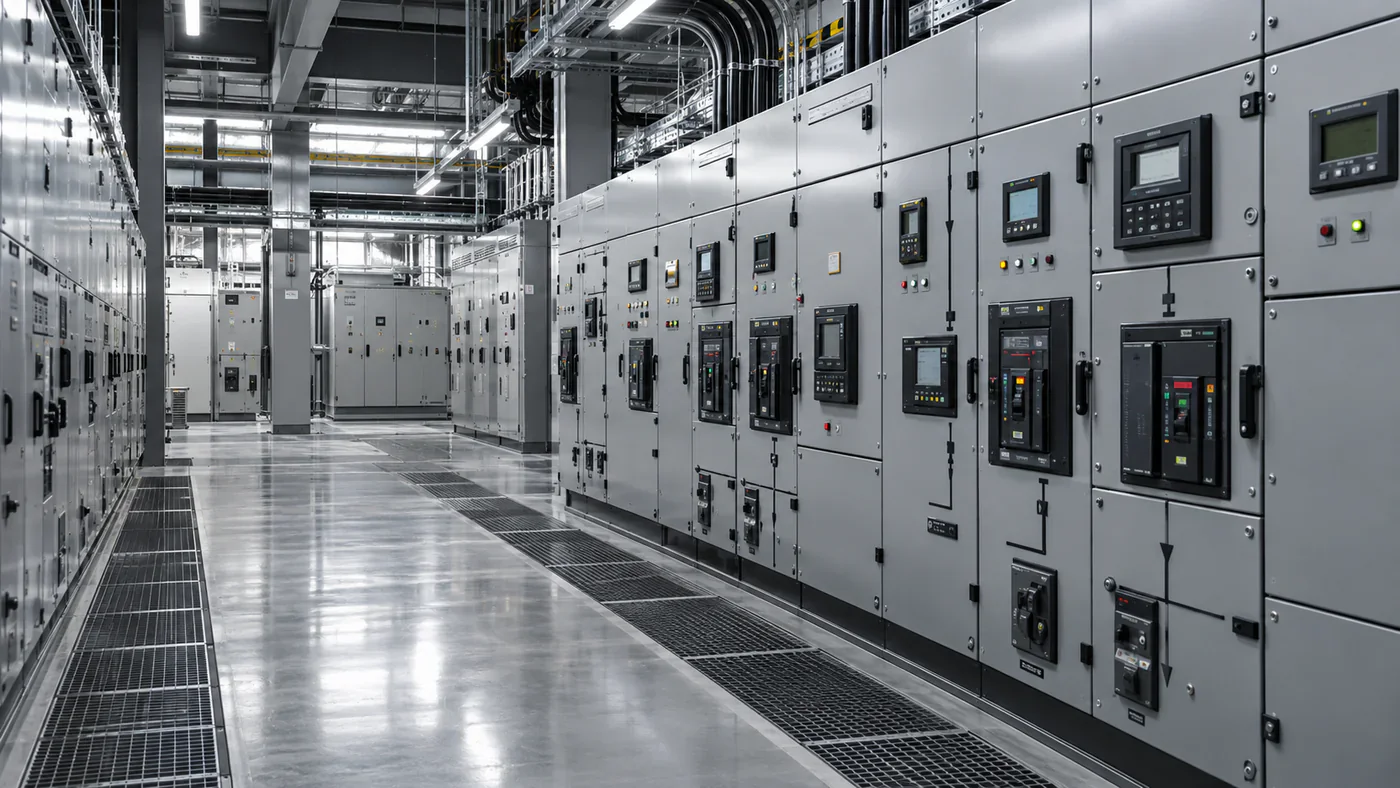
Switchgear is one of the easiest data center costs to underestimate because the quote looks like a piece of equipment while the project experiences it as a system.
The factory lineup is only the visible part. The real project cost can include protection relays, controls, metering, bus, breakers, cable or busway terminations, freight, setting, field testing, commissioning, spare parts and the schedule consequences of waiting for equipment that arrives late.
In 2026, that schedule risk matters almost as much as the purchase price. Electrical equipment remains one of the longest-lead portions of a data center build, and switchgear sits directly in the path between available utility power and usable IT capacity.
Voltage, bus rating, breaker count, interrupting duty, relays, controls and enclosure requirements drive the factory scope.
Freight, rigging, terminations, controls integration, testing and commissioning can sit outside the purchase order.
Submittals, approvals, manufacturing, factory testing, shipping and field acceptance all sit between design and energization.
Switchgear is not just another electrical cabinet
In a data center, switchgear performs a simple-sounding job with high-consequence requirements: it receives electrical power, divides it into controlled paths, protects those paths and allows sections of the system to be isolated when equipment fails or maintenance is required.
The word itself can hide several different products.
At low voltage, a project may use metal-enclosed power circuit breaker switchgear, commonly associated with UL 1558 in North America, or a switchboard built to a different product standard and architecture. UL Solutions identifies UL 1558 as the standard for metal-enclosed low-voltage power circuit breaker switchgear and UL 891 as the standard for switchboards.
At medium voltage, data center designs can use metal-clad or metal-enclosed switchgear with vacuum circuit breakers, protection relays and bus arrangements selected around the utility service and downstream electrical architecture.
That distinction matters for cost. A budget labeled simply "switchgear" can be comparing products with different breaker architectures, short-time ratings, maintainability and fault-management capabilities.
Where switchgear sits in the data center power path
A large facility can contain switchgear at several points rather than one centralized lineup.
The exact sequence varies. Some campuses distribute power at medium voltage deeper into the site. Others transform earlier and rely on larger low-voltage distribution systems. Generator paralleling gear and bypass paths can create additional switching layers.
That is why switchgear cost should be modeled from the electrical one-line rather than from building area alone.
There is no credible universal switchgear cost per MW
A simple dollar-per-MW benchmark is tempting because data centers are already discussed in megawatts. It is also easy to misuse.
The same 20 MW of IT load can be served through different voltage architectures, transformer block sizes, redundancy schemes and breaker counts. One design might concentrate power into a small number of large lineups. Another may distribute the same capacity across many smaller electrical rooms.
Public procurement also shows how wide the range can be even before the equipment reaches a data center.
A documented Omaha Public Power District procurement for new 15 kV metal-clad switchgear produced a winning bid of approximately $549,800 and a competing bid of approximately $779,000 for the same procurement package. Those 2024 utility bids are useful evidence of quote dispersion, but they are not 2026 data center price quotes and should not be copied directly into a project budget.
Current price pressure also remains significant. The U.S. Bureau of Labor Statistics index for switchgear and switchboard apparatus manufacturing rose from about 329.6 in January 2025 to about 411.5 in August 2026, an increase of roughly 25% over that period.
Breaker count, bus current, voltage class, interrupting rating, relay package, enclosure, controls, testing and delivery scope can change the quote materially even when two lineups appear similar on a one-line diagram.
The breaker count often matters more than the megawatt count
Switchgear is assembled around functions: mains, ties, feeders, sources, bypasses and spare positions.
Increasing the power rating of a lineup can increase bus and breaker requirements, but adding another protected feeder can also add a breaker cell, relay, metering, controls, interlocks and physical section.
A useful early budget therefore needs more than MW.
Moving from LV to MV changes breakers, insulation, testing, protection and equipment construction.
Main bus and feeder ratings influence copper content, thermal design and physical size.
Higher available fault current can require more capable breakers, bus and tested assemblies.
Mains, ties, feeders and spares can turn one electrical block into a long lineup.
Relays, metering, communications, PLC logic and remote operation add both hardware and engineering.
Tested containment and exhaust requirements can change equipment design, room layout and cost.
Outdoor, NEMA-rated, walk-in or e-house arrangements create different enclosure and HVAC requirements.
N+1 and 2N philosophies can duplicate mains, ties, sources or entire distribution paths.
Fault current can change the budget late if it is not resolved early
Available short-circuit current is not a detail to confirm after the switchgear has been selected.
Utility source strength, transformer impedance, generator contribution and parallel operating conditions all affect the duty that downstream equipment must withstand and interrupt.
If the fault study matures after a lineup has been budgeted, the project can discover that the assumed breaker rating is no longer sufficient. That can change equipment selection, dimensions and price.
Early procurement protects schedule only when the project is mature enough to avoid ordering the wrong equipment.
Arc-resistant gear is a system decision, not a checkbox
Arc-resistant switchgear is designed and tested to manage the effects of an internal arcing event under specified conditions.
Schneider Electric, for example, describes its Power-Zone 4 Arc Resistant low-voltage switchgear as designed around ANSI/IEEE C37.20.7 arc-resistant requirements. Medium-voltage manufacturers offer similar concepts with ratings and exhaust arrangements specific to the tested assembly.
The important budgeting point is that arc resistance can affect more than the factory price.
Exhaust plenums, room clearances, ceiling conditions, duct routing, working space and equipment orientation may all become part of the design. A project that compares only the switchgear purchase orders can miss part of the building cost created by the safety strategy.
AIS versus GIS can trade footprint for complexity and procurement risk
At medium voltage, air-insulated switchgear remains common because it is familiar, maintainable and modular. Gas-insulated or compact alternatives can reduce footprint where electrical-room area is constrained.
That space saving is not automatically an economic saving.
Compact equipment can carry a higher equipment price, require different maintenance capabilities and create more vendor-specific dependencies. Procurement lead time can also vary sharply between technologies and manufacturers.
Familiar architecture, accessible components and broad market availability, with a larger room footprint.
Valuable where footprint is constrained, but equipment cost, specification and service strategy need separate evaluation.
The right comparison is therefore not equipment price alone. It is equipment plus electrical-room area, installation, serviceability, schedule and lifecycle support.
Redundancy can multiply switchgear faster than load
A 2N data center does not simply buy a larger version of the same lineup. It can create two independent power paths with separate mains, feeders, buses and downstream equipment.
A main-tie-main arrangement can add still more switching and protection functions depending on operating philosophy.
This is one reason a cost-per-MW ratio can fail. The denominator may stay the same while the number of switchgear sections and breakers changes substantially.
2026 switchgear lead times are still long — and the published ranges disagree
Current lead-time data do not produce one neat answer.
JLL's 2026 Global Data Center Outlook shows an average U.S. switchgear lead time of roughly 43 weeks in its regional data center equipment comparison.
SourceBlue's Q2 2026 cost index reports estimated ranges of 26–58 weeks for low-voltage switchgear and 28–48 weeks for medium-voltage switchgear.
Other active-procurement trackers report materially longer windows for specialized medium-voltage gear, including ranges extending beyond a year.
These figures are not necessarily contradictory.
One survey may measure typical equipment from major manufacturers while another procurement desk is tracking a narrower group of 15 kV metal-clad, arc-resistant or highly customized data center lineups. Quoted lead time can also mean different things: factory slot, approved submittal to shipment, purchase order to shipment, or purchase order to commissioning.
Published ranges are useful for feasibility. The project schedule should ultimately use the manufacturer's current definition of lead time, submittal duration, approval assumptions and promised ship date.
Delivery is not the same as energization
Even a reliable factory ship date does not mean the data hall can be powered that week.
The switchgear package may need factory acceptance testing before shipment. Once delivered, crews still need to receive and set the sections, reconnect shipping splits, terminate conductors or bus, complete control wiring, verify relay settings and perform acceptance testing.
Utility or commissioning dependencies can sit after that work.
A procurement schedule should therefore carry separate milestones for approved submittals, release to manufacturing, FAT, shipment, site readiness, installation, testing and energization.
Scope gaps make cheap switchgear quotes look artificially attractive
Two supplier totals are comparable only if the scope is comparable.
Consider this simplified example.
This is an original Data Center Scope example, not market pricing. Its purpose is to show why procurement teams need a scope matrix rather than a column of vendor totals.
The installed cost ledger is larger than the purchase order
Enclosures, bus, breakers, protection, controls, metering and specified accessories.
Shop drawings, relay logic, communications, settings coordination and project-specific customization.
Routine tests plus any project-specific FAT or witness-testing requirements.
Shipping sections, unloading, indoor movement, pads and final alignment.
Terminations, bus duct, grounding and coordination with adjacent transformers, UPS equipment or distribution.
Breaker tests, insulation checks, primary or secondary injection, relay verification and interlock testing as required.
EPMS, SCADA, generator controls, remote operation and alarm mapping.
Spare breakers, relays, control power components and service agreements.
Early procurement protects the schedule but can lock the design too soon
Long lead times push switchgear procurement toward early release.
That is rational, but it creates a design-management problem. Releasing too early can lock dimensions, breaker ratings, source arrangements and protection architecture before the rest of the project is mature.
More mature one-line, fault study and interfaces, but greater risk of losing the required manufacturing slot.
Better chance of protecting energization, but more exposure to redesign, change orders and field modification.
A strong procurement plan identifies the minimum information that must be frozen before release and the details that can remain flexible after the manufacturing slot is secured.
Standardization can reduce both procurement and operational risk
Large operators often gain leverage by repeating electrical blocks, breaker families, relay platforms and control philosophies across buildings.
The benefit is not limited to unit pricing.
Standardized equipment can simplify spare strategy, technician training, commissioning procedures, settings templates and future expansion. Repeated designs can also reduce engineering effort if the utility service and fault duties remain compatible.
But standardization should not become blind replication. A lineup that was suitable for a 50 kA fault duty or one utility voltage cannot simply be copied to a site with different electrical conditions.
Spare breakers are easier to justify when replacement lead times are long
A spare breaker consumes capital and storage space. It also creates an immediate recovery option for a component whose replacement may not be available on the operating team's schedule.
The value depends on interchangeability.
If several lineups use the same breaker frame, rating, trip unit and accessories, one strategic spare may cover multiple positions. If every electrical room uses a different configuration, the spare inventory can grow quickly.
I would therefore evaluate spare strategy while the equipment family is being selected, not after commissioning.
Brownfield projects need a different switchgear decision
An operating facility may not have the luxury of replacing an entire lineup simply because the protection or controls are obsolete.
Retrofit programs can replace breakers, relays, controls or selected internal components while retaining structurally sound equipment. In the right facility, that can shorten an outage and avoid a long new-build procurement cycle.
It is not automatically safer or cheaper.
The project still needs to confirm equipment condition, short-circuit ratings, parts support, certification implications, available outage windows and whether the existing enclosure can safely support the new duty.
Used or secondary-market equipment can also shorten schedule, but a mission-critical facility should treat provenance, testing, documentation, warranty and compatibility as part of the commercial decision rather than assume that immediate availability equals equivalent value.
How I would build a 2026 switchgear budget
- Start with the electrical one-line and identify every MV and LV switching layer.
- Define voltage, continuous current, fault duty and required short-time ratings.
- Count mains, ties, feeders, sources, bypasses and spare positions.
- Define redundancy and normal operating states.
- Specify protection, metering, communications and remote-control requirements.
- Decide whether arc-resistant construction is required and include its building implications.
- Obtain current manufacturer lead times before fixing the project schedule.
- Separate factory equipment from freight, installation, terminations, field testing and controls integration.
- Normalize vendor proposals in a common scope matrix.
- Add spares and lifecycle support deliberately rather than hiding them in contingency.
- Model schedule exposure separately from equipment CAPEX.
So what does data center switchgear cost in 2026?
There is no single defensible switchgear cost per MW that can be applied across data centers.
Public procurement confirms that even apparently similar lineups can produce large bid spreads. BLS data also show that switchgear and switchboard manufacturing prices remain well above early-2025 levels. Meanwhile, 2026 data center research still places switchgear lead times in the range of many months, with specialized equipment capable of taking longer.
The better budget has three separate numbers: factory switchgear cost, installed system cost and schedule exposure.
Factory cost answers what the manufacturer sells. Installed cost answers what the project must spend to energize it. Schedule exposure answers what happens if the gear becomes the long pole between an otherwise complete building and usable power.
Keeping those numbers separate makes switchgear easier to procure, easier to compare and much harder to underestimate.
Sources and research notes
- JLL — 2026 Global Data Center Outlook . Used for current U.S. data center equipment lead-time context, including switchgear.
- SourceBlue — Q2 2026 Cost Index Report . Used for 2026 estimated low- and medium-voltage switchgear lead-time ranges.
- U.S. Bureau of Labor Statistics — Producer Price Index, Selected Industries . Used for switchgear and switchboard apparatus manufacturing price-index context through 2026.
- U.S. Department of Energy — Strengthening America's Grid Supply Chain . Used for broader 2026 circuit-breaker, substation-component and electrical supply-chain context.
- UL Solutions — Data Center Offerings / Power Infrastructure . Used for North American low-voltage switchgear and switchboard standards context.
- UL Solutions — UL 891 Switchboard Guidance . Used to distinguish switchboards from low-voltage switchgear.
- Schneider Electric — Power-Zone 4 Arc Resistant . Used for arc-resistant low-voltage switchgear design context.
- SecondWatt — Switchgear Pricing Guide 2026 . Used as a secondary source for documented public-procurement price examples and quote-dispersion context. Public procurement figures are not presented as current data center quotations.