
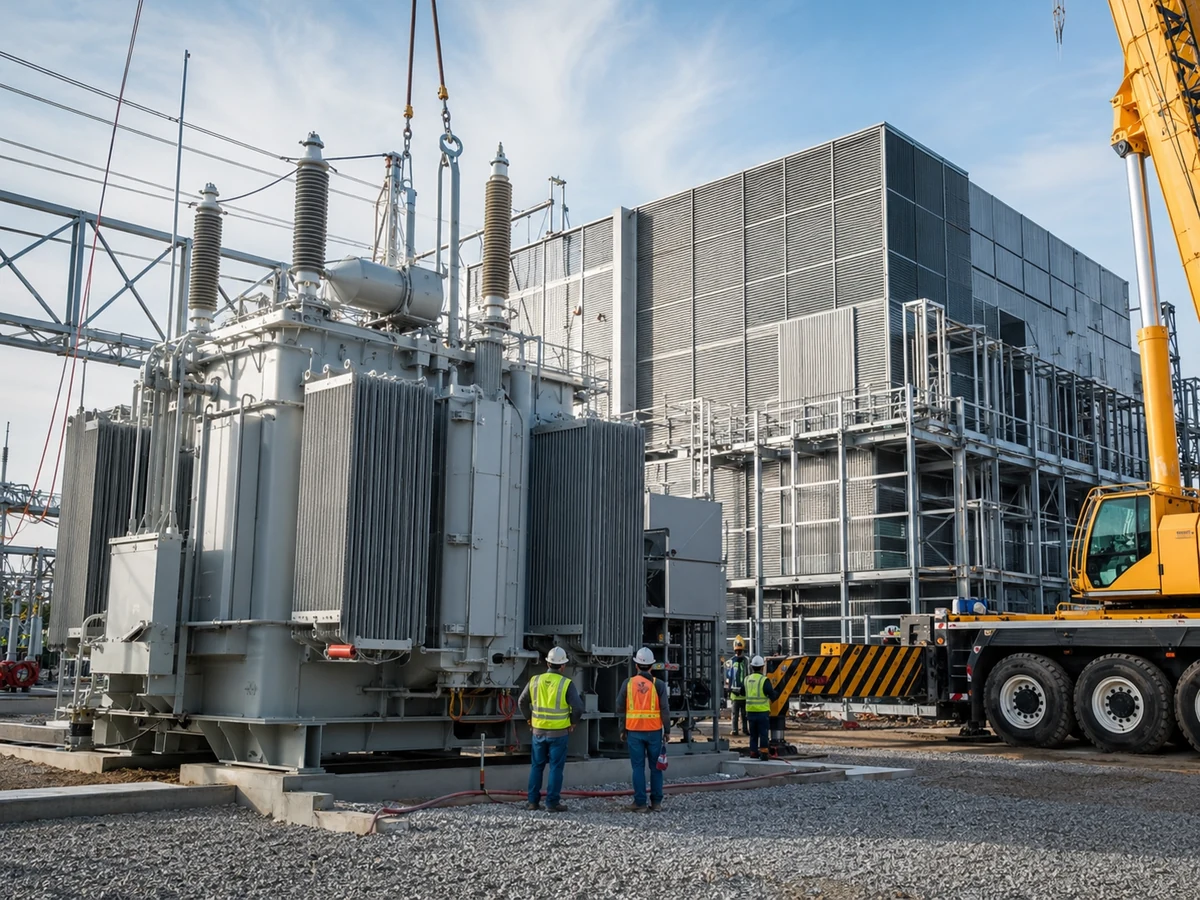
A transformer can be a relatively small line in a data center's total development budget and still determine when the entire facility opens.
That is the unusual economics of transformer procurement in 2026. The equipment is expensive, but the larger exposure can be the months or years during which land, construction and customer demand are waiting for an electrical component that has not arrived.
I would therefore evaluate transformer cost in two dimensions: purchase and installation cost, and schedule exposure.
Rating, voltage, specification, accessories and manufacturer all change the equipment price.
Transport, foundations, switchgear, protection, cabling, oil containment, testing and energization can sit outside the quote.
Long procurement queues can delay revenue, commissioning and the economic use of an otherwise completed site.
The 2026 transformer problem is bigger than data centers
Data centers are competing for electrical equipment with utilities, renewable-energy projects, industrial facilities, grid replacement programs and other large loads.
The U.S. Department of Energy said in August 2026 that critical grid components including transformers, circuit breakers and substation equipment face supply-chain constraints that have produced lead times of two years or more.
DOE also says some transformers have experienced four- to nine-fold price increases over the last five years. That does not mean every transformer bought by a data center costs nine times what it did five years ago. It shows how severe the supply-chain repricing has been in parts of the market.
Large transformer lead times can reach three to four years
DOE's March 2026 transformer webinar provides an especially useful current reference.
It says distribution-transformer lead times had increased from roughly three to six months in 2019 to one to two years or longer in the latest available market data.
More importantly for large data center substations, DOE says large transformers used for substations and generators have seen lead times grow from around three years to as much as four years.
Reuters reported a somewhat different but compatible market snapshot in July 2026: some high-voltage transformers were reaching 160 weeks, compared with 143 weeks in 2024.
Rystad Energy's May 2026 grid-equipment outlook adds useful segmentation: most power transformers still exceed 12 months, while the largest units exceed 24 months.
There is no useful universal 2026 price per MVA
Transformer pricing depends on too many variables for one public $/MVA figure to work across projects.
Voltage class matters. So do winding configuration, insulation, impedance, cooling arrangement, losses, tap changers, monitoring, enclosure requirements and whether the unit is a standardized design or a heavily customized large power transformer.
DOE describes large power transformers as custom-made equipment that can weigh hundreds of tons and cost millions of dollars.
That is useful scale context, but it is not a quote for a particular data center.
Voltage, losses, impedance, accessories, redundancy, logistics and specification can make the same nameplate capacity produce very different procurement costs.
Start transformer sizing with the electrical architecture
A 100 MW data center campus does not automatically need one 100 MVA transformer.
The campus can be divided into multiple buildings, substations and power blocks. Redundancy may require spare transformation capacity, and the utility service voltage can determine where transformation occurs.
This architecture should exist before a cost model applies a transformer count.
A 48 MVA example shows why redundancy changes the equipment count
Consider a simplified facility requiring 48 MVA of transformation capacity.
Suppose the concept uses 16 MVA transformer blocks.
Real substation design is more complex than this arithmetic example. But the lesson is useful: a project budget based only on required MVA can understate installed equipment.
Transformer cost extends beyond the factory price
Core and windings, tank, bushings, cooling, controls, monitoring and specified accessories.
Large units can require route studies, specialist trailers, permits and coordinated delivery.
Pads, oil containment, fire separation and site-specific civil works.
Breakers, relays, protection schemes and integration with the utility and downstream electrical system.
High- and medium-voltage connections, terminations and grounding.
Factory acceptance, site testing, protection verification and utility coordination.
Transport can become an engineering problem of its own
Large power transformers are not ordinary freight.
DOE notes that large units can weigh hundreds of tons. Site access, bridge limits, turning radii, rail availability and final positioning can therefore affect both cost and schedule.
A cheaper transformer from a distant supplier can lose part of its economic advantage if transport becomes unusually complex.
International sourcing can also add customs, port and inland-logistics exposure.
The cost of delay can exceed the transformer price
Imagine a data center phase that is otherwise capable of opening six months earlier, but cannot energize because a critical transformer is late.
During those six months the project can continue carrying financing, security, project management and other holding costs while generating no operating revenue from the delayed capacity.
Delay cost is project-specific. It can include financing carry, extended construction overhead, delayed lease commencement and the opportunity cost of unavailable capacity.
I would not add an arbitrary delay percentage to every transformer. I would model schedule exposure separately so that procurement decisions remain visible.
Ordering earlier shifts risk into design maturity
The obvious response to a three-year procurement window is to order earlier.
But early ordering creates its own problem: the transformer may need to be released before the rest of the design is mature.
That creates a tradeoff between schedule certainty and design certainty.
Better-defined specifications, but greater exposure to production queues and project delay.
Earlier manufacturing slot, but more risk that project assumptions change after procurement.
Standardization can have a real economic value
DOE has repeatedly identified excessive transformer customization as a contributor to supply-chain complexity.
In August 2026 the department said greater standardization could help streamline production, reduce lead times and lower costs through economies of scale.
For a data center developer, standardization can also create flexibility across phases and sites if the same equipment family can be reused.
That does not mean forcing every project into one transformer design. Voltage, utility requirements and engineering constraints still govern.
Buying a spare transformer is an insurance decision
Long replacement lead times make spare strategy more important.
A spare ties up capital in an asset that may never be used. But a major failure without a compatible spare can expose the facility to a replacement timeline measured in years rather than weeks.
The decision therefore depends on the failure consequence, interchangeability, procurement lead time and whether a shared spare can serve multiple transformers or sites.
I would treat the spare as a resilience investment, not simply add it to the base transformer $/MVA benchmark.
How I would build a 2026 transformer budget
- Confirm utility service voltage and the electrical one-line concept.
- Define required transformation capacity by phase rather than only at final campus buildout.
- Select transformer block size and redundancy.
- Obtain current manufacturer lead-time indications before locking the development schedule.
- Separate transformer purchase price from freight, civil works, protection, switchgear and installation.
- Add testing and utility energization activities.
- Model schedule exposure independently from equipment CAPEX.
- Evaluate standardization and spare strategy.
- Replace concept assumptions with quotations as specifications mature.
So what does a data center transformer cost in 2026?
There is no credible universal transformer price per MVA that covers every data center project.
What is defensible in 2026 is the market constraint: transformers remain expensive, heavily specification-dependent and unusually slow to procure.
DOE reports critical equipment lead times of two years or more and large transformer timelines reaching three to four years. Reuters' July market reporting found some high-voltage transformers at about 160 weeks.
For a development model, I would therefore keep three numbers separate: transformer CAPEX, installed electrical-system CAPEX and schedule exposure.
Combining all three into one $/MVA assumption hides the part of the decision that may matter most.
Sources and research notes
- U.S. Department of Energy — Strengthening America's Grid Supply Chain . Current 2026 lead-time and transformer-price context.
- U.S. Department of Energy — March 2026 Transformer Webinar . Used for distribution and large-transformer lead-time context.
- Rystad Energy — Grid Equipment Market Outlook, May 2026 . Used for current transformer lead-time segmentation.
- Reuters, July 9, 2026: U.S. power companies scramble to secure equipment as data center demand strains supplies. Used for the 160-week high-voltage transformer reference and current cost-increase context.
- Cushman & Wakefield — 2026 Data Center Development Cost Guide . Used for broader critical-equipment and development-cost context.