
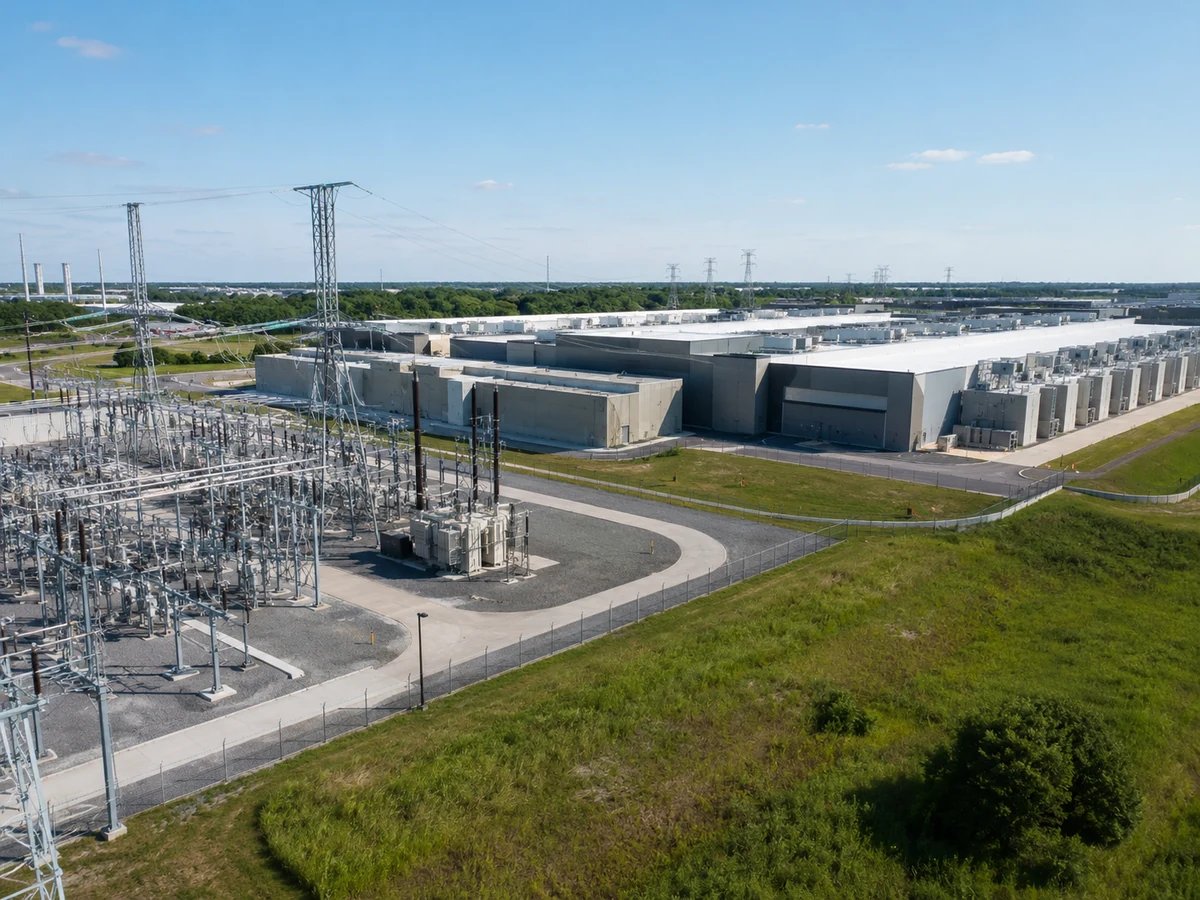
A site can have a transmission line nearby and still be years away from having usable data center power.
That is the central interconnection problem in 2026. Geographic proximity to the grid is not the same thing as an executable utility service plan.
A developer may need load studies, engineering, deposits, new substations, transmission upgrades, distribution work, contracts, collateral and a credible ramp schedule before the utility can commit to an energization date.
Utilities need a defined site, requested MW and load ramp before they can evaluate the system impact.
Substations, lines, breakers, transformers and regional transmission can all sit between the request and real power.
Deposits, contracts, minimum bills and collateral increasingly test whether the project is real.
Interconnection is becoming its own development workstream
The scale of current data center load requests has pushed utility interconnection from a technical coordination issue into a major commercial and regulatory problem.
On June 18, 2026, the Federal Energy Regulatory Commission issued show-cause orders to all six regional grid operators under its jurisdiction.
FERC directed them to justify or reform the rules governing how data centers and other large loads connect to the transmission system.
The Commission's stated objectives include faster integration, consumer protection, reliability, transparency and stronger controls around speculative requests.
The first interconnection cost may be only a study fee
AEP Ohio provides one of the clearest current examples of how utilities are formalizing large data center requests.
Under its Data Center Tariff, new facilities or expansions of 25 MW or more must follow a mandatory load-study process.
The customer must demonstrate control of the property and provide a specific location, requested load, final load and ramp schedule.
As of 2026, AEP Ohio publishes the following one-time load-study fees:
These fees are useful because they are public and current. They are also easy to misuse.
A $100,000 study fee is not the cost of connecting a 100 MW data center. It is the cost of entering a defined study process.
The study can be cheap while the resulting infrastructure is expensive
The engineering study exists to identify what must change in order to serve the requested load.
The answer can range from relatively limited local work to major new transmission infrastructure.
Metering, feeders, breakers and connection into existing utility infrastructure.
New or expanded substations, transformers, protection and associated civil works.
New lines, reconductoring, regional upgrades or additional bulk system capacity.
In some regions, serving the load also raises questions about future energy and capacity supply.
Who pays for the upgrades is becoming a defining question
Historically, utility infrastructure costs can be recovered through different combinations of direct customer contributions, tariffs and broader rate-base treatment.
The political and regulatory direction in 2026 is increasingly focused on preventing costs caused by large data center projects from being shifted to other electricity customers.
FERC Commissioner David Rosner specifically highlighted Cost Recovery Agreements in the June 2026 large-load proceedings.
The concept is straightforward: if infrastructure is built for a large load and that load fails to materialize, residential customers should not be left paying for unused upgrades.
The answer varies by utility, state, regional transmission organization and project structure. It should be resolved explicitly rather than hidden inside a generic interconnection allowance.
AEP Ohio shows how utilities are testing whether demand is real
The AEP Ohio tariff does more than charge study fees.
It requires defined load ramps and long-term contractual commitments. Under the current published framework, the ramp cannot exceed four years.
The initial contract term is the load-ramp period plus eight years.
This structure matters economically because the developer is no longer merely reserving a place in a queue. It is making a long-duration commitment around how the load is expected to materialize.
Study time and power-delivery time are different clocks
AEP Ohio says it will make reasonable efforts to complete qualifying load studies within approximately 45 days where regional transmission upgrades are not required and 60 days where they are.
Those study durations should not be confused with the in-service date.
If major regional transmission upgrades are required, the actual in-service date can remain dependent on engineering, permitting, equipment procurement and construction far beyond the study itself.
The land can be ready years before the electricity is
This is where utility interconnection connects directly to land economics.
A developer can control the site, receive zoning, complete design and even advance construction while still carrying uncertainty around the final power-delivery schedule.
That is why I would never use the phrase “powered site” without defining what evidence supports it.
Physical proximity alone says very little about available capacity or delivery timing.
The grid impact and required infrastructure have begun to become project-specific.
Commercial obligations, infrastructure scope and an expected in-service path are documented.
Virginia is also changing the economics of large-load commitments
Virginia's State Corporation Commission adopted a separate GS-5 rate class for large-load customers such as hyperscale data centers.
The SCC says the objective is to recover the unique costs of serving these customers while reducing cost shifting to other rate classes.
New qualifying large-load customers contracting from January 1, 2027 are expected to carry a minimum service obligation of at least 14 years.
The framework also requires large customers to pay at least 85% of transmission and distribution costs incurred to serve them each month, regardless of actual usage, subject to specified exemptions.
Customers without sufficient credit can also face collateral requirements linked to minimum contract charges.
These are tariff and credit n construction CAPEX, but economically they belong in the site-selection model.
Interconnection deposits can become a project-filtering mechanism
One reason utilities are demanding stronger commitments is the growth of duplicate and speculative load requests.
FERC's June 2026 orders explicitly address this issue through escalating readiness requirements.
The logic is important for developers. A request for 500 MW is not economically equivalent to having a financeable 500 MW project with land control, a defined schedule and capital behind it.
Study fees, collateral and contract commitments therefore do two jobs: they fund utility work and they help separate probable projects from speculative requests.
A real interconnection budget needs more than one CAPEX line
Utility engineering, system-impact analysis and formal request processing.
Financial security required to demonstrate project readiness or protect the utility from stranded investment.
Equipment physically connecting the customer site to the utility system.
New transformers, breakers, protection, control systems and associated civil infrastructure.
New lines, capacity reinforcement or regional network work identified through planning studies.
The private substation and distribution system from the utility handoff point into the data center campus.
Financing, site holding, extended project overhead and delayed revenue while waiting for power.
Do not double-count the substation
Interconnection budgets often become confusing because the utility and developer scopes meet at the substation.
One estimate may include the utility's high-voltage facilities while another may include the developer-owned campus substation.
If both numbers are then added to a broad power infrastructure $/MW assumption, the same equipment can be counted twice.
Transmission, utility substation and connection scope as defined by the service agreement.
Campus transformation, switchgear, UPS, generators and downstream distribution.
The cost of waiting should be modeled separately from the utility invoice
Imagine a 50 MW first phase with buildings substantially complete but energization delayed by nine months.
The utility may not send a nine-month delay invoice. The project still incurs an economic cost.
Financing remains outstanding. Security and maintenance continue. Project staff remain engaged. Lease or service revenue starts later.
Keeping schedule exposure separate avoids pretending that every dollar is literally paid to the utility.
How I would diligence utility power before buying the land
- Confirm the utility service territory and relevant large-load tariff.
- Establish site control before assuming the utility will study the project.
- Define requested MW and a credible multi-year load ramp.
- Ask what study process, fees and deposits apply.
- Identify whether regional transmission review is required.
- Separate utility-owned and customer-owned infrastructure.
- Document which upgrades are allocated to the project.
- Obtain the strongest available evidence for the expected in-service date.
- Model the financial impact of a later energization date.
- Do not call the site “power-ready” until the documents support it.
So what does data center utility interconnection cost in 2026?
There is no national flat price per MW.
A public study fee can be as low as tens of thousands of dollars while the infrastructure identified by that study can require major substation or transmission investment.
The strongest current direction is toward greater project-specific cost recovery, stronger contractual commitments and more rigorous proof that the requested load is real.
For a data center development model, I would therefore keep five numbers visible: study cost, utility upgrade cost, customer-side electrical cost, financial security and schedule exposure.
That is much more useful than assigning one arbitrary “interconnection $/MW” number to every U.S. site.
Sources and research notes
- Federal Energy Regulatory Commission — Large Load Integration, June 18, 2026 . Used for current federal large-load interconnection policy.
- FERC Commissioner Rosner — Large Load Show Cause Orders . Used for cost recovery, readiness and speculative-request context.
- AEP Ohio — Data Center Tariff . Used for current study fees, study timing, load ramp and contract structure.
- Virginia State Corporation Commission — Data Center Initiatives . Used for GS-5, minimum charges, contract term and collateral context.